Tag Archives: iht

Inheritance Tax and Trusts: Changes so far and changes to come?

The government published a number of policy documents and consultations on 23 March 2021, better known as the new ‘Tax Day’.

It was predicted that there could be a major overhaul in capital gains tax (CGT) and inheritance tax (IHT) but much to everyone’s surprise, this wasn’t the case.

There are however a few important upcoming changes to be aware of which I believe are relevant to individuals and private client practitioners.

Inheritance Tax

Easing of admin burden

It was pleasing to see the government’s support on the following administrative recommendations:

  • With effect from 1 January 2022, it is expected that 90% of estates will no longer be required to submit IHT forms for non-taxpaying estates where probate or confirmation is required.
  • A temporary measure was introduced during Covid-19 concerning wet signatures required for inheritance tax forms. This temporary measure has now become permanent with HMRC accepting declarations from personal representatives/trustees in place of signatures to ease the administrative burden.
  • The reporting requirements will be amended, and further clarification will be given for non-UK domiciled estates owning indirect interests in UK residential property.
    In addition to the above, the government will continue to review the processes involving lifetime and trust charges and digitising the IHT forms.

Major reform still to come?

The government has also indicated that it will be looking at the second IHT report concerning the simplification of IHT. If some or all of these changes are implemented, this could still result in a significant overhaul in the taxation of passing on wealth.

The recommendations outlined in the second IHT report abolish many of the current exemptions and reliefs used today and are replaced with simpler reliefs with the intention that the newer rules will be easier to understand for many taxpayers. Given that some of these changes also impact CGT, I would have thought it would not be unreasonable to assume further changes to CGT could arise in the future as the economy recovers.

Trusts

A consultation was published on the taxation of trusts between 7 November 2018 and 28 February 2019. The government was seeking views on whether trusts adopted the principles of being transparent, fair, and simple.

Based on the responses received from the consultation, the government concluded that it did not indicate a desire for a comprehensive reform at this stage, but it will continue to keep it under review to ensure that long term, taxation of trusts meets its objective.

When this consultation was initially released, I considered it to be ‘woolly’ in nature with no real objective in mind but more of a fishing expedition to see if there are any tax ‘loopholes’ that needed to be looked at, especially where offshore trusts were concerned.

What is surprising to me is that vulnerable beneficiary trusts have been overlooked especially during this time where the pandemic has had an impact on people’s mental health. Simplifying the taxation of these trusts could benefit many of those who are currently unable to manage their own affairs.

Back to the Future for CGT?

Removing distortions and raising taxes

In July, Rishi Sunak tasked the Office for Tax Simplification (OTS) with investigating possible changes to capital gains tax (CGT). The report was released yesterday (11 November 2020) and made a series of recommendations aimed at removing distortions and raising taxes.

Philosophy and tax

In 1998 Gordon Brown stated that the ‘capital taxation system should better…reward risk taking and promote enterprise.’ It took him until his final Budget almost a decade later to put this philosophy into practice when he slashed CGT rates to 18%. At the same time, he introduced entrepreneurs’ relief and abolished indexation allowance for individuals.

The OTS look back further to Nigel Lawson for the inspiration for their report, who in 1988 said that there is ‘little economic difference between income and capital gains’ as his justification for the aligning CGT and income tax rates which would stay in place until Brown’s final Budget.

Back to the future

The headline-grabbing recommendation from the OTS is to once against realign CGT rates with those of income tax. This would not only raise a substantial amount of tax, but would remove the incentive to re-characterise income as gains in order to take advantage of lower rates. They suggest reintroducing indexation allowance to compensate for inflation and increasing the flexibility in the use of capital losses.

If the Government decide against such a hike in CGT rates, the OTS recommend shifting two boundaries between capital gains and income:

  1. ‘Money boxing’ whereby income is rolled up in a personal company and then realised as capital upon liquidation. Instead, distributions of excess cash would be treated as dividends.
  2. Employee share incentives, where Government-approved schemes allow share-based rewards to be taxed as capital. Notably, the OTS distinguishes between all-employee share schemes but takes aim at those which can be targeted at specific employees, such as EMI.

Relief reform

The OTS have taken aim at entrepreneurs’ relief (aka business asset disposal relief) once again. They reiterate the general consensus that a relief given on disposal of a business does little to incentivise investment at its inception. The OTS contrasts this with EIS, which gives upfront income tax relief and is considered far better at incentivising investment. Interestingly they make no mention of the exemption of EIS shares from CGT, which is an exceptionally generous relief that seems at odds with the rationale of giving relief at the time of investment rather than at disposal.

Once again the OTS looks to days gone by for its inspiration, and suggests converting entrepreneurs’ relief to retirement relief. It recommends reintroducing an age limit linked to retirement, upping the 5% minimum shareholding to 25% and a minimum holding period of 10 years.

The OTS are even more brutal in their assessment of investors’ relief, flatly stating that it should be abolished.

Reducing the annual exempt amount

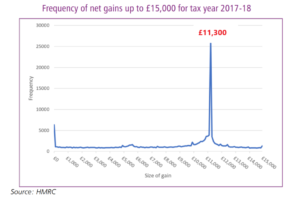
The annual exempt amount is a threshold below which CGT is not paid, currently set at £12,300 per year.

An arresting graph from the 2017/18 tax year illustrates how this is used to wash out gains each year, primarily in investment portfolios. It should be obvious from the graph what this threshold was in 2017/18.

The strongest policy rationale for this is to reduce the administrative burden of reporting capital gains. Currently, 265,000 people pay CGT each year, which current data suggests would rise to 565,000 if the exemption was lowered to £4,000. However, many of these would simply wash out fewer gains each year and so this is likely to be a vast overestimate.

The OTS concludes that a reduction of the annual exempt amount to between £2,000 and £4,000 would be appropriate.

Death and taxes

Finally, the OTS restates its suggestions on the interaction of CGT and inheritance tax (IHT) from its IHT report last year. The key recommendation was removing the CGT uplift upon death where there is no IHT charge (e.g. because assets pass to a spouse, or business assets are exempted). This would be replaced by ‘no gain no loss’ where the recipient inherits the donor’s base cost of the asset.

However, this report goes further and suggests that the CGT uplift on death is removed “more widely” (presumably completely). This would create widespread issues with historical valuations, which the OTS proposes to mitigate by changing the general rebasing date for assets from 1982 to 2000.

The OTS notes that CGT is payable on lifetime intergenerational gifts, except for certain business assets which attract gift holdover relief. Again, this treats the recipient as inheriting the base cost of the asset. The OTS suggests expanding this to non-business assets in line with their recommendations upon death.

Planning

The OTS have released their report under two weeks before Rishi Sunak’s spending review on 25 November 2020. Implementing some or all of these recommendations then would leave very little time for planning, but it’s widely considered that Sunak is unlikely to raise taxes so soon.

However, with glimpses of the end of the pandemic in sight, it would seem prudent to accelerate existing plans for company liquidations and asset disposals ahead of the Budget expected next spring.

Financial Planning priorities for employers and individuals – 2020

Catriona:     Hello, today Richard Verge, head of Goodman Jones private tax team is talking to David James, director of financial planning at Charles Stanley. We’ve been getting a lot of questions from people over the last few months and today’s session is going to be looking at some of the questions, put to us by employers who are keen to see what they can do to protect the business as well as their employees, as well as those questions that we’ve had from individuals and their families who similarly want to make sure they’re in the best place possible to face the future.

Richard:       Hello David.

David:          Hi Richard.

Employers’ questions about pension contributions

Richard:       We’ve been talking through some of the questions which clients have been grappling with in recent weeks, particularly now that the lockdown is beginning to ease and people are looking ahead towards the next few months. One of the questions I’ve been asked a number of times are from employers concerned about their employees being able to continue to afford contributions into their auto-enrolled pensions. What options do they have at the moment?

David:          I mean, the first thing to say is that auto-enrolment is still fully alive during the current pandemic or Coronavirus situation we’ve found ourselves in. So the auto-enrolment duties still apply to the employer and it’s their duty to continue to make those payments in line with the auto-enrolment guide or the actual current contribution rates. So they have to fulfill those. And it’s probably worth mentioning that under the job retention scheme that employers can claim up to 80% of the employee’s salary up to a maximum of two and a half thousand, but they’re also able to claim the 3% pension contribution that they pay on behalf of the employee.

Richard:       Okay.

David:          So where possible you would expect that most employers would aim to maintain the auto-enrolment contribution levels as they did prior to the COVID pandemic, but on a reduced salary based upon the job retention scheme. So up to 80% of their salary. If employers decide to pay a little bit more and top that up by a little bit, then that is part of the overall salary position. So they need to maintain that auto-enrolment requirement during this period.

Richard:       Okay, so if someone is actually looking to suspend say their pension contributions as their cash is tight, they want to reduce income. What can they do then?

David:          It’s obviously very important that people try where possible to continue to maintain their pension contributions, because it’s a long term investment for them, for their retirement. But the rules are quite clear when it comes to auto-enrolment, that if a member decides to stop paying in because they can’t afford to at the moment; and I fully understand why that would be the case. They have to leave the scheme. So by leaving the scheme, then the employer will then stop making their contributions at the same time.

Richard:       And what about then, can they pick that up again at a later time? Can they sort of dip in and out of the scheme as they need to?

David:          Under the normal rules, they’d be invited back in, in 12 months’ time because that’s normally what the auto-enrolment rules would suggest that they do. However, you would expect that the employers would be a little bit more flexible during this period. And if someone looked to walk, back in six months’ time, I’m fairly sure that most employers would consider that and allow them to do so.

Richard:       What about other benefits that are linked to salary? If peoples’ income has gone down during this period; are there any other things that they should be thinking about which may be affected by that change in, income level?

David:          A couple of things to bear in mind here would be if they have some sort of group income protection arrangement whereby the company has taken out an insurance policy to cover people’s salaries, should they be off work after a deferred period of time. Most of those policies would still pay should a member of staff be taken ill or long term sick during the COVID situation. However, that would also then be linked to the current salary of the employee up to the maximum. Now the maximum you can claim under income protection is 75% of your salary. So if an employee was receiving, let’s say 80% of their salary under the job retention scheme, as long as that 80% of the salary didn’t mean they were getting more than 75, the statutory requirement underneath the income protection plan, that plan will be fully able to pay.

Protection for employers

Richard:       You’ve mentioned about income protection, that sort of leads me into other areas. Are there any other ways that employers can sort of protect themselves or safeguard themselves from the impact of the pandemic at the moment?

David:          I think the big question that I would have for businesses at the moment and probably more so looking at the directors, the key personnel is that

COVID has had a massive impact on businesses. And we would hope that in the next few months, please, God things may start to get back to normal, but a concern that I would have for businesses, if they suddenly lost a key person or a director due to an illness or death, then that would have a massive financial implication on the business at a time when their finances are probably stretched to the maximum. So I would be stressing to companies at the moment that they should review their existing directorship protection arrangements and all their business will, whichever you may wish to call it. And their key personal arrangements to ensure that they are fully protected, should something tragic happened to the business while they’re trying to get back onto their feet.

Safety of money for private individuals

Richard:       That’s dealing with things from the employer side, I’m also getting a lot of questions coming indirectly from individuals and private clients. And a lot of them are worried. Well, there seems to be a divergence between those who are thinking well, yes, we’re in for a short recovery. Is it going to be a nice V-shaped recovery and others are saying, well, what about a second spike? What about the safety of money? Should people be looking to put their money into safe products?

David:          I think at the moment, we have to bear in mind that if people are invested, they probably would continue to stay invested in the markets because the markets have sort of rebounded somewhat in the last couple of weeks since the pandemic first hit the country and the world for that matter. So I’m not saying to any of my clients to disinvest during the current climate, because they would then crystallize any losses that they’ve already incurred. But I think the safety of cash at the moment is something for clients to bear in mind.

And the FSCS protection scheme allows bank accounts, the protection of 85,000 pounds per account per institution. And I think it’s always worth double-checking whether or not your bank is part of a wider organization. And you may think you’ve got money in more than one bank, but if they’re a part of the same group, you could only be able to protect one account up to the maximum 85,000 and 170,000 for a joint account.

There is some sort of slight caveats in the FSCS protection scheme that say that they will protect balances up to a million pound against a bank failing. And that has certain caveats to it such as the sale of a property, for example, where someone could suddenly have a large amount of cash in their bank account that they wouldn’t normally have because they’re waiting to buy another property or they’ve received benefits under death in service arrangement. That scheme extends that to a million pounds, but for a short period only.

Richard:       Okay.

David:          While we’re talking about cash on deposit. I think another thing the client should bear in mind is that the national savings and investment, and, you know, I’m a fan of that institution. They offer protection on most of their accounts up to a million pounds, which is far in excess of the FSCS protection scheme. Obviously, you’d have to have the right amount of money and you couldn’t have 500,000 and claim for a million. You’d need a million pounds in there, in order to have that fully protected, but it is a very, very safe haven for cash in the short term.

Richard:       Okay. So it sounds like national savings is perhaps a good idea if you’re worried.

David:          Definitely. And I also think some of the contracts, they have are quite competitive in particular, the premium bonds. I think they’re a very good investment for clients that look to have money in a near-cash position. They do pay out, provide you have a maximum of 50,000, quite regularly. And as it’s deemed to be winnings, any returns on that premium bond are tax-free in the individual’s hands.

Richard:       If we’re looking at things other than cash, obviously the markets are a bit difficult to pick at the moment. Clearly, some investments have done well because of the changes in the environment we’ve found ourselves in. Whereas many have done badly, given that overall, the markets are fairly low at the moment. Do you think this a good time to be investing in the markets?

David:          Well, it definitely depends on people’s timescale and their risk appetite. So, you know, how risk-averse they may be because it has settled down in the markets. But I have to say in my view, going forward, I think we’re in for a bit of a rough ride. So in terms of investing large lump sums of money into the market at the moment, I don’t think you’d ever pick it at the right time because on a daily basis, we’re seeing markets fall by a percent or up by a percent.

So it’s quite volatile and volatility is the thing that makes markets concerned in the first place. So I think if someone was looking to take advantage of the market at the moment being in a lower position, I would probably suggest that they look to drip-feed money rather than placing it in one large lump sum. So typically for a client recently, we agreed that we drip feed a capital sum in over a period of 12 months, rather than going into the market in one go. And I think that’s probably a sensible thing to consider.

Inheritance Tax planning

Richard:       The last topic I wanted to ask you about David, is the question of inheritance tax planning. This whole pandemic as brought to people’s minds the question of, should they start looking at their inheritance tax position? And if so, what could they do? I think my first question to you is when is a good time to sort of start thinking about inheritance tax planning.

David:          My answer would be today. Because we all know how the inheritance tax works and the fact that we have a period of time more often when we can make a gift to people that peel away over a seven-year period.

But the other thing to look at here Richard is that some people have gone through difficult financial times and they’re probably still living in difficult financial times. So where families are considering making gifts to loved ones. Now is a pretty good time to do that because not only will they be reducing their inheritance tax, but they could be helping their family members out by helping them through this troubled time, by giving them some capital they weren’t expecting.

So I think now is the time to reconsider inheritance tax because we both know how much money the Exchequer raised last year from inheritance tax some five and a half billion pounds. And I don’t see that figure going down. I see that figure going up. So the longer you leave and the longer you delay with inheritance tax, more often than not, the situation will get worse and the opportunities to reduce that position diminished too. So people need to start considering their inheritance tax planning right away.

Richard:       On that very point about inheritance tax, not going away. Obviously, there are concerns being expressed about where the government’s going to get the money to pay for all the assistance they’ve been giving to businesses and individuals during the coronavirus crisis. On the inheritance tax side of things, there’s been a lot of talks even before this about whether business, property relief and AIM-listed stock were going to be an issue. And whether that relief was going to be withdrawn. Do you have any thoughts on that?

David:          I hope that doesn’t change because I think AIM gives a lot of people the opportunity to invest in it in a diversified market. It also gives businesses the opportunity to start up and grow because they’re attracting investors, but it is a more high-risk area than our financial planning because these are startups. So more often than not, there is a greater level of risk attached to these companies. So you are investing for the long term and you have the incentive to do so because they become taxing center after two years.

So I think our government has been pretty strong over the years in trying to encourage new business and new companies, startups. I would expect that to continue. I wouldn’t see any reduction in that if anything, they probably want to see more of that to help the economy get back to normal.

Richard:       So I’m getting from you that you still think AIM-listed products are possibly a good part of your overall IHT planning strategy?

David:          I definitely think so, but for the right people, because some of these areas of investments are much higher risks than the normal sort of run of the mill investments that you and I would know, like an ordinary equity share or something along with that, but even though you’re buying shares in a company, you are taking a lot more risk than you would normally, given this status of the AIM market. But if you speak to clients who’ve invested in AIM over the years. I’m pretty sure most of them are very happy with the returns because there have been some absolute standout returns from those over the last few years.

Richard:       One other minor point that we did discuss previously was about writing policies into a trust. Is that something that you’d like to just mention?

David:          Yes, I think on two fronts, really, I think it’s very important that if people take out life insurance policies to protect their families, they should really consider making sure that those policy proceeds are paid into a trust. And the main reason is that once again, we’re in very difficult financial times and money is tight. If somebody had a payment from a life insurance contract that was caught up in probate, there could be waiting a lot longer than normal to receive those funds at a time when they really need them.

So just by simply writing that policy into trust for their beneficiaries means that they can usually get that money paid to them within about four weeks. So it’s very good financial planning. And I think I’ve moved that over towards pensions as well because under pension’s rules, it’s very important that nomination of beneficiaries is kept up to date so that if somebody passed away during the current situation, their nomination of beneficiaries needs to be accurate so that the pension provider or the trustees can get that pension passed across to the beneficiaries as soon as possible.

Once again, because money may be tight and people might want to get their hands on that money so they can deal with their affairs, promptly and probate can probably take up to a six month period before anything happens there. So the benefit of writing life insurance interest and nomination of beneficiaries being up to date, I think it’s a really important area for clients to do. And more often than not they can do that without an advisor because they can either check their existing arrangement to see what it says, speak to their existing advisor, and if they have life coverage and there’s no trust involved, their insurance company can send them a trust form. And with their advisor, they could probably quite easily put that together. So there is a belt and braces so to speak.

Richard:       I think you anticipated what I was going to say next there David.

David:          Sorry.

Richard:       Not at all, because if my clients are anything like I am you know, these policies have been started some time ago and I was going to ask you, what’s the best way of checking one, whether life policies are written in trust and two whether pension arrangements have been correctly nominated who the potential beneficiaries are.

David:          Yes. I mean the financial adviser, if they recommended their life insurance in the first place probably would have ensured that the client wrote the policy and trust. But if they haven’t by just contacting the adviser, they can get the necessary forms and that can be dealt with. And also with the nomination beneficiaries at Charles Stanley, it’s something we are very keen on ensuring, and this is something we would conduct our annual review just to make sure that the client’s circumstances haven’t changed since their last meeting. And if there have been changes, those changes are actioned after that meeting. So the client fully understands what would happen to their life insurance or their pensions in the event of their untimely death.

Richard:       Okay. Well, thanks very much, David, for your insight, hopefully, that’s been of help to some of our listeners and I look forward to having another conversation with you very soon.

David:          Face to face, hopefully, Richard.

Richard:       Face to face, that would be good.

David:          Face to face would be lovely.

Richard:       With a pint of beer.

David:          Absolutely.

Catriona:     Thank you for listening. If you’d like to speak to Richard or David, they’d love to talk to you. You can find their details at goodmanjones.com or charles-stanley.co.uk.

David James leads Fitzrovia Financial Planning, a joint venture between Goodman Jones and Charles Stanley which came about because of the very close working relationship we have with their independent and impartial advisers.

He can be contacted at david.james@charles-stanley.co.uk

Richard Verge leads a team of tax advisers specialising in advising people on a personal level whether that be in connection with their individual tax affairs or the tax affairs of their families or businesses.  As such he gives advice and guidance on personal tax and succession planning as well as overseeing the tax return process.

Email Richard on richard.verge@goodmanjones.com

 

Who will pay for the Government’s Coronavirus support? – What higher rate tax-payers need to consider now

As all of us start to think more about the future and less about the day-to-day in these strange times, what could be ahead for us as individuals?

Most commentators agree that the government’s focus in the short-term should be to stimulate the economy; what about the long-term need to cut the Budget deficit? As we know, there are really only two ways of doing that, by reducing spending or increasing taxes.

So, what could affect private individuals, both in the UK and abroad, who may be watching what the UK does with interest? Early indications are that people still want to remain in, come to or invest in the UK, but other countries are getting their act together and in this new world, the UK may find it has to work harder to attract and keep wealthy investors and entrepreneurs both in and outside of the UK.

Short-term Stimuli

Some stimulus methods which would directly affect private individuals could be exemptions or reductions in Stamp Duty Land Tax; a reduction in VAT, perhaps only for certain sectors; and fresh/revamped tax incentives aimed at start-ups. Any of these are likely to only be temporary to kickstart the economy.

Balancing the Books

Turning to the longer-term, raising taxes appears to be the most likely option, particularly as the public appear to be somewhat resigned to this; they do not want services cut further.

Income Taxes

The difficulty here lies in public perception; raising the higher and possibly the additional rates of tax by 1% will raise a fraction of the extra revenue needed compared to raising the basic rate of tax by 1%. This would suggest therefore that any increase in income tax rates should be across the board, rather than targeted at one section of society.

Another possibility is aligning the dividend rates of tax with the income tax rates. Removing this differential would probably be seen to be fair in the current climate.

It would also be possible to introduce a withholding tax on dividends paid to non-residents receiving UK dividends which are currently outside the scope of UK tax. This may not bring much additional tax into the UK as the withholding tax would be relieved in many cases under the UK’s extensive double-tax treaties with other countries, but politically it may be attractive.

Capital Gains Tax

Capital taxes in the UK account for a fraction of the overall tax take and changes in the capital gains tax rate are widely expected. The current rates for higher rate taxpayers of 20% (most disposals) and 28% (mainly residential property) could be standardised to 28% across all disposals or at least a higher flat rate. It would also be relatively easy to align the rates with income tax rates or perhaps penalise UK resident non-domiciled individuals with standard income tax rates on their capital disposals.

New Taxes?

This article focusses on private clients rather than corporate entities, so the usual rumours of introducing a wealth tax in addition to inheritance tax are already resurfacing, especially as over the years many countries have abolished their version of inheritance tax and brought in a wealth tax. However, the cost of administrating such a tax would seriously outweigh the overall tax-take and although this rumour may be popular with the public, for that reason it is unlikely to gain further traction.

Cutting Reliefs

The other side of the coin is to consider restricting or withdrawing certain reliefs. This may be the final nail in the coffin for certain capital gains tax and inheritance tax reliefs which tend to disproportionately benefit the wealthy. In this category could be the inheritance tax relief for business property which could increase the inheritance tax-take by a substantial amount should the government feel able to make such a bold move.

Steps to consider before the Autumn

Crystal ball gazing can never be more than someone’s opinion on what might happen, but experience shows that during a recession individuals tend to want to regularise their affairs, and the pandemic has given people more time to consider their personal position.

• Think about your short, medium, and long-term plans for you and your family
• Take time to evaluate the areas which need attention now
• Consider taking dividends where appropriate
• Consider taking distributions from trusts
• Check assets held with inherent gains
• Actively look at lifetime giving

All the above bullet-points have tax implications and advice should be sought before implementation. Goodman Jones’ Private Client team are well versed in helping you make the right decisions at the right time.

What is the Report into simplifying Inheritance Tax (IHT) from the Office of Tax Simplification (OTS) and what should you do?

The Government has asked the OTS to look at IHT, and whether it can be simplified. It also has a consultation underway on the taxation of trusts. There is therefore likely to be some pressure on IHT reliefs in the future, perhaps seeing some restrictions being brought in.

However, the OTS did make some suggestions that could help the taxpayer if they were introduced – though in the current climate it is unlikely that there will be time or appetite to make changes to the tax system.

However, it may be worthwhile having a chat with your Goodman Jones contact if you feel that these changes may affect you, or just if you feel that IHT is something you need to consider. The prospect of a change in government means that all of this may fall by the wayside, to be replaced with something even more restrictive, so it could be the right time to take advantage of current reliefs before they are lost.

What did the report say?

The OTS’s first report looked into filing obligations and Returns, leaving the more meaty aspects to the second report which dealt with:

• Lifetime giving
• Gifts made seven years before death
• Interaction between capital gains tax and inheritance tax
• Reliefs on death

Lifetime Giving

Currently, there are four main gift exemptions:

• £3,000 per year
• any gift of less than £250
• gifts on marriage
• regular gifting out of income.

The OTS have suggested replacing these with a higher annual gift allowance but did not specify how much this should be. This could have some advantages – it would be simple to understand and there is no real justification for a gift on marriage being exempt other than historical accident.

However, the proposals to restrict relief for gifts out of income has potential downsides and which would run the risk of introducing new anomalies in its place. IHT has always been a tax on transfers of capital, and the gifts out of income rules were a way of recognising the dividing line between income and capital. The rules may not be perfect, but they have been around a long time and were well understood.

Gifts made seven years before death

If a gift is made in the seven years before death, then this will be taxable on death, but with taper relief for deaths after three years.

It is proposed to change that to a five-year window but with no taper relief on the basis that it is difficult to keep records of gifts. A reduction from seven years to five years is welcome but may not reduce record keeping requirements substantially.

There are currently circumstances where there is a fourteen year period before death that has to be taken into account – where someone made a gift, created a trust in the seven year period following, and then died within seven years of creating the trust – and it is suggested that this is abolished but with no mechanism put forward for the disregard. This would be welcome.

Fourteen years is a long time to keep records of gifts, or, more realistically, try to reconstruct the pattern of gift giving in such a period when someone dies.

Payment of tax and the nil-rate band

The nil-rate band of £325,000 is exempt from IHT. The band applies to both gifts made in the seven years before death and also the estate of the deceased. It is allocated to gifts in chronological order, with the earlier gifts getting relief in priority, and then any unused portion being allowed against the deceased’s estate.

The recipient of the gift should pay the tax due, but if they do not do so within 12 months, the executors become jointly liable.

The OTS say that these rules are poorly understood and cause unfairness as between lifetime recipients and beneficiaries under the will. They suggest that the executors should be liable for all tax, rather than recipients and / or that the nil rate band be applied proportionately against all gifts.

This seems to introduce other anomalies. Someone who is having a will drafted by an experienced adviser would have discussed who they want to bear the tax on the gifts, and it is just as easy to warn a beneficiary to keep the potential tax due to one side as it is for executors to pay taxes.

If an executor has to pay IHT on gifts made outside the will, then this could increase the number of insolvent estates and the ability of HMRC to recover the tax.
If these changes are brought in, individuals who have drafted wills on the understanding of the current rules would potentially have to redraft them.

Interaction between inheritance tax and capital gains tax

Currently, when someone dies owning an asset, the beneficiaries of the estate take on any assets at the market value on death.

There is a suggestion that where Agricultural or Business Property relief applies on death, that there should be no capital gains tax charge but that the beneficiary should take on the base cost of the deceased instead of market value.

There is some argument to be had that where IHT is not paid in full the capital gains tax uplift should not be available. Though it is a longstanding feature of IHT that assets should pass tax free to a spouse, and this is likely to be the most common situation. The OTS report admits this suggestion of restricting the uplift causes difficulty where APR or BPR may not be available in full on a particular asset so that IHT would be payable despite the relief applying. They suggest a restricted uplift to deal with this situation. Far from being a simplifying measure, this would make the tax more complex, and we see no need to make these changes to deal with a situation that has never attracted much complaint solely because it is considered that it puts pressure on the taxpayer to hold assets till death.

The comments regarding extending APR to situations where the farmer is away from the family business due to care requirements in old age are welcome.

Life Insurance Products

The OTS suggest clarifying the position as regards transfers between pensions and whether they create an inheritance tax charge, and also the status of life insurance products that are not ‘written in trust’ to keep them outside the deceased’s estate. That would be welcome – there has been a lot of pressure from HMRC on pension transfers, and the rules often generate IHT in heart-breaking situations.

Anti-Avoidance

The OTS also suggest looking at the pre-owned asset tax rules again. As IHT is now on the same footing as other taxes as being caught by the rules requiring schemes to be notified to HMRC and the overriding rules requiring transactions to be done without tax avoidance motives then there seems little point in keeping a tax in place that is poorly understood, rarely considered and presumably generates few receipts.

Conclusion

Overall, the report has some useful suggestions, but it is not clear what political appetite there will be for change in the current climate. Nevertheless, please talk to your Goodman Jones contact about your situation so that you are best placed to face the future.

What is the OTS?

The Office of Tax Simplification is an independent office of HM Treasury which gives independent advice on simplifying the UK tax system. It issued the first of two reports on the simplification of IHT, a tax it describes as complicated and unpopular, in November.

The Office says that more people took part in this review than in previous ones. IHT affects only 5% of the estates of 570,000 people who die each year in the UK, but 50% of those 570,000 families involved still have to fill in IHT forms. IHT also worried people before their death even when they were not likely to be paying the tax.

However, it would be surprising if the Government moved to make any substantial changes to Inheritance tax in the short to medium term as their priorities will be elsewhere.

Will Philip Hammond’s first Autumn Budget be a budget for the young?

Political battle lines are increasingly being drawn up along the age divide and Philip Hammond is under pressure to introduce policies to attract the young voters in his first Autumn budget. I was interested to see a definition of young voter this weekend describing anyone between the ages of 18 to 40! This might sound alarming for anyone within a few years of either side of the boundary, but it divides the population approximately into a young half and an old half. So what changes might we see in the budget that attract the younger side of the dividing line without upsetting the traditional older Tory supporter?

Here are 5 questions to think about as we approach Budget Day:

1. Stamp Duty Land Tax (SDLT) – Should residential transactions be delayed in anticipation of a reduction in SDLT?
2. Income Tax – How might a reduction in income tax for younger workers affect you or your staff?
3. National Insurance (NIC) – How would an increase in NIC for the self-employed impact on your business?
4. Pensions – Should you consider taking a lump sum from your pension before the budget?
5. Inheritance Tax (IHT) – Should you take action in anticipation of a change to IHT business property relief?

Stamp Duty Land Tax

Most commentators now think the current high levels of SDLT are causing a blockage in the housing market. Those already with a home and perhaps thinking of downsizing are being discouraged to do so due to the high SDLT cost of moving, and those seeking to get on the housing ladder or upsizing are also struggling. A decrease in SDLT across the board would help both sides, but would it be affordable? A policy aimed only at the young, say an exemption for first time buyers might help, but it would be likely to push up prices unless the housing supply increased. Perhaps a “downsizer” exemption would help free up supply? We have previously seen the short term effect of any expected change in SDLT rates which has either accelerated transactions or completely suspended them depending on whether rates are about to go up or down. Any change, which would almost certainly be a reduction is therefore likely to be implemented with immediate effect.

Income tax

Not so long ago we had higher personal tax allowances for the older generation, so it is not too much of a stretch to imagine a higher allowance for younger people. Introducing a lower rate of tax for the young would be very difficult to implement, but a higher personal allowance would be comparatively simple to introduce.

National Insurance

The last attempt to increase NIC by a modest 2% for the self-employed helped the Conservatives lose their Commons majority so it would be understandable if there was a reluctance to revisit this area. However this is no longer a manifesto promise and a rebalancing of the NIC rates between the employed and self-employed is long overdue. There is scope for change here. A possible increase in the age at which NIC liability starts being payable could be paid for by an increase in the self-employed rate.

Some change to discourage the increasingly widespread use of service companies as an NIC avoidance mechanism is likely. A first step towards this was the introduction last year of the “off-payroll working rules” for the public sector. A similar rule for the private sector could be on the cards, but a more radical move might be to charge NIC on family company profits at the point of earning rather than at the point of extraction (a move back towards close company apportionment for those in the older camp and with long memories). Either way this could be a big money earner for the exchequer.

Pensions

Pensions have been hit hard in recent times but the sheer size of the accumulated pension funds makes them a tempting pot for any chancellor to dip their hands in to. The one aspect of pension relief that no one has dared touch to date is the 25% tax free lump sum. This allowance has no particular justification and is a historical quirk with its origins lost in the passage of time. Outright abolition would be political suicide for any party but a brave chancellor might get away with a tinkering at the edges say a percentage or two reduction if sold on the rebalancing of the age divide ticket.

Inheritance tax

The likelihood of IHT being reduced in a young people’s budget is remote. An increase is far more likely and there is already a lot of speculation around the high cost to the exchequer of business property relief (BPR). The principle behind BPR is sound, allowing businesses to be kept intact without having to be sold off to pay IHT bills. However, this does encourage people to hold onto their businesses and business assets until death, rather than passing them on to the next generation early. In the past BPR has been at lower rates than the currently very generous 100%, so it would be easy to reduce that rate. There would however be knock on effects, for example an industry of AIM listed funds has built up around the availability of BPR for IHT planning, so a reduction would be likely to have a serious impact on the value of those funds and the availability of funding for those underlying companies.

What was in the Chancellor’s Spring Budget?

Family wealth preservation using a Family Investment Company

Traditionally a tool for family wealth preservation has been a trust. However successive governments have cut down their tax benefits. This led to a rise in debate about the benefits of using a family limited partnership instead. Although many advisers talked about these partnerships, comparatively few had clients who implemented them. Their relative lack of popularity may have been due to concerns about collective investment scheme legalisation and the professional costs of their maintenance. An alternative could be a Family Investment Company.

What is a Family Investment Company?

A Family Investment Company (FIC) is a UK resident private company whose shareholders are almost invariably entirely made up of family members. Assets are transferred into the FIC and those assets generate investment returns which can be used to provide family wealth. Alternatively, returns can be directed to be used for things such as payment of school fees.

Family investment company helps to protect family wealth

With the UK having a corporation tax rate starting at just 19%, interest in family investment companies has risen.  They are typically used to spread wealth throughout the family or as inheritance tax efficient vehicles. As they are structured around UK companies, the foundations on which they are built are well understood, easy to implement and have low annual compliance costs.

How does a Family Investment Company work?

Typically the founders transfer cash into the company in exchange for shares and loans. Non-cash assets such as property can be also transferred into the company but this may lead to stamp duty land tax or capital gains tax concerns.

The founder can then gift shares of the company to other family members as a potentially exempt transfer. There would be no inheritance tax consequences on the donor if they survive seven years following the date of the gift. Assuming that the gift occurs soon after creation of the company then there are no capital gains tax concerns for the donor.

Control

It is common for the Articles of the company to be drafted so that the donor retains control over the company and this is where the company can operate like a trust. One of the advantages of a FIC over a trust is that some people feel they have more direct control through share ownership than the less tangible control that they have over trust assets.

Tax position

If the FIC generates rental or interest income then this will be taxable at the low UK corporate rate of tax. Dividends received by the FIC could be tax free.

There is tax payable on distribution of assets out of the company. However with the first one thousand pounds of dividend being tax free and a follow on rate starting at 8.75% this may not be a concern. Even the highest rate of dividend tax is lower than the 45% rate currently applied to trusts.

A FIC should be considered a medium to long term strategy in the same way as a trust is considered a long term strategy tool.

Requirements and disclosure

As a FIC is based on a UK company there are Companies House filing requirements, including annual accounts which will be on public record. Public filings can possibly apply the reduced disclosure of abridged accounts (where permitted) or consideration maybe given to using an unlimited, and not a limited, company.

Conclusion

It may be felt a reflection of the UK government’s strategy on low corporate taxation that a UK company, for the benefit of UK individuals, may be an appropriate, low risk and tax efficient holding vehicle.

A FIC should be considered a medium to long term strategy in the same way as a trust is considered a long term strategy tool.

[cta-family-business-subscribe]

Family Giving: Passing family business and other wealth between the generations

To be successful in X Factor a competitor needs at least three yesses to follow their dreams.  In the world of family giving you need to overcome only two hurdles.   That doesn’t necessarily mean that family giving is any easier than progressing through the rounds of X Factor.

Grandson With Grandfather And Father Opening Christmas Gifts

When one gifts down through the family generations the two taxes which need to be considered are Capital Gains Tax and Inheritance Tax.

Capital Gains Tax

Capital Gains Tax (CGT) is the tax when an individual disposed of an asset, whilst Inheritance Tax can be considered the additional tax on transferring that asset.  The Government appreciate that it wouldn’t be right to charge both on a single transaction and therefore there are various reliefs which can be claimed to prevent one of them applying.  Ideally there would be no tax on a gift and much succession planning is based around eliminating these taxes.

Gifting Sterling

Capital Gains Tax is only chargeable on certain assets.  A commonly gifted asset which has no CGT implication is gifts of Sterling.  You will note that I am very specific about the currency.  If a gift is made in a currency other than Sterling then there could be Capital Gains Tax considerations.

Gifting Shares

If the gift is of shares in a trading business and the recipient of the gift is a UK tax resident, then there may be the possibility to jointly elect with the donor to holdover or delay the gain element.  This effectively means that the donor does not pay any CGT on the gift but the recipient acquires the asset at the same base cost as that applicable to the donor.  At best this is a tax deferral as the recipient will pay more tax when they sell the shares.

If the business is not a trading business it may be possible to undertake a demerger to allow a business which would otherwise not qualify for this relief to become qualifying.

Potentially Exempt Transfers

Most gifts of assets are potentially exempt transfers (PETs) for Inheritance Tax (IHT) purposes.  In simple terms this means that the gift becomes free of IHT should the donor survive seven years from the date of the gift.  To be a PET the gift must be unfettered and there has been talk for many years about the risk of HMRC extending the seven year period to something longer.  If the donor dies within the seven year window then not all of the gift falls into IHT.  The potential liability tapers away within the seven years and it is possible to buy life assurance which would cover the tax should it become payable within that window.

IHT and CGT

If you pause at that point it would appear that Capital Gains Tax is the primary concern.  This is because gifts could potentially be exempt from IHT due to the seven year rule.

Gifts into certain structures can give rise to an immediate IHT charge.  In order to prevent both IHT and CGT being payable on the same commercial transaction it is then possible to make a tax election to prevent the CGT being payable.  Depending on value and circumstance the IHT may be less than the CGT which would otherwise be payable.  This can lead to planning whereby an IHT charge of nil or a modest value is deliberately generated in order to avoid a higher CGT cost.  This planning needs to then be tempered with the cost of running the resulting structure or the future cost of unwinding it.

Gifting shares in a trading businesses in a Will

Many trading assets are exempt from IHT.  As an alternative to gifting during life and having the recipient take on the donor’s Capital Gains Tax base cost it may be more efficient for the donor to retain the asset and leave it to the recipient in their Will.  At death there is no IHT on the trading asset and the asset is transferred to the individual at its market value as at the date of death.

This has led to planning involving business owners and their elderly parents.  The business person gifts shares in the family company to their elderly parents and holds over the capital gain.  The understanding is that the Will of the elderly parent transfers the asset back to their child.  With the right fact pattern the death of the parents does not lead to any Inheritance Tax on the shares and the business person reacquires the shares from the estate of their parent with an uplifted base cost of the assets.

You could say that was a yes, yes and yes.

[cta-family-business-subscribe]


Update on the reforms to non-domiciliaries (non-doms)

The long awaited further consultation document from HMRC has been released for individuals who are resident but not domiciled in the UK. This document provides further detail on the reforms but also importantly seeks responses on certain aspects of the proposed changes.
The main points to note are as follows:Nondom

UK Inheritance tax (IHT) on UK residential property

  • IHT will now be payable from 6 April 2017 on all UK residential property owned by non-doms either directly or indirectly via offshore companies, offshore trusts and overseas partnerships.
  • The mechanism for bringing such UK residential property held in this way into the UK tax net will be to remove these structures from the definition of excluded property – and therefore no longer excluded from IHT.
  • This will apply whether the overseas structure is owned by an individual or a trust. Shares in offshore close companies and similar entities will no longer be excluded property if, and to the extent that, the value of any interest in the entity is derived directly or indirectly from residential property in the UK. There will be no change to the treatment of companies other than close companies and similar entities.
  • The change will be effective for all chargeable events which take place after 5 April 2017, such as on death or the 10 year anniversary of a trust
  • There are questions in the consultation over how to define a residential property for these purposes. HMRC seem to favour the same definition as that of a ‘dwelling’ for Non-Resident Capital Gains Tax purposes; with the exception that no relief will be given for main homes.
  • HMRC raise concerns of being able to keep track over the charge to IHT on certain overseas structures and whether a block on property sales can be imposed until all IHT debts are paid.

Deemed domicile for long term residents

  • Individuals who have been resident in the UK for 15 out of the previous 20 tax years (the 15/20 test) will become deemed domicile in the UK for income tax, capital gains and IHT from 6 April 2017.
  • HMRC confirm that years spent as a child will count towards the 15/20 test. Split years of UK residence will also be included which means that proper planning for arrival and departure should be in place.

Rebasing of foreign assets

  • Individuals who become deemed domicile from April 2017 can elect to rebase their directly held foreign assets to market value at this date; thereby only paying capital gains tax on any increase in value. This will be restricted to those individuals who have previously paid the remittance basis charge in any year prior to April 2017. The rebasing will not be available to a non-dom who becomes deemed domiciled after April 2017 or to those with a UK domicile of origin (i.e. born in the UK).

Temporary window for separating mixed funds

  • The taxation of mixed funds is a complex area and HMRC are aware that it can prevent non-doms from remitting money to the UK.
  • For a period of one year commencing 6 April 2017, HMRC are introducing a temporary window to allow individuals to re-organise and separate their mixed funds into clean capital, foreign income and foreign gains. This will be available to all non-doms, apart from those with a UK domicile of origin.

Non resident trusts

  • There was some discussion in HMRC’s initial consultation to introduce a ‘benefits charge’ (taxing individuals on the benefits they receive from a trust rather than the income), however this has been scrapped.
  • Instead all deemed domiciles will be taxed on chargeable gains arising from a trust if they retain an interest in the trust. This is not extended to deemed domicile settlors where the trust was set up before becoming deemed domicile (unless they derive a benefit from the trust).

Foreign Capital Losses

The treatment of foreign capital losses will need to be changed. In particular a foreign loss election will last only until the individual becomes UK domiciled or deemed-domiciled.

Other changes

  • The annual £2,000 unremitted foreign income de-minimis will remain for non-doms, even after they become deemed domicile.
  • The initial consultation suggested that an individual’s deemed domicile status for IHT purposes would only be lost after 6 years of non-UK residence. This has now been agreed by HMRC to be 4 years and it also applies to the spousal election(which can be made where one party to a marriage or civil partnership is non-domiciled).

It seems that HMRC have listened to some of the responses given to the initial consultation. There are certainly some valuable transitional rules, such as the rebasing of foreign assets and separation of mixed fund accounts which will need to be considered. This is a complex area of taxation and any change to existing arrangements may require consideration of three different taxes. As always, anyone that is potentially affected by these changes must take advice in good time.

The Gift that Keeps on Giving [Charitable Donations]

You only need to watch programmes such as Children in Need and Comic Relief to realise what a wonderfully charitable lot we are in this country. From Lands End to John O’Groats, our incredible generosity knows no bounds.

Whether it be donating to the local Church, paying your National Trust subscription, signing up for a regular direct debit to a charity close to your heart or via payroll giving, most of us have made, to some extent, charitable donations.

Understanding the best way to donate is important in order to maximise relief for the charity and/or yourself. There really is the option of ‘having your cake and eating it’ as far as ensuring that the charity receives value, whilst you receive tax relief at your marginal rate of tax.

Perhaps the most recognised way to donate is through simple cash, which would include telephone payments through a debit or credit card and cheques. For every £100 that you donate, the charity is able to reclaim a further £25 from HMRC. This assumes that you have paid sufficient tax in the year to cover the reclaim. If it subsequently transpires that you do not have sufficient tax for the reclaim, you will have to pay HMRC the £25 in order for them to honour your pledge. This is because a gift aid declaration guarantees the charity the right to the tax from HMRC.

The scenario described above can be alleviated by basic planning. There is a carry back facility available so if you anticipate having no income in 2014/15 but have made a donation on 20 April 2014, a claim may be made within your Tax Return for 2013/14 (when you paid sufficient tax), which is due to be submitted to HMRC by 31 January 2015. The ability to carry back can also be efficient if in the previous year you paid tax at the additional rate (45%) but for the current year your income will be taxed at basic rate (20%). That way, you stand to receive £31.25 tax back on the £100 in the form of additional rate relief, as opposed to nil at basic rate. Once your Return has been submitted, the ability to claim a carry back of relief is lost, as no amendments to that particular section of the form can be filed thereafter.

For those of you out there who happen to be high net worth and philanthropic, there is one particular scenario that could have a huge benefit all round. Imagine that the first of your UK rental business portfolio properties is now worth £200,000 but was bought back in the 1980’s when property could be snapped up for the current price of a sports car, particularly outside London and the South East. The gain is £160,000 after deducting the original cost, costs of sale and the Capital Gains Tax Annual Exempt Amount, meaning that the tax liability as a higher or additional rate taxpayer would be £44,800. If you are feeling particularly generous, you may decide to convey the property to your favourite charity, which will have the following benefits:-

  • It will be a no gain/no loss transaction meaning that the charity receives the property without any capital gains tax ever being paid. This saves £44,800 in tax that you would otherwise have paid on sale.
  • The value of the property (less any consideration paid by the charity) is deductible from your taxable income, which means that in the example shown above, you would receive tax relief of an incredible £90,000.
  • The charity has a property worth £200,000 and the transaction is exempt from SDLT.

The same opportunity exists for quoted shares. If you wanted to recoup your original investment, there is nothing to prevent the payment of consideration by the charity but that would, of course, mean that this is deducted from the deemed disposal proceeds.

Revisions to the mainstream Inheritance Tax legislation are less commonplace than many of the other taxes acts. However, one beneficial change that was recently made drops the rate of IHT to 36% payable on a deceased person’s free-estate where 10% of that estate is left to charity. The 10% calculation is made after reducing the amount exposed to tax through relief, exemptions and the nil rate band.

At one stage it appeared that the current government were going to limit the amount of tax relief that could be received through charitable giving to £50,000. Whilst there have been limits imposed for certain loss relief and pension contributions, common sense prevailed and charitable donations were not affected by new legislation.

Particularly in times of austerity, charities are keener than ever to receive gifts from the Great British public so if you do have the odd spare house sitting around collecting dust and you are feeling particularly generous, there may just be a way that you can help whilst mitigating the financial loss through tax relief.