Tag Archives: charity

Budget 2015 – George Osborne’s Gift to Charity

Has George Osborne been giving to charities in his final pre-election budget? The answer I think is a qualified yes. Certainly no big giveaway but there is a planned increase in the amount that can be donated under the Gift Aid Small Donations Scheme (GASDS).

The government has not seen the widespread take up of the scheme that it had hoped and therefore plans to introduce legislation to extend the maximum annual donation amount which can be claimed through the scheme from £5,000 to £8,000 from April 2016.

Many would argue that this still does not go far enough in encouraging take up of the scheme since a charity still has to have a two year Gift Aid history before becoming eligible. Similarly it only applies to cash payments and this too has come in for criticism.

The Gift that Keeps on Giving [Charitable Donations]

You only need to watch programmes such as Children in Need and Comic Relief to realise what a wonderfully charitable lot we are in this country. From Lands End to John O’Groats, our incredible generosity knows no bounds.

Whether it be donating to the local Church, paying your National Trust subscription, signing up for a regular direct debit to a charity close to your heart or via payroll giving, most of us have made, to some extent, charitable donations.

Understanding the best way to donate is important in order to maximise relief for the charity and/or yourself. There really is the option of ‘having your cake and eating it’ as far as ensuring that the charity receives value, whilst you receive tax relief at your marginal rate of tax.

Perhaps the most recognised way to donate is through simple cash, which would include telephone payments through a debit or credit card and cheques. For every £100 that you donate, the charity is able to reclaim a further £25 from HMRC. This assumes that you have paid sufficient tax in the year to cover the reclaim. If it subsequently transpires that you do not have sufficient tax for the reclaim, you will have to pay HMRC the £25 in order for them to honour your pledge. This is because a gift aid declaration guarantees the charity the right to the tax from HMRC.

The scenario described above can be alleviated by basic planning. There is a carry back facility available so if you anticipate having no income in 2014/15 but have made a donation on 20 April 2014, a claim may be made within your Tax Return for 2013/14 (when you paid sufficient tax), which is due to be submitted to HMRC by 31 January 2015. The ability to carry back can also be efficient if in the previous year you paid tax at the additional rate (45%) but for the current year your income will be taxed at basic rate (20%). That way, you stand to receive £31.25 tax back on the £100 in the form of additional rate relief, as opposed to nil at basic rate. Once your Return has been submitted, the ability to claim a carry back of relief is lost, as no amendments to that particular section of the form can be filed thereafter.

For those of you out there who happen to be high net worth and philanthropic, there is one particular scenario that could have a huge benefit all round. Imagine that the first of your UK rental business portfolio properties is now worth £200,000 but was bought back in the 1980’s when property could be snapped up for the current price of a sports car, particularly outside London and the South East. The gain is £160,000 after deducting the original cost, costs of sale and the Capital Gains Tax Annual Exempt Amount, meaning that the tax liability as a higher or additional rate taxpayer would be £44,800. If you are feeling particularly generous, you may decide to convey the property to your favourite charity, which will have the following benefits:-

  • It will be a no gain/no loss transaction meaning that the charity receives the property without any capital gains tax ever being paid. This saves £44,800 in tax that you would otherwise have paid on sale.
  • The value of the property (less any consideration paid by the charity) is deductible from your taxable income, which means that in the example shown above, you would receive tax relief of an incredible £90,000.
  • The charity has a property worth £200,000 and the transaction is exempt from SDLT.

The same opportunity exists for quoted shares. If you wanted to recoup your original investment, there is nothing to prevent the payment of consideration by the charity but that would, of course, mean that this is deducted from the deemed disposal proceeds.

Revisions to the mainstream Inheritance Tax legislation are less commonplace than many of the other taxes acts. However, one beneficial change that was recently made drops the rate of IHT to 36% payable on a deceased person’s free-estate where 10% of that estate is left to charity. The 10% calculation is made after reducing the amount exposed to tax through relief, exemptions and the nil rate band.

At one stage it appeared that the current government were going to limit the amount of tax relief that could be received through charitable giving to £50,000. Whilst there have been limits imposed for certain loss relief and pension contributions, common sense prevailed and charitable donations were not affected by new legislation.

Particularly in times of austerity, charities are keener than ever to receive gifts from the Great British public so if you do have the odd spare house sitting around collecting dust and you are feeling particularly generous, there may just be a way that you can help whilst mitigating the financial loss through tax relief.

Not Just For The Rich [Tax Advice]

I was recently reading an article which complained how the rich were able to get away with paying so little tax because they could afford to pay for tax advice. But a quick Google shows you just how much free advice is on the wonderful web. Moreover, you can get plenty of advice by joining the various blogs /forums where individuals are free to put their queries forward and advice will be fed back from a wide variety of opinionated users and, more importantly, advisors in the relevant industry.

So ‘doing my bit for mankind’ I have decided to do a series of 3 blogs giving free tax advice that everyone can take advantage of.

My first looks at two things to consider before we reach the end of the tax year:-

The giving gift – Charitable donations are eligible for higher rate tax relief and the relief is not restricted to just monetary donations, items which are donated to charity and then sold on are also eligible. Nowadays most of the high street charity shops are set up to take your details so they can write and tell you how much they’ve made from selling your donations. Also, if you make regular contributions each year, be sure to get it included in your PAYE code now as it will save you having to make the claim for relief at the end of the year.

One for the Pros – If you pay professional subscription/membership fees yourself and they are necessary or helpful to your job then you can claim to relieve the cost against the relevant income source. More details can be found on HMRC’s website here: http://www.hmrc.gov.uk/incometax/relief-subs.htm

If you hurry and inform HMRC before 5 April you can claim relief for expenses incurred in years as far back as 2009/10.

More freebies to follow next week!

Charity Staff Foundation – Charity Innovator of the Year Award 2013

Thursday 7th March saw a packed Central Hall Westminster host the inaugural Charity Staff Foundation Awards.

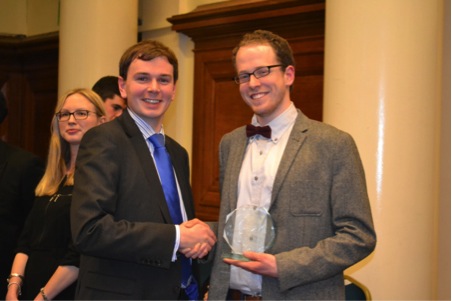
Rory Fenton, Dialogue Officer of the British Humanism Association with Martin Bailey, Goodman Jones.

Rory Fenton, Dialogue Officer of the British Humanism Association with Martin Bailey, Goodman Jones.

The Charity Staff Foundation is a charity which aims to encourage and provide access for young people to make long-term careers in the charity sector. It also provides a support structure for those who work and volunteer for charities. This involves the CSF providing training, advocacy and practical support such as a helpline and mentoring programme www.charitystaff.org.uk.

The awards are part of this work and Goodman Jones are proud to be founding sponsors of the awards which recognise and celebrate the immense contribution and outstanding achievements made by volunteers and charity staff across 20 different categories, ranging from Community Volunteer of the Year to Social Entrepreneur of the Year, and Small Charity of the Year to International Aid Courage Award.

As Paul Hackwood, of The Church Urban Fund, said when he presented an award to Volunteer Co-ordinator of the Year “whilst the CSF Awards might not have the glamour of the Hollywood Oscars, it does have the commitment, people and passion” to improve society.

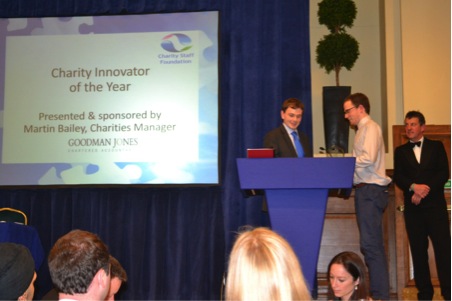
Goodman Jones were particularly proud to sponsor the award for ‘Charity Innovator of the Year’, as we know ourselves, now more than ever, organisations are seeking smarter approaches to working to combat reduced resources and tighter financial constraints.

This award celebrates those who achieved significant changes within and for their organisation through the use of innovation.

The standard of entries was extremely high and the nominees included Michelle Saliba da Costa of Ataxia UK and Geoff Wheeler of SIFA Fireside but the award, presented by Charities Manager, Martin Bailey, went to Rory Fenton, Dialogue Officer of the British Humanism Association.

Rory’s enthusiastic and committed work with faith and community groups focuses on inclusion and equality by encouraging the representation of the humanist and non-religious in local forums and networks. Rory’s work has increased the wider understanding of Humanism and ensures that its voice is heard along with those of differing faiths www.humanism.org.uk.

Rory has fully embraced innovation across a diverse range of subjects from international development to physics, and from economics to humanism; he is a regular blogger on these and many other topics.

CSF Awards 2013

Rory Fenton being presented the award by Martin Bailey.

So if your Charity has a true innovator or unsung hero within its ranks, or if you work with someone who goes beyond the call of duty, do get in touch with the Charity Staff Foundation later in the year as nominations open for the 2014 awards in November.

The annual awards are a great opportunity for people within the charity sector to get together and celebrate the wonderful work that is carried out by both staff and volunteers, highlighting special achievements, encouraging good practice and recognising dedication.

Photos courtesy of Charity Staff Foundation

Charity Funding – Join The In-Crowd

The charity and not-for-profit sector is not immune to the effects of the economic downturn. If fact, it is widely argued that the “Third Sector” is the hardest hit sector and will take the longest to recover. With government spending cut back, businesses reducing expenditure (and suffering from funding shortages themselves), and many individuals suffering from reduced disposable income, charities and not-for-profit organisations are fighting for every penny available. So what can be done?

There are several sources of finance available to businesses other than traditional high street bank lending, and individuals have benefited from the emergence of pay-day lenders to provide short-term sources of finance.

But what about charities and not-for-profit organisations? There is a temptation to push ever harder at getting donations, whether through the use of “chuggers” to attract new donors or aggressively targeting increased donations from existing donors.

High net worth individuals are an ever more attractive option, given the gift aid relief available to individuals and charities and the recent scrapping of the government’s proposed cap on tax reliefs to individuals, as well as a reduction in the Inheritance Tax rate to 36% for individuals leaving at least 10% of their estate to charity.

Organisations may also look at more frequent fundraising events, or try to generate additional trading profits, such as through price increases.

However, push too hard and there is a risk that goodwill towards a charity fades and people become more reluctant to donate. This loss of goodwill can be just as detrimental to a charity, and can impact upon longer term funding.

Given the reduced availability of funding, the not-for-profit sector needs to be just as flexible as commercial organisations in finding alternative sources of funding to those traditionally available, whilst maintaining goodwill and encouraging people to want to get involved. So, is there an option that ticks both boxes?

Well one such option is crowdfunding. This is an ever growing and increasingly popular way for charities to seek funding for their charitable activities. In fact, the popularity and success of crowdfunding for charities has led to the model being adapted for use by commercial entities.

Crowdfunding is the concept of many individuals contributing usually small amounts of money to a project or cause they believe in. It allows charities and not-for-profit organisations to seek both financial and non-financial resources from individuals and is designed to attract people to contribute because of the project or cause rather than any tax or other benefits available.

There are various crowdfunding websites (such as peoplefund.it, startsomegood.com, kickstart.org and pleasefund.us) where organisations list a project they are running. They detail the purpose of the project, the level of funding required and what the funding will be used for. The individuals then make a donation towards this project.

The increased use of social media and awareness of social responsibility has led to crowdfunding being an ever more popular option for charities, and in particular smaller charities, to attract funding. But it can bring other benefits – it provides an opportunity for charities to engage with individuals and the local community, and provide information regarding its activities. This helps to promote the charity and its objectives, and may attract other benefits in addition to funding, such as publicity and attracting new volunteers – both as important to a charity as finance.

Tax Avoidance – the next target for banker bashers?

The media found a new target. This time it was people whose tax bills are reduced as a consequence of totally legitimate and laudable behaviour.

Let’s deal with “laudable” first. The country apparently approves of philanthropy. There is widespread support for charitable causes, from the arts to medical research, from help for the aged to charities for kids, good causes command respect.

The country also apparently approves of risk-takers establishing businesses that provide people with employment opportunities that might otherwise not exist.

Given these are perceived “good things”, governments of different hues have sought to create structures over the years to promote them. And because these good things involve individuals spending money, the structures have of necessity been money-related – which inevitably involves use of the tax system.

The Gift-Aid system is designed so that when a person gives money to charity, the charity can claim from the Treasury the basic rate tax deemed to relate to the donation. £10 donated becomes £12.50 to the charity. And a higher-rate tax payer is entitled to recover by way of tax relief the difference between his higher-rate, be it 40% or 50%, and the basic rate of 20% imputed into the donation. So a £400K charitable donation is worth £500K to the charity – and the donor gets a deduction for tax, if he’s a 50% tax payer, of £150K (50% – 20% times £500K).

Shock, horror! £150K tax saved! UK Uncut will have a field day!

But it’s cost him £400K to get it.

Don’t know about you, but personally, I’d rather not blow £400K simply to save myself £150K of tax. I’d grit my teeth, suffer the tax, and party on the net £250K I’d saved myself.

Similarly, the risk-taker might be making substantial losses in the business he’s set up. Horror of horrors!- he might get a tax break!

But the value of the tax break will only ever be a percentage of the losses that caused it.

The Chancellor now wants to cap unlimited tax reliefs at £50K or 25% of income, whichever is the higher.

Let’s look at an example. Let’s assume the person who gave £400K to charity had gross income of £1 million. Under the present regime, the charity gets £500K, a net £250K from the donor, and £250K from the Treasury.

Going forward, the individual can of course maintain his level of donation at £400K, but as his tax break will cease at £250K, he’ll more than likely cap his contribution at that level. In which case the charity will get £312.5K and the donor’s tax break will fall by £56,250. The charity will be £187,500 worse off, the Treasury £93,750 better off (£56,250 from the donor’s tax bill, £37,500 from the reduced top-up it pays the charity). The difference between the charity’s loss and the Treasury’s gain (£93,750) sits in the donor’s pocket.

Maybe he’ll give the extra away without a tax break – anything’s possible, however unlikely.

The same applies to establishing new businesses. The tax consequences of risk-taking are very much a part of the decision-making process as to whether or not to take the risk. Remove the tax break, you increase downside risk, making the risk-taker much more averse in the first place.

The media initially got this one completely wrong. Not surprising, given all it did is following the claptrap spouted by UK Uncut. And the Chancellor simply bought into this populist message, because frankly, it suited him – the less that goes to charities, the less business risks people take, the more tax revenues go to the Treasury. It’s just those “good things” that suffer.