
Tag Archives: Retirement Relief

What do the changes to CGT mean for family businesses?

Family businesses could see three key areas impacted by changes to capital gains tax proposed by the Office for Tax Simplification last month:

  1. Succession planning
  2. Cash extraction
  3. Share options for retaining key employees

The key changes

In their report released on 11 November 2020, the Office for Tax Simplification (OTS) made the following recommendations:

  • Align capital gains tax (CGT) rates with those of income tax.
  • Replacing entrepreneurs’ relief with retirement relief
  • Slashing of the CGT annual exemption
  • Removal of CGT uplift on death

Succession planning

Succession planning with a family business usually involves getting company shares into the hands family members or managers. This can be done during the lifetime of the owner, upon their death, or a mix of the two. However succession is approached, there will be CGT and inheritance tax (IHT) consequences:

  1. If shares are gifted during lifetime, CGT can be deferred if the company is trading and there shouldn’t be IHT to pay due to business property relief (BPR).
  2. If shares are sold, then CGT will be payable but potentially only at 10% if entrepreneurs’ relief is available.
  3. If shares are gifted on death via a Will, then there is a CGT-free uplift to market value, and again IHT should be nil due to BPR.

The OTS report could make the latter two options more expensive. They have proposed changing business asset disposal relief (aka entrepreneurs’ relief) to retirement relief, which would restrict the 10% tax rate to those at retirement age, whilst increasing the 5% shareholding test to 25% and the holding period from 2 years to 10 years. For certain shareholders selling their shares, this would mean 20% tax, or up 45% if CGT rates are aligned with income tax.

The OTS also suggest removing the CGT uplift on death, so that the base cost of inherited shares is no longer their value at the date of death, but instead the value that the deceased acquired them for. For family businesses this is often a negligible amount, so this proposal would greatly the future CGT liability if the shares were subsequently sold.

It is possible to pass on shares to the next generation without incurring CGT by spreading gifts out over many years, utilising annual exemptions. This has been generally used by owners of non-trading companies who cannot use hold-over relief to defer capital gains. However, this practice would be curtailed by proposals to reduce the annual exemption from £12,300 per year to between £2,000 and £4,000.

Cash extraction

Companies often accumulate excess profits over the years, which the owners haven’t needed to draw on as salary or dividends. If the business comes to the end of its life, the company can be liquidated and this excess cash extracted at capital gains tax rates of 20% (or sometimes 10% with entrepreneurs’ relief), rather than treated as income.

If CGT rates are aligned with income tax rates then extracting these rolled-up profits will get much more expensive. Even if the Government decide to keep CGT rates as they are, the OTS has recommended that distributions of rolled-up profits are treated as dividends and tax at rates of up to 38.1%.

Share options for retaining key employees

The EMI scheme, which allows selected employees to enjoy CGT rates on gains on share options, is a very tax efficient way to reward key employees and to retain them by giving them a stake in the company. However, the scheme is at risk of being scrapped due to the ability to target certain employees.

Planning

Rishi Sunak prepared the ground for future tax rises in his recent spending review, so these proposals could be implemented in the Budget expected next spring. It would seem prudent to accelerate existing plans for company liquidations ahead of this, or to put in place an EMI scheme in case these are scrapped going forward.

Back to the Future for CGT?

Removing distortions and raising taxes

In July, Rishi Sunak tasked the Office for Tax Simplification (OTS) with investigating possible changes to capital gains tax (CGT). The report was released yesterday (11 November 2020) and made a series of recommendations aimed at removing distortions and raising taxes.

Philosophy and tax

In 1998 Gordon Brown stated that the ‘capital taxation system should better…reward risk taking and promote enterprise.’ It took him until his final Budget almost a decade later to put this philosophy into practice when he slashed CGT rates to 18%. At the same time, he introduced entrepreneurs’ relief and abolished indexation allowance for individuals.

The OTS look back further to Nigel Lawson for the inspiration for their report, who in 1988 said that there is ‘little economic difference between income and capital gains’ as his justification for the aligning CGT and income tax rates which would stay in place until Brown’s final Budget.

Back to the future

The headline-grabbing recommendation from the OTS is to once against realign CGT rates with those of income tax. This would not only raise a substantial amount of tax, but would remove the incentive to re-characterise income as gains in order to take advantage of lower rates. They suggest reintroducing indexation allowance to compensate for inflation and increasing the flexibility in the use of capital losses.

If the Government decide against such a hike in CGT rates, the OTS recommend shifting two boundaries between capital gains and income:

  1. ‘Money boxing’ whereby income is rolled up in a personal company and then realised as capital upon liquidation. Instead, distributions of excess cash would be treated as dividends.
  2. Employee share incentives, where Government-approved schemes allow share-based rewards to be taxed as capital. Notably, the OTS distinguishes between all-employee share schemes but takes aim at those which can be targeted at specific employees, such as EMI.

Relief reform

The OTS have taken aim at entrepreneurs’ relief (aka business asset disposal relief) once again. They reiterate the general consensus that a relief given on disposal of a business does little to incentivise investment at its inception. The OTS contrasts this with EIS, which gives upfront income tax relief and is considered far better at incentivising investment. Interestingly they make no mention of the exemption of EIS shares from CGT, which is an exceptionally generous relief that seems at odds with the rationale of giving relief at the time of investment rather than at disposal.

Once again the OTS looks to days gone by for its inspiration, and suggests converting entrepreneurs’ relief to retirement relief. It recommends reintroducing an age limit linked to retirement, upping the 5% minimum shareholding to 25% and a minimum holding period of 10 years.

The OTS are even more brutal in their assessment of investors’ relief, flatly stating that it should be abolished.

Reducing the annual exempt amount

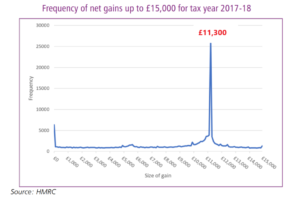
The annual exempt amount is a threshold below which CGT is not paid, currently set at £12,300 per year.

An arresting graph from the 2017/18 tax year illustrates how this is used to wash out gains each year, primarily in investment portfolios. It should be obvious from the graph what this threshold was in 2017/18.

The strongest policy rationale for this is to reduce the administrative burden of reporting capital gains. Currently, 265,000 people pay CGT each year, which current data suggests would rise to 565,000 if the exemption was lowered to £4,000. However, many of these would simply wash out fewer gains each year and so this is likely to be a vast overestimate.

The OTS concludes that a reduction of the annual exempt amount to between £2,000 and £4,000 would be appropriate.

Death and taxes

Finally, the OTS restates its suggestions on the interaction of CGT and inheritance tax (IHT) from its IHT report last year. The key recommendation was removing the CGT uplift upon death where there is no IHT charge (e.g. because assets pass to a spouse, or business assets are exempted). This would be replaced by ‘no gain no loss’ where the recipient inherits the donor’s base cost of the asset.

However, this report goes further and suggests that the CGT uplift on death is removed “more widely” (presumably completely). This would create widespread issues with historical valuations, which the OTS proposes to mitigate by changing the general rebasing date for assets from 1982 to 2000.

The OTS notes that CGT is payable on lifetime intergenerational gifts, except for certain business assets which attract gift holdover relief. Again, this treats the recipient as inheriting the base cost of the asset. The OTS suggests expanding this to non-business assets in line with their recommendations upon death.

Planning

The OTS have released their report under two weeks before Rishi Sunak’s spending review on 25 November 2020. Implementing some or all of these recommendations then would leave very little time for planning, but it’s widely considered that Sunak is unlikely to raise taxes so soon.

However, with glimpses of the end of the pandemic in sight, it would seem prudent to accelerate existing plans for company liquidations and asset disposals ahead of the Budget expected next spring.