Tag Archives: tax relief

Research and Development (R&D) tax relief for the construction sector


Many construction business owners are missing out on valuable tax breaks because they are under the misapprehension that Research & Development (R&D) tax relief only applies to those conducting formal research, such as pharmaceutical companies.

Any construction company undertaking some form of innovation may qualify for R&D relief.  This is much more common than is often thought, with construction companies often coming across a problem and developing a new or unique solution to overcome it.  If you have an employee who is a problem solver, for example, one would expect to have a claim and the cost of an employee can be considerable.

Is it worth it?

If you are an SME  (Small and Medium-sized Enterprise – fewer than 500 employees and either turnover of  up to €100m, or gross assets of  up to €86m) you benefit from an enhanced rate of R&D relief. A profit-making SME can claim an additional deduction of 130 per cent of the R&D spend.

For year ending 31 March 2016 – the effective tax saving is 26% of R&D spend

Graphic 1

There are separate rules for larger companies.  They are restricted to claiming an additional deduction of 30 per cent of the R&D spend.

For year ending 31 March 2016 – the effective tax saving is 6% of R&D spend

Graphic Large

What if we’re not making a profit?

Even loss-making companies may be able to access cash back, which will be particularly welcome by start-ups or those needing cash to fund development.

SMEs can convert 230 per cent of R&D spend into tax credits at a rate of 14.5 per cent and receive cash.

For year ending 31 March 2016 – the effective tax saving is up to 33.35% of R&D spend
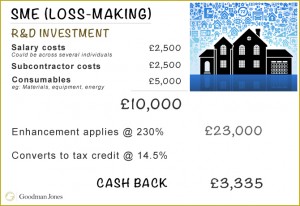
Graphic SME Loss

For a large company using the R&D Expenditure Credit scheme, a taxable receipt of 11 per cent of the R&D spend is granted.

For year ending 31 March 2016 – the effective tax saving is up to 8.80% of R&D spend
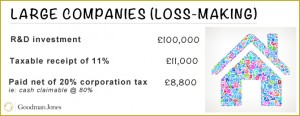
gj-large-companies-loss-making

Red tape?

There are time restrictions, so businesses should not delay in finding out whether they might qualify for R&D relief.

Claims must be made within two years of the end of an accounting period but it is possible to go back and amend a tax return to include a claim.  So if you submitted a tax return for the year ended 31 December 2014, you have until 31 December 2016 to go back and make a claim.

The claim is a relatively straightforward process, involving explaining what you did in writing and putting the costs against it before the claim figures are included in the computations.

Well worth it

We have guided a number of our clients in the property and construction sector through this and we were all delighted when we saw how quickly HMRC accepted the claims and in certain instances repaid substantial amounts of tax.




Should I Incorporate my Buy-to-Let Business?

The introduction of three specifically targeted rule changes aimed at cooling the buy-to-let market have led many landlords to ask whether they should be incorporating their buy-to-let businesses. But have the goal posts really moved in favour of incorporation for rental businesses?

My own view is that for most people the pendulum has swung against incorporation due to the new dividend rules and the changes to the taxation of rental income do not alter this. There is no doubt that incorporation could be beneficial in some circumstances but there is no “one size fits all” answer and for some, incorporation could make them significantly worse off.

The changes particularly aimed at the buy-to-let market are in connection with:

  1. A restriction on the tax relief for interest payments
  2. The availability of wear and tear allowances on furnished lettings
  3. Stamp duty land tax increase for second properties

Interest relief

Commencing in April 2017, interest relief will be restricted to 20% basic rate only. This restriction is being phased in gradually over 4 years so that by the 2020/21 tax year all interest relief will be at 20% only.  There are important implications arising from this change that are examined in a previous blog.

Wear and tear allowance

With effect from April 2016, the 10% wear and tear allowance for furnished lettings is abolished. This is replaced with an allowance for renewals instead. This essentially means that the first purchase of an item of furniture or furnishings is not an allowable expense, but the subsequent replacement of such items will be an allowable expense against the property income. This wear and tear allowance has however been available to both individuals and corporates letting residential accommodation and hence its abolition affects both. Landlords have previously been able to claim renewals but it is generally accepted that the old 10% wear and tear allowance was beneficial in many cases.

Stamp duty land tax increase

The Autumn Statement announced a new additional 3% rate of stamp duty land tax (SDLT) to be applied to all purchase of second properties. We have yet to see draft legislation on this but it is going to apply to both individuals and corporates but with an exception proposed for corporates owning 16 or more properties.

Of the above three rules changes only the first does not apply to companies and it is this which is largely the reason why people are questioning whether a corporate structure would be appropriate. However, it should be noted that companies only pay corporation tax at 20% (soon to reduce to 18%) so this exclusion is of little consequence to a company.

I conclude from the above that the announced changes are not going to make a significant change to the decision that we already face over whether it is beneficial to run a letting business as an individual or company. The major factors that it is necessary to consider therefore remain largely the same as they have always been and there is no one size fits all solution:

Some people will find it advantageous to incorporate, but the reasons for this have largely not been affected by the above rule changes. The questions to consider include:

  1. Will you be able to borrow on similar terms through a corporate or as an individual?
  2. Will you need to extract profits from the company? If you do then you will be exposed to the higher rates of income tax on extraction, whereas if you are able to retain profits in the company they will suffer tax at the lower corporate rates only.
  3. Selling a property within a company gives rise to a potential double tax charge as the company will pay corporation tax on the gain on sale and the individual will suffer further tax on profit extraction.
  4. For existing buy-to-let businesses there is also the issue of capital gains tax and SDLT charges to consider on transferring property into the company on incorporation. Don’t forget that whilst there is no SDLT on gifts for no consideration, if there are loans outstanding that will be transferred to the company with the property then they will treated as consideration for SDLT purposes.
  5. The additional compliance costs of running a company also need to be factored in as they will in some instances outweigh any tax benefit.

A further point to consider is interest relief which is available on borrowing personally to lend to a company. Under current proposals the restrictions to interest relief on buy-to-lets does not apply on loans taken out by individuals to lend on to their buy-to-let companies. This would at first sight appear to be loophole. However, in most circumstances it would be necessary to fund the interest payments by charging interest to the company and hence for the individual the interest paid and received would be self-cancelling leading to no benefit. There is also a question-mark over whether banks would be prepared to lend to the individual when the property was in a company.

So, incorporation is most likely to suit a business which has low borrowing requirements, low turnover of properties and can afford to roll up profits within the company to take advantage of the low corporation tax rate. This is not your typical buy-to-let Landlord

The above gives only a brief overview of some of the issues involving the incorporation of a buy-to-let business. Each person’s circumstances will be different and you should take proper advice before taking any action.


Tax Relief on Pension Contributions

I have noticed an increase in the numbers of clients who are seeking advice about pension contributions and the tax relief they provide. Of course, not being an IFA, I can’t advise on the pension planning side of their questions. I leave that to my appropriately qualified colleagues.

Being a tax advisor I can advise on the nuts and bolts of the tax relief. I can also make forecasts about how I believe that tax relief may change in the future.

In July the Chancellor issued a consultation document on revisions to the tax relief. The smart money is on change from April 2016 and some commentators are suggesting that the 25 November autumn statement may announce what the future holds.

I, like many of my colleagues in the profession, expect that the change will be no more than a £1 reduction in contribution limits for every £2 of income above £150,000 with everyone being able to make at least £10,000 of contributions. I suspect that the tax relief will remain at the individual’s marginal rate and therefore a 45% taxpayer will receive 45% tax relief on contributions above £150,000. When calculating the restriction the contribution made will be added to income and therefore, in reality, this will hit individuals with incomes of less than £150,000. Others believe that there will be a flat rate of tax relief on all contributions at 20% or 33%. A further suggestion has been the reversal of the tax profile so that contributions are made out of taxed income but extraction out of the pension pot is tax free, i.e. a sort of savings plan.

What is certain is that the consultation has led to higher earners considering their pension position in more detail with a view to maximise contributions before 5 April 2016.

There is the ability to carry forward unused pension relief capacity from the previous three years. 2015/16 has a further boost to the permitted pension contribution levels arising from the Pension Input Period (PIP) changes. In simple terms the PIP is the pension’s year end. Various pension schemes have different year ends. The impact of the year end was not well understood and, for those who understood it, led to both opportunities and difficulties. HMRC have, quite rightly, decided to do away with this complexity and are aligning the year end of all pensions with the tax year end. In order to ensure that no-one could be disadvantaged by this move there is the ability to claim up to two years pension tax relief in 2015/16. This is relevant for individuals who made contributions before 9 July 2015 and potentially adds an extra £40,000 of contribution capacity before 5 April 2016.

In theory, the interaction of carry forward rules and changes to PIPs mean that an individual could make contributions in excess of £200,000 in 2015/16 and get almost £100,000 of tax relief. If pension changes are to restrict the capacity for future contributions then it may not be such a bad thing to build up a pot whilst there is the possibility to do so.

Interest rates are low and some individuals are considering taking out loans to finance the enhanced contribution they will be making in 2015/16. Loans would be paid back by the surplus cash which the individual has in future years when they are restricted on their ability to finance future pension contributions.

There are a myriad of possibilities and each should be tailored for the individual, their risk profile and needs. Professional advice, both tax and financial, should be sought before binding commitments are made.

The Gift that Keeps on Giving [Charitable Donations]

You only need to watch programmes such as Children in Need and Comic Relief to realise what a wonderfully charitable lot we are in this country. From Lands End to John O’Groats, our incredible generosity knows no bounds.

Whether it be donating to the local Church, paying your National Trust subscription, signing up for a regular direct debit to a charity close to your heart or via payroll giving, most of us have made, to some extent, charitable donations.

Understanding the best way to donate is important in order to maximise relief for the charity and/or yourself. There really is the option of ‘having your cake and eating it’ as far as ensuring that the charity receives value, whilst you receive tax relief at your marginal rate of tax.

Perhaps the most recognised way to donate is through simple cash, which would include telephone payments through a debit or credit card and cheques. For every £100 that you donate, the charity is able to reclaim a further £25 from HMRC. This assumes that you have paid sufficient tax in the year to cover the reclaim. If it subsequently transpires that you do not have sufficient tax for the reclaim, you will have to pay HMRC the £25 in order for them to honour your pledge. This is because a gift aid declaration guarantees the charity the right to the tax from HMRC.

The scenario described above can be alleviated by basic planning. There is a carry back facility available so if you anticipate having no income in 2014/15 but have made a donation on 20 April 2014, a claim may be made within your Tax Return for 2013/14 (when you paid sufficient tax), which is due to be submitted to HMRC by 31 January 2015. The ability to carry back can also be efficient if in the previous year you paid tax at the additional rate (45%) but for the current year your income will be taxed at basic rate (20%). That way, you stand to receive £31.25 tax back on the £100 in the form of additional rate relief, as opposed to nil at basic rate. Once your Return has been submitted, the ability to claim a carry back of relief is lost, as no amendments to that particular section of the form can be filed thereafter.

For those of you out there who happen to be high net worth and philanthropic, there is one particular scenario that could have a huge benefit all round. Imagine that the first of your UK rental business portfolio properties is now worth £200,000 but was bought back in the 1980’s when property could be snapped up for the current price of a sports car, particularly outside London and the South East. The gain is £160,000 after deducting the original cost, costs of sale and the Capital Gains Tax Annual Exempt Amount, meaning that the tax liability as a higher or additional rate taxpayer would be £44,800. If you are feeling particularly generous, you may decide to convey the property to your favourite charity, which will have the following benefits:-

  • It will be a no gain/no loss transaction meaning that the charity receives the property without any capital gains tax ever being paid. This saves £44,800 in tax that you would otherwise have paid on sale.
  • The value of the property (less any consideration paid by the charity) is deductible from your taxable income, which means that in the example shown above, you would receive tax relief of an incredible £90,000.
  • The charity has a property worth £200,000 and the transaction is exempt from SDLT.

The same opportunity exists for quoted shares. If you wanted to recoup your original investment, there is nothing to prevent the payment of consideration by the charity but that would, of course, mean that this is deducted from the deemed disposal proceeds.

Revisions to the mainstream Inheritance Tax legislation are less commonplace than many of the other taxes acts. However, one beneficial change that was recently made drops the rate of IHT to 36% payable on a deceased person’s free-estate where 10% of that estate is left to charity. The 10% calculation is made after reducing the amount exposed to tax through relief, exemptions and the nil rate band.

At one stage it appeared that the current government were going to limit the amount of tax relief that could be received through charitable giving to £50,000. Whilst there have been limits imposed for certain loss relief and pension contributions, common sense prevailed and charitable donations were not affected by new legislation.

Particularly in times of austerity, charities are keener than ever to receive gifts from the Great British public so if you do have the odd spare house sitting around collecting dust and you are feeling particularly generous, there may just be a way that you can help whilst mitigating the financial loss through tax relief.

Not Just For The Rich [Tax Advice]

I was recently reading an article which complained how the rich were able to get away with paying so little tax because they could afford to pay for tax advice. But a quick Google shows you just how much free advice is on the wonderful web. Moreover, you can get plenty of advice by joining the various blogs /forums where individuals are free to put their queries forward and advice will be fed back from a wide variety of opinionated users and, more importantly, advisors in the relevant industry.

So ‘doing my bit for mankind’ I have decided to do a series of 3 blogs giving free tax advice that everyone can take advantage of.

My first looks at two things to consider before we reach the end of the tax year:-

The giving gift – Charitable donations are eligible for higher rate tax relief and the relief is not restricted to just monetary donations, items which are donated to charity and then sold on are also eligible. Nowadays most of the high street charity shops are set up to take your details so they can write and tell you how much they’ve made from selling your donations. Also, if you make regular contributions each year, be sure to get it included in your PAYE code now as it will save you having to make the claim for relief at the end of the year.

One for the Pros – If you pay professional subscription/membership fees yourself and they are necessary or helpful to your job then you can claim to relieve the cost against the relevant income source. More details can be found on HMRC’s website here: http://www.hmrc.gov.uk/incometax/relief-subs.htm

If you hurry and inform HMRC before 5 April you can claim relief for expenses incurred in years as far back as 2009/10.

More freebies to follow next week!

Seed EIS

I have noticed a marked increase in questions about the Seed EIS scheme. Perhaps the forthcoming 31 January tax payment date is leading people to consider tax efficiency more closely!

The scheme is for companies which are seeking early stage funding in the first two years of their trade. There is a 50% income tax relief available for qualifying investments. Shares held for three years can be sold without capital gains tax. Capital gains made in 2012/13 and reinvested in this tax year into Seed EIS companies can be eliminated entirely. Other gains are deferred until the year that the Seed EIS company’s shares are sold.

The tax breaks are generous. This is a reflection of the high risk nature of such businesses. There are many conditions about the size of the business which also need to be satisfied in order for Seed EIS to be relevant. There are also practical considerations that need to be considered. The practical considerations include:-

A Seed EIS qualifying company cannot be under the control of another company. This sometimes leads to difficulties if a company is bought off the shelf from a company incorporator. HMRC have confirmed that companies set up by incorporating agents ( in situations where the incorporator is itself a company) will lead to loss of Seed EIS. This is because the incorporating agent controls the trader and therefore there is a time when the trader is under the control of another company.

Similarly there are certain steps which a subscriber should follow if they are also to be seeking Seed EIS relief. This is to prevent them accidentally tripping one of the conditions surrounding share ownership levels.

The conclusion is that Seed EIS, for qualifying activities, is a valuable and generous relief. However, it needs to be treated with care and the detail of the legislation understood and followed.

Flat Conversion Allowances – Get ‘em while they’re hot!

In May 2012, HM Treasury released its consultation paper relating to the “enveloping” of high value residential property.

Much has been written about it already, so I won’t bore with another summary – but it made me want to revisit what had resulted from a previous consultation issued in May 2011. If you missed that one, it was entitled “Consultation on the removal of 36 tax reliefs” – I can’t deny that the title is snappy and to the point.

Using the Government’s words, that consultation was issued so as “to simplify the tax system through the removal of reliefs”.

So let’s pick one of the 36 at random – Flat Conversion Allowances – and see what happened to that relief?

Well, no prizes for guessing that in December 2011, Flat Conversion Allowances (sometimes called Flats Above Shops relief) were repealed and they will be withdrawn for expenditure incurred after March 2013.

It strikes me as odd, that when there is a shortage of affordable property in parts of the UK, and when the smaller end of the construction industry is on its knees, the relief is repealed. Or, perhaps there is greater wisdom involved in that by giving advance notice of the repeal, it will accelerate property owners’ decisions to convert and give a much needed boost to the construction sector (I’ll leave the funding issues as a matter for another day!)

All I know is that anyone thinking about converting under-used space above commercial premises may want to revisit this relief and reconsider the timing of their plans if they want to claim the currently available 100% capital allowances.

Entrepreneurs Relief

Here is our latest video with Graeme Blair our Tax Partner explaining Entrepreneurs relief.
Entrepreneurs relief is a valuable tax relief at an appealing rate of only 10%. It benefits individuals who have personally devoted their time to the growth of their business.

Entrepreneurs relief is available on the disposal of a trade by the self employed or shares in a trading company. As ever there are conditions such as the trade or trading company must have been owned by the entrepreneur throughout the one year prior to the disposal.

In the video Graeme goes on to explain Entrepreneurs relief in more detail.