Tag Archives: entrepreneurs relief

Back to the Future for CGT?

Removing distortions and raising taxes

In July, Rishi Sunak tasked the Office for Tax Simplification (OTS) with investigating possible changes to capital gains tax (CGT). The report was released yesterday (11 November 2020) and made a series of recommendations aimed at removing distortions and raising taxes.

Philosophy and tax

In 1998 Gordon Brown stated that the ‘capital taxation system should better…reward risk taking and promote enterprise.’ It took him until his final Budget almost a decade later to put this philosophy into practice when he slashed CGT rates to 18%. At the same time, he introduced entrepreneurs’ relief and abolished indexation allowance for individuals.

The OTS look back further to Nigel Lawson for the inspiration for their report, who in 1988 said that there is ‘little economic difference between income and capital gains’ as his justification for the aligning CGT and income tax rates which would stay in place until Brown’s final Budget.

Back to the future

The headline-grabbing recommendation from the OTS is to once against realign CGT rates with those of income tax. This would not only raise a substantial amount of tax, but would remove the incentive to re-characterise income as gains in order to take advantage of lower rates. They suggest reintroducing indexation allowance to compensate for inflation and increasing the flexibility in the use of capital losses.

If the Government decide against such a hike in CGT rates, the OTS recommend shifting two boundaries between capital gains and income:

  1. ‘Money boxing’ whereby income is rolled up in a personal company and then realised as capital upon liquidation. Instead, distributions of excess cash would be treated as dividends.
  2. Employee share incentives, where Government-approved schemes allow share-based rewards to be taxed as capital. Notably, the OTS distinguishes between all-employee share schemes but takes aim at those which can be targeted at specific employees, such as EMI.

Relief reform

The OTS have taken aim at entrepreneurs’ relief (aka business asset disposal relief) once again. They reiterate the general consensus that a relief given on disposal of a business does little to incentivise investment at its inception. The OTS contrasts this with EIS, which gives upfront income tax relief and is considered far better at incentivising investment. Interestingly they make no mention of the exemption of EIS shares from CGT, which is an exceptionally generous relief that seems at odds with the rationale of giving relief at the time of investment rather than at disposal.

Once again the OTS looks to days gone by for its inspiration, and suggests converting entrepreneurs’ relief to retirement relief. It recommends reintroducing an age limit linked to retirement, upping the 5% minimum shareholding to 25% and a minimum holding period of 10 years.

The OTS are even more brutal in their assessment of investors’ relief, flatly stating that it should be abolished.

Reducing the annual exempt amount

The annual exempt amount is a threshold below which CGT is not paid, currently set at £12,300 per year.
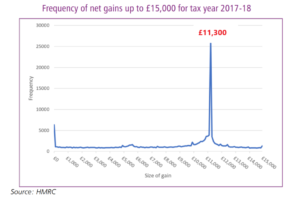
An arresting graph from the 2017/18 tax year illustrates how this is used to wash out gains each year, primarily in investment portfolios. It should be obvious from the graph what this threshold was in 2017/18.

The strongest policy rationale for this is to reduce the administrative burden of reporting capital gains. Currently, 265,000 people pay CGT each year, which current data suggests would rise to 565,000 if the exemption was lowered to £4,000. However, many of these would simply wash out fewer gains each year and so this is likely to be a vast overestimate.

The OTS concludes that a reduction of the annual exempt amount to between £2,000 and £4,000 would be appropriate.

Death and taxes

Finally, the OTS restates its suggestions on the interaction of CGT and inheritance tax (IHT) from its IHT report last year. The key recommendation was removing the CGT uplift upon death where there is no IHT charge (e.g. because assets pass to a spouse, or business assets are exempted). This would be replaced by ‘no gain no loss’ where the recipient inherits the donor’s base cost of the asset.

However, this report goes further and suggests that the CGT uplift on death is removed “more widely” (presumably completely). This would create widespread issues with historical valuations, which the OTS proposes to mitigate by changing the general rebasing date for assets from 1982 to 2000.

The OTS notes that CGT is payable on lifetime intergenerational gifts, except for certain business assets which attract gift holdover relief. Again, this treats the recipient as inheriting the base cost of the asset. The OTS suggests expanding this to non-business assets in line with their recommendations upon death.

Planning

The OTS have released their report under two weeks before Rishi Sunak’s spending review on 25 November 2020. Implementing some or all of these recommendations then would leave very little time for planning, but it’s widely considered that Sunak is unlikely to raise taxes so soon.

However, with glimpses of the end of the pandemic in sight, it would seem prudent to accelerate existing plans for company liquidations and asset disposals ahead of the Budget expected next spring.


Coronavirus and the Future of Tax

The coronavirus crisis has left a hole in the public finances, with debt exceeding 100% of (a somewhat diminished) GDP. There are traditionally three main ways that this can be financed:

1. Increase borrowing
2. Increase taxes
3. Decrease public spending

The first has been the approach so far, although there is still the possibility of locking in debt for the long term by issuing long-dated government bonds as was the case after both world wars.

Prime Minister Boris Johnson has ruled out a return to austerity, which is politically toxic and arguably economically unwise at a time of subdued demand.

This leaves tax increases, although these will need to be carefully targeted and timed to avoid weakening a nascent recovery. Unprecedented times give the opportunity for bold thinking and reform, which may be tempting for a Chancellor who has declared himself to be “unencumbered by dogma”. So what might he do?

Capital gains tax rates

The rates of capital gains tax (CGT), broadly 20% for higher rate taxpayers, are very low by historical standards. Indeed, it wasn’t much more than a decade ago that CGT rates were aligned with those of income tax. With that in mind, it is not unreasonable to think that Mr Sunak may once again align CGT and income tax rates.

It is unlikely, though, that CGT will be subsumed entirely under the umbrella of income tax, as is the case in some countries. There are important differences between income and capital gains, notably that gains may be significant in one year but that there may be no gains or even capital losses in other years. Inflation is also an issue where assets have been held for long periods of time, which could be negated by reintroducing indexation allowance.

Aligning CGT rates with income tax rates would also reduce the incentive to avoid tax by recharacterising income as capital gains. This has been the subject of increasingly complex anti-avoidance rules, which could be rendered largely unnecessary.

The annual exemption could be abolished, although this tax-free allowance (currently £12,300 per year) cuts down on administration and its abolition would raise relatively little revenue.

Capital gains tax rates reliefs

By far the biggest CGT relief is principal private residence relief. With most wealth tied up in people’s main homes, it will surely be tempting to reform or abolish this relief. However, it would be politically controversial, particularly for a party whose traditional supporters are homeowners.

The effects of abolishing the relief could be very uneven, hitting hard those who have owned their house for many years whilst leaving those who moved recently unscathed. To counteract this, it is likely that only increases in value from a given date (for example, the day of the Budget) would be taxed. However, this would mean that it would take years for the abolition of principal private residence relief to raise significant revenue, particularly as house prices are at a historic high.

Entrepreneurs’ relief (now Business Asset Disposal relief) was only recently changed when the lifetime allowance was reduced from £10m to £1m, but given criticism that it does little to increase investment, its abolition could be considered once more.

Wealth tax

The current crisis has hit many of the poorest hardest, and in an increasingly unequal society a wealth tax might seem like an obvious choice. However, it appears to have been ruled out by the Government. Beyond ideology, there are practical reasons for this.

A wealth tax would be an administratively difficult task, as it would require a declaration of wealth to be made by all individuals – not something that is required under the current tax compliance system. With records of wealth needing to be built from scratch, it would be prone to evasion and avoidance.

Annual land/property value tax

Property taxes, on the other hand, are much harder to avoid for the simple reason that it is rather tricky to move land. This could take the form of a land value tax or a property tax. The former is a levy on the unimproved value of land, ignoring the value of buildings which is included in a property tax.

A land value tax encourages productive use of the land and introduces a cost to land speculation, so could potentially spur development. The downside is the administration involved in valuing land across the country.

Such taxes could replace stamp duty land tax, which creates friction and distortions in the housing market by adding to the cost of moving home.

National Insurance

National Insurance could be abolished by merging it into income tax, creating instead higher income tax rates. This would align the tax rates for earnings and other forms of income, which due to National Insurance are effectively higher for earnings with seemingly little policy rationale. National Insurance is also a regressive tax, with higher earners charged at a lower rate than many lower paid workers.

Abolishing National Insurance would help level the playing field between the employed and self-employed, which is driven largely by the difference in National Insurance rates between the two. Combined with aligning dividend rates to those of other income (see below), this should eliminate much tax avoidance in this area and the burdensome red tape for businesses that has been and is being introduced to deal with this.

However, most National Insurance is paid not by individuals but by employers,. It seems unlikely that individuals will want to take on this burden in the form of higher tax on their wages, fearing (probably rightly) that their employers will be reticent to pass on their savings to their employees in the form of higher salaries. Instead, a payroll levy could be introduced to replace employer’s National Insurance, but this could undermine the levelling of the playing field between the employed and self-employed discussed above.

Abolishing National Insurance would impact the over-65s, who currently do not have to pay it. Raising income tax rates would be keenly felt by this group, who are a key Conservative demographic.

It should also be noted that the Conservative manifesto pledged not to raise National Insurance, income tax or VAT rates. Although it could be argued that the current crisis has changed everything, accusations of breaking promises would undoubtedly be made by some. A watered-down version of the above with aligning of income tax and National Insurance thresholds could raise revenue without technically changing and tax rates, although the manifesto also pledged to raise the National Insurance threshold to match the income tax personal allowance.

Pensions

The tax rules for pensions effectively defer tax, with tax relief given for contributions and later withdrawals being taxed. Given that earnings during a person’s working life are generally higher than the pension they receive once they retire, this often results in an overall tax saving. To counteract this, first an annual cap on pension contributions was introduced, followed by a lifetime cap on the value of pension pots. However, it’s still possible to get higher and additional rate tax relief on contributions of up to £40,000 per year – an amount well above the median earnings in the UK. It is quite possible, therefore, that this cap could be lowered again or that relief is restricted to basic rate tax.

Given the rationale of the tax rules for pensions, there seems to be little justification for the 25% tax-free pension lump sum. This could therefore also be scrapped, although this could be seen as a retrospective change for those who have saved into their pensions with the expectation of withdrawing 25% of their pension pot tax-free.

Dividends

Dividends have long been taxed at a lower rate than other income, as compensation for the fact that company profits have already been subject to corporation tax. In an era of low corporation tax rates this may seem unnecessary, but dividend rates were significantly increased four years ago to reflect this.

Even so, the Chancellor may be tempted to align dividend tax rates with general income tax rates as it is unlikely to be politically controversial. Depending on other reforms (particularly National Insurance and corporation tax), this may mean that it is no longer beneficial for business people who own their own companies to pay themselves with dividends.

Corporation tax

In the run up to the last general election, it was announced by Boris Johnson that a planned cut in corporation tax from 19% to 17% would no longer go ahead. This put a halt to reductions in corporation tax rates stretching all the way back to the Thatcher era.

The rationale behind lower corporation tax rates has been to attract multinational businesses to the UK and to increase investment. However, research suggests that other factors matter more to companies than headline tax rates, and a raising of rates to 24% has been mooted.

There have been warnings from business groups that raising corporation tax rates could choke off a recovery. However, given that the tax is charged on profits it is not clear why this would be the case. Companies which have suffered losses would not be paying corporation tax in any event.

Interest deductibility

Interest paid on corporate debt is deductible against trading profits. There are restrictions on deductibility for the most highly geared companies, but the prevalence of debt financing has left some companies fragile in the face of economic shocks. There is a case to be made to remove the tax incentive to load companies with debt.

However, the time may not be right, as many companies have been forced to take on debt in order to make it through the coronavirus crisis.

The future?

The House of Commons Treasury Committee and the Office for Tax Simplification are currently both investigating potential changes to the tax system. Change seems inevitable, but it is unclear how bold the Government, bruised by its handling of the coronavirus crisis, will dare to be.

How to determine the best tax strategy for a family business


Charlotte’s excellent commentary on family businesses and the need to look at succession planning strategically identifies the particular complexities that family businesses experience. As she says “It gets complicated by the personalities, relationships and the emotions of the people involved. That’s why it has the potential to go devastatingly wrong”

The tax tail should never wag the commercial dog. Despite this, tax is always a concern for a family business. There is an argument that family members are more concerned about tax than professional management within a larger business. This is because any tax payment ultimately comes from the family’s pocket, even if this is reflected in a reduction in the value of the family business.

Tax planning must support the long term aspirations of the family

Charlotte’s blog reinforces the need for a long-term understanding of the family’s aspirations. Long-term impacts should be factored into any advice. For example, clients often instruct us to assist on share option planning and efficiency of external funding. Both of these can result in share capital being owned by non-family members. The long-term aspirations of the family need to be understood given there is a risk that non-family shareholders have an interest in driving the business towards a sale.

Trading Status of a family business

Goodman Jones’ tax team are regularly being asked to give advice on the trading status of family businesses. Trading status is important as trading businesses have access to valuable reliefs which provide for efficiency of succession planning. For example, exemption from inheritance tax and the ability to tap into gifting reliefs are valuable tools in the family business setting.

Entrepreneurs’ Relief

Even if there is no intention to sell the family business, access to Entrepreneurs’ relief is seen as crucial by many families. Should the family be given an offer for the business they can’t refuse, then there is a desire to ensure that they can access the 10% rate of capital gains. Differing classes of shares, bespoke Articles of Association, unusual share rights and trust structures are all common in family businesses. They need to be managed and understood to ensure the continued availability of entrepreneurs’ relief. At a more basic level, even advice about the use of surplus funds owned by the business can ensure continued eligibility to entrepreneurs’ relief.

Structuring for growth

Family businesses are more dynamic than their larger counterparts. A family business can react to an opportunity more quickly than a traditional corporate environment. We have many discussions with our clients about structures for new opportunities and how to maximise the tax-efficiency of the upside whilst protecting the family against the risk of an unsuccessful venture. Family business members are often more sensitive to downside risk than shareholders of larger corporates as the impact on the family wealth is more directly linked to the company’s performance and downsides can be disastrous for the family.

In conclusion, all aspects of a family business have tax consequences, including ensuring continued access to trading reliefs. Sophisticated family business advisers such as Goodman Jones work with their clients to understand the long-term aspirations of the family and help shape business decisions which are congruous to those long-term aims.

Entrepreneurs’ Relief Revisions now finalised

Following on from my previous blog and the issue of alphabet shares discussed there, HMRC have revisited Entrepreneurs’ Relief and amendments were made to the Finance Bill as it made its way through Parliament. This softened the effects of the restrictions that were originally proposed in the Budget. The Finance Act received Royal Assent on 12 February 2019 and these revisions are now final.

Equity Holders

Under the new rules introduced by the Finance Act 2019 an individual would need to be an ‘equity holder’ to obtain Entrepreneurs’ Relief on their shares. An equity holder is a term which is rather wider than holders of ordinary share capital and includes holders of convertible loan notes, or debt securities with equity like characteristics. So a holder of ordinary share capital could have found their entitlement was diluted below the 5% threshold when other rights were taken into account. Additionally the rights of the ‘equity holder’ are not restricted to checking that they have at least 5% of the ordinary share capital which controlled at least 5% of the voting rights. The 5% test is extended to considering the individual’s entitlement to the distributable reserves of the company and assets on a winding up of that company.

Alphabet Shares

These changes cause difficulties when there were different classes of shares – alphabet shares – which are often used to declare dividends between different classes of shareholders at different rates. Entrepreneurs’ Relief would not have been available if these new rules had been introduced without change as the discretionary levels of dividend would have meant that shareholders would not have had a guaranteed entitlement to 5% of the company’s distributable reserves.

This proposed change was not withdrawn. Instead, an additional and alternative, 5% test has been introduced which softens the impact of the change. The legislation looks at a shareholder’s entitlement to the proceeds if the whole company were sold, including a liquidation as well as a sale. One important difference here is that this test is applied as a snapshot considered at the date of the sale/liquidation rather than throughout the whole share ownership period. So in the case of alphabet shares, it would be possible to vary entitlement to dividends throughout the holding period, but provided the shares rank equally on a sale/liquidation and the holder is entitled to 5% of the assets of the company on a winding up then Entrepreneurs Relief is available. This revision only considers ordinary share capital, so the rights of other ‘equity holders’ are disregarded when considering this.

The revision could be beneficial to management in situations where outside investors have a preferential right to proceeds in the event of a sale of the company. At the beginning of trading, when the company holds little value, the preferential rights would mean that an ordinary shareholder (i.e. management) may not be entitled to 5% of the sale proceeds. However, as the company increases in value, the ordinary shareholder’s entitlement increase. If the company is then sold, the two year qualifying holding period will begin on the date of the first acquisition of the shares, but the test as to whether it is his qualifying personal company would only be applied on the date of disposal when the 5% test will be satisfied.

Clients should still review their position as shareholder and their company Articles. to see if they satisfy this new test now that the rules have been finalised but this is a welcome relaxation of the original proposals.

Changes to Entrepreneurs’ Relief: What every business owner needs to know now

Entrepreneurs’ Relief is considered one of the most attractive tax reliefs but we’ve worked with a few business owners recently who have assumed they qualify only to find to their horror that they don’t.

In the most recent Budget there has been a relaxation to the conditions associated with the relief and two further restrictions on accessing the relief.

Relaxation of Entrepreneurs’ Relief

The relief applies where a shareholder owns at least 5% of a company’s share capital. The Government have been sympathetic to individuals who find that their interest is diluted below the 5% threshold due to capital funding rounds. The funding is for the benefit of the business as it provides capital to expand but is detrimental to the shareholder as they no longer meet the conditions for Entrepreneurs’ Relief.

Draft legislation has been issued which allows the shareholder to be treated as if they dispose of, and reacquire, their shares immediately before the dilution. This allows them to bank their Entrepreneurs’ Relief before they cease to meet the 5% threshold test. This is an election and therefore not mandatory on the shareholder. If a capital gain is treated as realised, then there is a second election which allows the individual to defer payment of the tax on the gain until the shares are subsequently sold. This prevents the Entrepreneurs’ Relief claim on the deemed disposal giving rise to a tax liability but without having the money to fund it.

Some practitioners are questioning how the shares can be valued at the time of dilution. Of course, if there is dilution then there would normally be a third-party acquiring share at a known value. If that third party is acquiring shares at a negotiated market value, then it gives an indication of the basis for the deemed disposal.

The disadvantage of deferring the gain until payment of the tax is the risk that tax rates rise, or Entrepreneurs’ Relief is abolished prior to the eventual share sale.

New restrictions on Entrepreneurs’ Relief

There have been two restrictions. The first is the qualifying holding period has been extended from one year to two for disposals on or after 6 April 2019. This suggests that some shareholders are looking to make a disposal before the end of the current tax year as they know that they will not meet the qualifying condition immediately on commencement of the next tax year.

The second restriction on Entrepreneurs’ Relief was brought in with immediate effect on 29 October 2018. Prior to this date the shareholder needed 5% of the company shares which represented 5% of voting rights. From 29 October 2018 the shares must also entitle the holder to 5% of the company’s distributable profits and 5% of the assets available to equity holders on a winding up. This change is to try to ensure that Entrepreneurs’ Relief is granted to individuals who have a genuine economic entitlement to 5% of the company. This defeats structures where classes of shares have been issued which are carefully structured to achieve Entrepreneurs’ Relief without genuine economic ownership.

Alphabet shares and family businesses

There has been debate within the profession about the impact of the new conditions on alphabet shares. Alphabet shares have often been issued in family companies to allow different shareholders the right to dividends without automatically requiring dividends to be paid to other shareholders at the same rate. These shares therefore allow individuals to receive dividends in sums which are tax efficient for themselves. Typically, the Articles of the company specifically state that the shareholder is not entitled to dividends in the company until such time as the Board declare dividends on their classes of share. This is to prevent the need for all classes to receive dividends at the same rate.

If the Articles state that a shareholder is not entitled to dividends, then some commentators have identified that alphabet shares may not be eligible to Entrepreneurs’ Relief as there is no entitlement to 5% of the dividends of a company in any 24-month period.

There are two schools of thought. The first is that HMRC did not intend the Entrepreneurs’ Relief changes to apply to alphabet shares and will confirm this in due course. The other school of thought is that HMRC were aware of the impact of the Entrepreneurs’ Relief changes to alphabet shares and they are leaving it to the shareholder to determine if they wish to keep the alphabet shares (and therefore have income tax efficiency) or to restructure (to generate capital gains tax efficiency after a further two years).

It is important that HMRC issue their views on Entrepreneurs’ Relief and alphabet shares as any restructure then has a two-year follow-on period before Entrepreneurs’ Relief is available on the shares which replace the alphabet shares.

Make sure you check your position against the new requirements.

Possible extension of Entrepreneurs’ Relief: Consultation wants to hear from Family Businesses

Philip Hammond, the Chancellor, had promised that his Spring statement would not contain tax announcements. He was true to his promise, well almost.

Amongst the usual statements about economic growth, employment prospects and borrowing needs there were congratulatory comments about the numbers of persons that have benefitted from first time buyer stamp duty reliefs and further suggestions that a litter levy may be enacted. On the theme of waste there was also a call for evidence on how the tax system could be used as an incentive to reduce reliance on certain plastics.

Of relevance to the SME sector is the announcement of a consultation on extending the availability of Entrepreneurs’ Relief. The Government are concerned that bringing external investors into a family business can dilute the founders down below a 5% stake in a company. As the 5% limit is the minimum required for Entrepreneurs’ Relief the Government feel that some businesses may not seek external funding specifically to prevent the founders falling below 5%. The 5% threshold may therefore hold back the seeking of external funds and therefore hold back growth in a business.

There is a consultation which closes in mid-May about the practicalities of allowing the founders to be treated as selling their shares and immediately reacquiring them at the point that they would otherwise be diluted down 5%. This would therefore allow the entrepreneur to “bank” the 5% rate before they are diluted below it.

The cynic may think “well that is just a way of getting money in earlier and leaving reduced tax take for a future Government”. The consultation suggests otherwise as it is making noises about the resulting gain not being payable until such later time as the shares are actually sold and the entrepreneur has cash to pay the tax.

This is certainly a novel solution for a perceived issue and the Chancellor should be applauded for facing it head on.


Reasons why entrepreneurs should take a longer term view and not rush to liquidate their company.

There is much concern about the proposed new rules from HM Revenue & Customs regarding Members’ Voluntary Liquidations (MVLs). The Government’s proposals are that from 6 April 2016, distributions on a solvent winding up of a limited company will be treated as income rather than capital if within two years the shareholder starts up a similar company and it is reasonable to assume that the main purpose of the MVL is to pay less income tax.

While there is a feeding frenzy going on, with many company owners considering winding up before the 6 April deadline, this may be because there is a misapprehension that Entrepreneurs’ Relief is also being scrapped. However, this is not so: the proposed measures will not affect bona-fide business owners winding up (or selling) a trading company at the end of its useful life. Those who take such a long-term view will still benefit from a 10 per cent tax rate on capital gains up to a lifetime limit of £10m.

Take the short term tax saving motive out of the equation and there is really no need to panic. There are also many commercial reasons why it is not prudent to liquidate a company. Not only is there the sheer hassle of closing a company, changing bank accounts, making employees redundant and informing customers, it doesn’t do much for stability. There is the bigger picture: there may be pre-qualification criteria for tendering on more profitable or more prestigious contracts that entrepreneurs will find harder to meet because they are not building up a track record by starting from scratch every couple of years. Also, when it comes to accessing funding, which is hard enough in any case, is this the best way of presenting a serious business with a healthy future?

It is worth looking at the big picture from a commercial perspective rather than the short-term tax advantage. Those who keep chopping and changing miss out on useful and tax efficient remuneration structures such as share option schemes – a handy way of incentivising staff over the longer term, tying them in and rewarding success. Such schemes work well if you don’t have much cash to pay salaries as it is usually tied in with a transaction that will happen in the future, and they’re actively supported by Government policy

As with most Anti-avoidance legislation, there will be some genuine casualties if the proposed legislation comes into law in its current form. Property special purpose vehicles (SPVs), established for specific projects and then liquidated to access the money, will be hit hard. This could be a real issue for property developers or their investors if they are caught by the rules.

Whatever your business, it is worth taking a long-term view when considering how you exit the company eventually and how your staff are rewarded in the meantime and I strongly recommend seeking advice to ensure you have a plan in place to deal with any changes that are coming.

Furnished Residential Lettings v Furnished Holiday Lets

Is there really that much of a difference between the two? Both are furnished, both are lettings but in the weird and wonderful world of taxation, they are poles apart.

Whilst cost is an obvious consideration when choosing a property to purchase, one cannot overlook the tax advantages and potential rental yield attributable to a furnished holiday let.

Imagine that the beautiful character cottage you have been holidaying at in Cornwall for many years comes onto the market for what you consider to be an affordable asking price. You realise that due to work commitments, holidays at the property will be at a premium but the opportunity to purchase it with a view to moving there on retirement is too much to resist. What are your options if you do take the plunge?

Firstly, you could let the property out as a normal furnished or unfurnished residential let, given that it is located in small town with all the basic amenities that a tenant would require on the doorstep. Of course, this would guarantee a regular income but not necessarily recoup your outlay at a particularly expeditious rate.

A more appealing option may be to enter the furnished holiday let market, which given that you have been paying up to £1,500 for a week in the cottage, could be a particularly lucrative option especially in the summer season.

The tax advantages of owning and letting a furnished holiday let are numerous, in particular the myriad of Capital Gains tax reliefs. Firstly, you need to be aware of the basic qualifying rules whereby the property must be let for 105 days and be available for 210 days in any given tax year. HMRC also stipulate that the property cannot be in ‘longer term occupation’ for more than 155 days during a tax year. The definition of ‘longer term occupation is over 31 days consecutively. When I plug the numbers into my calculator (I’m a Tax Adviser not an Accountant!), this means that there are potentially 155 days for you or the family to spend at the property. There are even periods of grace available where the conditions regarding days let are not met in a particular tax year.

As if that is not good enough, providing that the property has qualified as a furnished holiday let during the final twelve months of ownership, the chargeable gain will be eligible for a 10% tax rate by virtue of qualification for Entrepreneur’s Relief.

If you decide that you want to dispose of the existing property and acquire a larger, more luxurious one at any time, another Capital Gains tax relief often overlooked is Rollover Relief. If you make a considerable gain on disposal of the initial property, that gain can be rolled into the purchase of the new property, meaning that in many situations no tax is paid until the new property is ultimately sold. As death is not a chargeable occasion for rolled over gains, there will be no tax to pay whatsoever if the second property is retained for life with the eventual recipient inheriting it at probate value.

Other tax advantages are capital gains tax gift relief, the ability to count the profit as net relevant earnings for pension contribution purposes and capital allowances on furnishings and appliances.

Consideration should be given to the cost of replacing household furnishings and employing an agent to manage the property but on balance furnished holiday lettings do continue to offer some great tax breaks.

An investment property that could qualify as a long term residential let as well as a furnished holiday let would be tax utopia but to find an area to appeal equally to prospective residential tenants as well as holidaymakers is difficult.

Whether you are deliberating over buying that dream cottage in the UK or villa in the sun (the furnished holiday let rules also apply to properties located in the EEA), to help you have peace of mind where potential tax exposure is concerned, you are welcome to contact one of our experienced tax team for some advice.

Entrepreneurs Relief

Here is our latest video with Graeme Blair our Tax Partner explaining Entrepreneurs relief.
Entrepreneurs relief is a valuable tax relief at an appealing rate of only 10%. It benefits individuals who have personally devoted their time to the growth of their business.

Entrepreneurs relief is available on the disposal of a trade by the self employed or shares in a trading company. As ever there are conditions such as the trade or trading company must have been owned by the entrepreneur throughout the one year prior to the disposal.

In the video Graeme goes on to explain Entrepreneurs relief in more detail.