Tag Archives: OTS

Back to the Future for CGT?

Removing distortions and raising taxes

In July, Rishi Sunak tasked the Office for Tax Simplification (OTS) with investigating possible changes to capital gains tax (CGT). The report was released yesterday (11 November 2020) and made a series of recommendations aimed at removing distortions and raising taxes.

Philosophy and tax

In 1998 Gordon Brown stated that the ‘capital taxation system should better…reward risk taking and promote enterprise.’ It took him until his final Budget almost a decade later to put this philosophy into practice when he slashed CGT rates to 18%. At the same time, he introduced entrepreneurs’ relief and abolished indexation allowance for individuals.

The OTS look back further to Nigel Lawson for the inspiration for their report, who in 1988 said that there is ‘little economic difference between income and capital gains’ as his justification for the aligning CGT and income tax rates which would stay in place until Brown’s final Budget.

Back to the future

The headline-grabbing recommendation from the OTS is to once against realign CGT rates with those of income tax. This would not only raise a substantial amount of tax, but would remove the incentive to re-characterise income as gains in order to take advantage of lower rates. They suggest reintroducing indexation allowance to compensate for inflation and increasing the flexibility in the use of capital losses.

If the Government decide against such a hike in CGT rates, the OTS recommend shifting two boundaries between capital gains and income:

  1. ‘Money boxing’ whereby income is rolled up in a personal company and then realised as capital upon liquidation. Instead, distributions of excess cash would be treated as dividends.
  2. Employee share incentives, where Government-approved schemes allow share-based rewards to be taxed as capital. Notably, the OTS distinguishes between all-employee share schemes but takes aim at those which can be targeted at specific employees, such as EMI.

Relief reform

The OTS have taken aim at entrepreneurs’ relief (aka business asset disposal relief) once again. They reiterate the general consensus that a relief given on disposal of a business does little to incentivise investment at its inception. The OTS contrasts this with EIS, which gives upfront income tax relief and is considered far better at incentivising investment. Interestingly they make no mention of the exemption of EIS shares from CGT, which is an exceptionally generous relief that seems at odds with the rationale of giving relief at the time of investment rather than at disposal.

Once again the OTS looks to days gone by for its inspiration, and suggests converting entrepreneurs’ relief to retirement relief. It recommends reintroducing an age limit linked to retirement, upping the 5% minimum shareholding to 25% and a minimum holding period of 10 years.

The OTS are even more brutal in their assessment of investors’ relief, flatly stating that it should be abolished.

Reducing the annual exempt amount

The annual exempt amount is a threshold below which CGT is not paid, currently set at £12,300 per year.
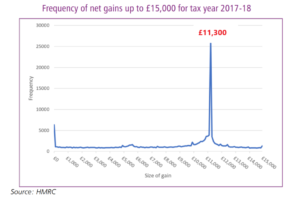
An arresting graph from the 2017/18 tax year illustrates how this is used to wash out gains each year, primarily in investment portfolios. It should be obvious from the graph what this threshold was in 2017/18.

The strongest policy rationale for this is to reduce the administrative burden of reporting capital gains. Currently, 265,000 people pay CGT each year, which current data suggests would rise to 565,000 if the exemption was lowered to £4,000. However, many of these would simply wash out fewer gains each year and so this is likely to be a vast overestimate.

The OTS concludes that a reduction of the annual exempt amount to between £2,000 and £4,000 would be appropriate.

Death and taxes

Finally, the OTS restates its suggestions on the interaction of CGT and inheritance tax (IHT) from its IHT report last year. The key recommendation was removing the CGT uplift upon death where there is no IHT charge (e.g. because assets pass to a spouse, or business assets are exempted). This would be replaced by ‘no gain no loss’ where the recipient inherits the donor’s base cost of the asset.

However, this report goes further and suggests that the CGT uplift on death is removed “more widely” (presumably completely). This would create widespread issues with historical valuations, which the OTS proposes to mitigate by changing the general rebasing date for assets from 1982 to 2000.

The OTS notes that CGT is payable on lifetime intergenerational gifts, except for certain business assets which attract gift holdover relief. Again, this treats the recipient as inheriting the base cost of the asset. The OTS suggests expanding this to non-business assets in line with their recommendations upon death.

Planning

The OTS have released their report under two weeks before Rishi Sunak’s spending review on 25 November 2020. Implementing some or all of these recommendations then would leave very little time for planning, but it’s widely considered that Sunak is unlikely to raise taxes so soon.

However, with glimpses of the end of the pandemic in sight, it would seem prudent to accelerate existing plans for company liquidations and asset disposals ahead of the Budget expected next spring.


What is the Report into simplifying Inheritance Tax (IHT) from the Office of Tax Simplification (OTS) and what should you do?

The Government has asked the OTS to look at IHT, and whether it can be simplified. It also has a consultation underway on the taxation of trusts. There is therefore likely to be some pressure on IHT reliefs in the future, perhaps seeing some restrictions being brought in.

However, the OTS did make some suggestions that could help the taxpayer if they were introduced – though in the current climate it is unlikely that there will be time or appetite to make changes to the tax system.

However, it may be worthwhile having a chat with your Goodman Jones contact if you feel that these changes may affect you, or just if you feel that IHT is something you need to consider. The prospect of a change in government means that all of this may fall by the wayside, to be replaced with something even more restrictive, so it could be the right time to take advantage of current reliefs before they are lost.

What did the report say?

The OTS’s first report looked into filing obligations and Returns, leaving the more meaty aspects to the second report which dealt with:

• Lifetime giving
• Gifts made seven years before death
• Interaction between capital gains tax and inheritance tax
• Reliefs on death

Lifetime Giving

Currently, there are four main gift exemptions:

• £3,000 per year
• any gift of less than £250
• gifts on marriage
• regular gifting out of income.

The OTS have suggested replacing these with a higher annual gift allowance but did not specify how much this should be. This could have some advantages – it would be simple to understand and there is no real justification for a gift on marriage being exempt other than historical accident.

However, the proposals to restrict relief for gifts out of income has potential downsides and which would run the risk of introducing new anomalies in its place. IHT has always been a tax on transfers of capital, and the gifts out of income rules were a way of recognising the dividing line between income and capital. The rules may not be perfect, but they have been around a long time and were well understood.

Gifts made seven years before death

If a gift is made in the seven years before death, then this will be taxable on death, but with taper relief for deaths after three years.

It is proposed to change that to a five-year window but with no taper relief on the basis that it is difficult to keep records of gifts. A reduction from seven years to five years is welcome but may not reduce record keeping requirements substantially.

There are currently circumstances where there is a fourteen year period before death that has to be taken into account – where someone made a gift, created a trust in the seven year period following, and then died within seven years of creating the trust – and it is suggested that this is abolished but with no mechanism put forward for the disregard. This would be welcome.

Fourteen years is a long time to keep records of gifts, or, more realistically, try to reconstruct the pattern of gift giving in such a period when someone dies.

Payment of tax and the nil-rate band

The nil-rate band of £325,000 is exempt from IHT. The band applies to both gifts made in the seven years before death and also the estate of the deceased. It is allocated to gifts in chronological order, with the earlier gifts getting relief in priority, and then any unused portion being allowed against the deceased’s estate.

The recipient of the gift should pay the tax due, but if they do not do so within 12 months, the executors become jointly liable.

The OTS say that these rules are poorly understood and cause unfairness as between lifetime recipients and beneficiaries under the will. They suggest that the executors should be liable for all tax, rather than recipients and / or that the nil rate band be applied proportionately against all gifts.

This seems to introduce other anomalies. Someone who is having a will drafted by an experienced adviser would have discussed who they want to bear the tax on the gifts, and it is just as easy to warn a beneficiary to keep the potential tax due to one side as it is for executors to pay taxes.

If an executor has to pay IHT on gifts made outside the will, then this could increase the number of insolvent estates and the ability of HMRC to recover the tax.
If these changes are brought in, individuals who have drafted wills on the understanding of the current rules would potentially have to redraft them.

Interaction between inheritance tax and capital gains tax

Currently, when someone dies owning an asset, the beneficiaries of the estate take on any assets at the market value on death.

There is a suggestion that where Agricultural or Business Property relief applies on death, that there should be no capital gains tax charge but that the beneficiary should take on the base cost of the deceased instead of market value.

There is some argument to be had that where IHT is not paid in full the capital gains tax uplift should not be available. Though it is a longstanding feature of IHT that assets should pass tax free to a spouse, and this is likely to be the most common situation. The OTS report admits this suggestion of restricting the uplift causes difficulty where APR or BPR may not be available in full on a particular asset so that IHT would be payable despite the relief applying. They suggest a restricted uplift to deal with this situation. Far from being a simplifying measure, this would make the tax more complex, and we see no need to make these changes to deal with a situation that has never attracted much complaint solely because it is considered that it puts pressure on the taxpayer to hold assets till death.

The comments regarding extending APR to situations where the farmer is away from the family business due to care requirements in old age are welcome.

Life Insurance Products

The OTS suggest clarifying the position as regards transfers between pensions and whether they create an inheritance tax charge, and also the status of life insurance products that are not ‘written in trust’ to keep them outside the deceased’s estate. That would be welcome – there has been a lot of pressure from HMRC on pension transfers, and the rules often generate IHT in heart-breaking situations.

Anti-Avoidance

The OTS also suggest looking at the pre-owned asset tax rules again. As IHT is now on the same footing as other taxes as being caught by the rules requiring schemes to be notified to HMRC and the overriding rules requiring transactions to be done without tax avoidance motives then there seems little point in keeping a tax in place that is poorly understood, rarely considered and presumably generates few receipts.

Conclusion

Overall, the report has some useful suggestions, but it is not clear what political appetite there will be for change in the current climate. Nevertheless, please talk to your Goodman Jones contact about your situation so that you are best placed to face the future.

What is the OTS?

The Office of Tax Simplification is an independent office of HM Treasury which gives independent advice on simplifying the UK tax system. It issued the first of two reports on the simplification of IHT, a tax it describes as complicated and unpopular, in November.

The Office says that more people took part in this review than in previous ones. IHT affects only 5% of the estates of 570,000 people who die each year in the UK, but 50% of those 570,000 families involved still have to fill in IHT forms. IHT also worried people before their death even when they were not likely to be paying the tax.

However, it would be surprising if the Government moved to make any substantial changes to Inheritance tax in the short to medium term as their priorities will be elsewhere.