Tag Archives: income tax

Saying ‘I do’ – the tax advantages of marriage

I can now confirm myself fully qualified to comment on the above subject, having become a ‘Mrs’ just over a month ago. In the run-up to the big day there were of course all the usual last minute details to finalise, memorising my vows, the bridesmaid gifts, the decorations and …. my husband-to-be deciding to write a blog on the tax advantages of getting married (he is an accountant after all!!). I would like to add that he had not yet even written his groom’s speech at this point. Who would marry an accountant? I hear you ask…….

So in response I have decided to write about the tax considerations of what will happen next – income tax and inheritance tax planning and Wills. Who said romance was dead?

One of the main advantages of marriage (from a pure tax perspective) is the no gain/no loss rules for spousal transfer. Spreading ownership of assets is an effective method of reducing tax liabilities for income tax to take advantage of any lower tax rates that your respective spouse may fall into. This is a common tax planning tool for investment income and rental income – although it is worth remembering that you MUST transfer both the tax advantages and the beneficial ownership of the said assets. This means that when the asset comes to be sold, the proceeds and any tax bill are for the transferee’s enjoyment and responsibility. There is nothing to stop you moving the asset back into joint ownership before any sale of course and thus benefitting from both spouses’ annual exempt amounts, currently £11,100 each.

Another valuable relief as mentioned in the recent Summer Budget is the increase in the main residence inheritance tax nil rate band. This increase is only available though when a person downsizes or ceases to own a home and assets of an equivalent value are passed to direct descendants. But, in theory this means that by 2020 the potential nil rate band on the second death could be up to £1,000,000 – hopefully any use of this is far off in the future in the case of our recent nuptials (although my husband may feel differently!)

Lastly, it is always a good idea to revisit your Will and update this for any changes to your circumstances. This is particularly true when getting married because in most cases any previous Will that has been made is automatically cancelled on marriage. And on that cheery note I am off to practise my new signature ….

PAYE Coding Notices – Checking the Chaos

Many people do not realise the importance of checking PAYE coding notices; however you could be paying too much tax if your tax code is wrong.

At this time of year HMRC start issuing PAYE coding notices for the coming year. These are based on the recent 12-13 tax return submissions. If your circumstances or income have changed since then it is likely that the tax return will be inaccurate.

To help tax payers get their tax codes corrected HMRC has recently introduced a new email service which you can use to let them know that your PAYE code is wrong. This could save you a lot of time trying to contact them by phone.

Introduced into post war society, Pay As You Earn has led to employers acting as a tax collector for income tax, national insurance and even student loans. Bearing in mind the effect a tax code can have on an individual’s earnings, the importance of checking these is paramount – especially after the problems HMRC had back in 2010 with their PAYE computer systems and the ensuing mess that has followed for several years. As agents we no longer automatically receive PAYE coding notices from HMRC and we are therefore relying on well informed clients to forward these on to us to check.

Some of the more common adjustments you might find in a PAYE code are as follows: –

Car/Fuel Benefit
Medical Insurance
Child Benefit
Outstanding HMRC debts
State Pension
Gift Aid Relief
Pension Relief

For higher earners there are further problems. If you earn over £100k you will start to lose your personal allowances by £1 for every £2 of adjusted net income over the income limit. Therefore if your earnings hover around this threshold, or your salary fluctuates year on year, you may find that the allowances in your PAYE code fluctuate too. This could lead to a nasty shock at the end of the tax year, if you find out you have underpaid tax.

With the seemingly limitless amount of restrictions that can be included in tax codes it is imperative that these are checked by either the taxpayer or an agent. If you believe your PAYE code may be incorrect, or you require further information, please do not hesitate to contact one of the team here at Goodman Jones.

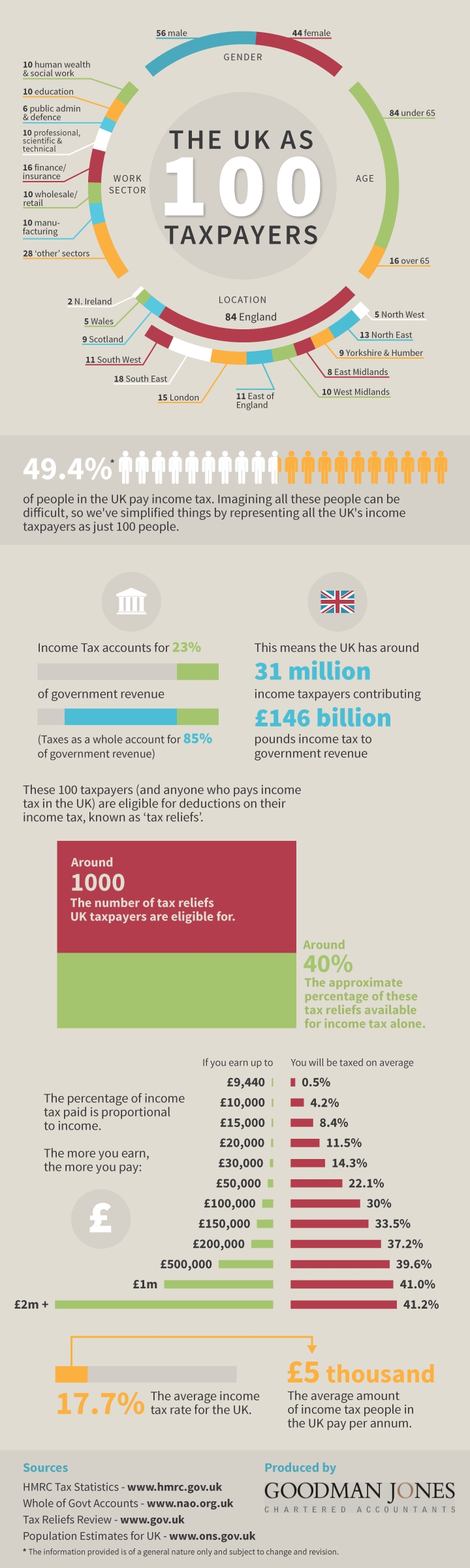
UK Income Tax – The UK as 100 taxpayers [infographic]

UK Income Tax – The UK as 100 taxpayers infographic
We have researched some data to create a visual graphic that easily shows the composition of income taxpayers in the UK. Visualising UK taxpayers as just 100 people makes it a little easier to comprehend.

Add this infographic to your website by copying and pasting the following embed code:


<img src="https://www.goodmanjones.com/blog/wp-content/uploads/2013/11/the-uk-as-a-100-taxpayers.jpg" width="540" alt="UK Income Tax – The UK as 100 taxpayers" id="the_img_link">
<a href="https://www.goodmanjones.com/blog/wp-content/uploads/2013/11/the-uk-as-a-100-taxpayers.jpg" id="the_img_link"></a>

Five good reasons why you shouldn’t delay submitting your tax return….

A press release issued by HM Revenue & Customs (HMRC) has confirmed that over half a million taxpayers submitted their 2011/12 tax returns online on the 31 January 2013, making the 31 January filing deadline the busiest day for the submission of returns.

As the 2012/13 tax year ends, HMRC will shortly start issuing tax returns to those within Self-Assessment.  HMRC’s statistics indicate that for many the completion of their return will be a low priority at this time, but there are genuine advantages to completing your tax return early.

1.    Receive your repayment as early as possible

Where a tax return shows a repayment is due, the repayment will only be issued once the return has been processed.  Therefore, any delay in the submission of the return will result in a delay in receiving the repayment.

2.    Make a reduced payment on account in July

In some cases a repayment is due where too much tax has been paid on account in the year.  One option is to complete your tax return before the second payment on account falls due on 31 July 2013.  This may enable you to make a reduced payment at that time.

3.    Spread collection of your tax liability over the next tax year, avoiding a lump sum payment in January

Where a return shows a tax liability of £3,000 or less, it may be possible for payment to be collected via your PAYE code.  Collection is spread over the course of a tax year, and no payment is required by 31 January.  However, the return must be filed online by Christmas for the liability to be ‘coded out’.

4.    Budget for any tax liabilities

The main danger in delaying the submission of your return is that you may face an unexpected tax liability.  If this happens, it is possible to agree a payment plan with HMRC, but the plan needs to be agreed before the 31 January payment deadline.  Leaving the completion of your return until the last minute gives you little scope to put an agreement in place.

5.    Avoid penalties and interest

With increased penalties for late returns, and surcharges and interest charged where tax is paid late, any delay in the submission of your tax return can also prove expensive.

All in all, there are real benefits to submitting your tax return early – not least the sense of satisfaction in knowing it’s done for another year!

Fully approved, fully effective tax avoidance – time’s running out …

Everyone knows what’s meant by a low risk investment.  It’s one where there’s minimal risk of losing any part of your stake.  You want safe? – government bonds, National Savings, bank and building society deposits up to £82K.  You won’t lose your initial stake, but in the current climate you will most certainly lose value.   With the likes of Halifax paying 0.11% on deposits over £25K, and inflation running at around 3%, “safe” has taken on a new meaning – you can sit back and relax as your savings “safely” whittle away to nought.

Probably the last thing anyone would categorise as “safe” is investment in early-stage start-up business.  You’re almost guaranteed to lose the lot.

Or are you?

For the “right” investor the extraordinary tax breaks available this tax year ensure that whatever you lose on your investment under the Seed Enterprise Investment Scheme [SEIS] will be more than compensated by the tax savings it offers.

It’s important to understand what’s meant by “right”.  First, it’s a taxpayer who’s made a capital gain this year on which tax will be payable. Second, that taxpayer has to have a sufficient income tax liability this year to cover the upfront tax relief SEIS offers.  Third, in the event the investment does what you expect – fail – in the year of failure the taxpayer should be exposed to a sufficient level of income tax at the maximum rate to have it mitigated by the availability of loss relief.

An example:  Joe has made a capital gain on the sale of a second home of, say, £70K.  Because he’s a higher rate tax payer, the CGT bill comes to £16.8K.  He will have earned £90Kin the year, on which he’ll be suffering £26K of income tax.  Because SEIS investments qualify for a 50% income tax relief, he invests £52K in a SEIS business – precisely to ensure he wipes out his income tax liability .  His tax bill on £52K of his gain vanishes, as does his income tax bill.  So his £52K investment will actually cost £11.4K.

Joe’s anticipating a significant uplift in his income profile over the next couple of years, such that he’ll be exposed to something over £50K of tax at the highest rate of 45%. When the investment he’s made does what we all expect, and becomes worthless, he gets income tax relief on his loss.  For income tax purposes his loss is the initial £52K less the income tax relief he received at the time of £26K – a loss of £26K.  He gets tax relief at 45% on that loss, equals £11.7K.

So a high risk investment that cost £11.4K goes sour – leaving him £300 better off.

And of course, there’s always the possibility, however remote, that his investment doesn’t do what we expect, and becomes the next Facebook.

Rather changes the concept of what constitutes a low risk investment.

But this only works for investments made this side of 5th April – so time is running out ……….

Mileage Allowances – Total People Tax Case

The Court of Appeal judgement of 6 November is the latest in this long running tax case. The case is strictly known as Cheshire Employer and Skills Development Limited, but commonly known as Total People as that is a previous name of the business. The Court of Appeal has found in favour of the taxpayer. Whether HMRC will appeal this most recent decision is not known at this time.

Total People employed approximately 150 training advisors whose role was to visit business premises of certain employers. They therefore spent most of their time away from Total People’s offices and were required to undertake a significant amount of travel which was only practical if undertaken by car. The advisors were expected to use their own cars and were given an allowance for doing so. The allowance was to cover the wear and tear and depreciation as a result of using a car for business purposes.

For administrative convenience, and to approximately equate with anticipated mileage, some advisors were provided with a monthly car allowance and a modest mileage allowance. As well as administrative convenience this also had the benefit that it was a disincentive for staff to potentially maximise their business travel and therefore their mileage claims.

Total People argued that the car allowance was therefore no different from a tax free mileage allowance. The Court of Appeal accepted the Total People’s position and therefore, to the limit of the recognised mileage rates, the car allowance can be received free of income tax and national insurance.

Total People’s approach to mileage claims is not unique. There are many businesses that have the same, or similar, policies. Based on the recent judgement it should be possible for those businesses to make a claim to recover national insurance overpayments and for individuals to submit tax returns to recover income tax previously paid. These claims will be under the error or mistake provisions of the tax administration legislation.

National insurance claims should be made by the end of the tax year. Due to the administrative process accompanying income tax claims it may be necessary for the employees to resubmit income tax returns before 31 January 2013.

Seed EIS

I have noticed a marked increase in questions about the Seed EIS scheme. Perhaps the forthcoming 31 January tax payment date is leading people to consider tax efficiency more closely!

The scheme is for companies which are seeking early stage funding in the first two years of their trade. There is a 50% income tax relief available for qualifying investments. Shares held for three years can be sold without capital gains tax. Capital gains made in 2012/13 and reinvested in this tax year into Seed EIS companies can be eliminated entirely. Other gains are deferred until the year that the Seed EIS company’s shares are sold.

The tax breaks are generous. This is a reflection of the high risk nature of such businesses. There are many conditions about the size of the business which also need to be satisfied in order for Seed EIS to be relevant. There are also practical considerations that need to be considered. The practical considerations include:-

A Seed EIS qualifying company cannot be under the control of another company. This sometimes leads to difficulties if a company is bought off the shelf from a company incorporator. HMRC have confirmed that companies set up by incorporating agents ( in situations where the incorporator is itself a company) will lead to loss of Seed EIS. This is because the incorporating agent controls the trader and therefore there is a time when the trader is under the control of another company.

Similarly there are certain steps which a subscriber should follow if they are also to be seeking Seed EIS relief. This is to prevent them accidentally tripping one of the conditions surrounding share ownership levels.

The conclusion is that Seed EIS, for qualifying activities, is a valuable and generous relief. However, it needs to be treated with care and the detail of the legislation understood and followed.

Employee Shares

The Government recently confirmed its intention to introduce a new type of employment contract in which it would be lawful for employees to waive certain statutory employment protections.

In exchange for reduced employment rights, employees would be offered shares in their employer with a value between £2,000 and £50,000. Although the acquisition of the shares would be subject to income tax (and national insurance, if relevant) the eventual sale of those shares, by the employee, would be exempt from capital gains tax.

Details released to date suggest that the legislation is principally intended for small and medium sized companies, but companies of any size will be able to use this opportunity. Rights which may be forfeited include unfair dismissal, flexible working, maternity leave and redundancy payments.

There will be flexibility in the legislation which permits the opportunity to be offered to employees recruited after the legislation is enacted or both future employees and current employees.

Some beneficial share option schemes, such as Enterprise Management Incentive, have restrictions as to their use if employees already hold shares in their employer. Current proposals imply that these existing share option schemes will not be adversely affected by the new legislation.

It has been suggested that legislation will be enacted from April 2013 and the Government will consult with Industry as to the practical implications of the proposals before then. Obvious practical considerations which need to be ironed out include the impact of numerous employees having an influence on the strategic direction of a private company and the alternatives should an employee leave the company whilst holding shares in their employer.

The squeezed middle

Many of the commentators on this week’s budget have used the term “the squeezed middle”. In recent years it has become a rallying call of the middle classes and intended to suggest that they are bearing the worst of the budget rises. I believe that there are many squeezed middles, and some of them are not even in the middle.

At the bottom end of the income scale the nation has many families whose financial security is reliant on tax credits and similar payments. With wholesale reform of welfare benefits, some of the families will have their incomes reduced and therefore may feel squeezed. Families are not the only groupings who will be feeling the pinch. Pensioners have received the news that their age related personal allowances will be frozen and eventually phased out. This is a tax cost to the elderly and therefore they are also being squeezed.

Personal allowances are due to rise, which is commendable. Unfortunately, the rate at which the 40% tax band starts is due to fall from £35,000 down to £34,370. Not only does this increase the tax liabilities of many hundreds of thousand middle earners, it also increases their tax administration burdens; a double whammy of increased taxes and increased administration. Is the correct term a “double squeeze” or a” tight squeeze”?

The middle are most effected by the taxation of child benefit for incomes over £50,000. Although this increase in tax is tapered to prevent a cliff edge effect, it does represent a considerable cost to the family whose income level is starting to be sufficiently high that they may pay for private education or private medical insurance. Those families may revert back to reliance on the state system. Could this taxation increase the budgetary requirements of the NHS and Department of Education?

In my mind the most heavily squeezed are those earning between £100k and £116k. Their marginal rate of tax is in excess of 60%. That hurts them, and it should be priority of the government to eliminate this distortion.

Those earning more than £150k will be feeling the opposite of squeezed. Their tax burdens are falling, unless of course they are thinking of buying a property for more than £2million in a company.

If a wealth tax is imposed in a future budget the highly remunerated may suffer. The inequality of a wealth tax is that it is not necessarily backed by money with which to pay the tax bill.

Overseas holiday homes purchased through a company

It is quite common for overseas holiday homes to be purchased in companies. Typically this is to circumvent overseas inheritance rules. Historically the use of a company has lead to a UK income tax and national insurance liability which was treated as a “cost” of the structure.

Pressure was placed on the Government to eliminate this cost, and in 2008, they revoked the income tax liability but not the national insurance liability. The national insurance liability has now been retrospectively revoked and reclaims of national insurance can be made for any prior year, even those earlier than 2008. Any refund must be claimed before 2015.