Tag Archives: tax avoidance

Is tax fair?

When I was at primary school I recall clearly one teacher. He had a catchphrase. A pupil would run up to him with a grievance and invariably end up saying, “Sir, it is not fair.” Those around knew the answer coming, mouthing the words in time with the teacher.   His words predictable and solidly spoken – in a deep voice he would say, “Life is not fair.”  To small children it never seemed a satisfactory answer – we expected fair.  As adults we appreciate the irregularities in life and its imperfections. Is life always fair? Certainly not.
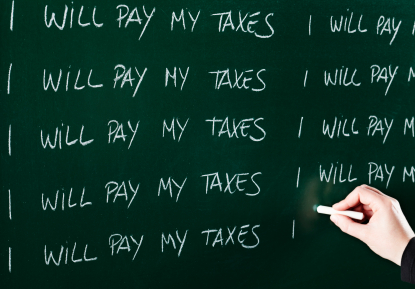
is tax fair

The recent ethical and moral debate on the UK tax system is a fascinating one. There has been an explosion of interest in tax avoidance. There certainly does appear to be an expectation that the tax system should be fair.  Especially as emotions tend to run high in times of economic hardship and when personal finances tighten.

Does a fair UK tax system exist?  Our ancestors certainly never managed one.  Is the current UK tax system fair for everyone? Absolutely not.  Is there an expectation that it should be? Perhaps.

Let us think what it would take to produce a fair tax system.  Taking the definition of the word “fair” it would require a tax system that:

 “Treats people equally without favouritism or discrimination.”

Do you think that is possible?  Of course not!  Fair is an opinion, it is subjective and your opinion may be completely different to mine.  As an individual you probably pay higher rates of income tax than a small company pays for corporation tax – quite possibly nearly double. Does that seem fair to you? Perhaps it does, perhaps it doesn’t – your view of fair on an issue may be different to mine.

More accurately as Peter in his post noted:


“There’s nothing “fair” about tax.  It’s whatever each government wants it to be.  A revenue-collecting device.”

So when you listen and read the stories on tax avoidance first keep in mind that the UK tax system will never be fair.  The real question is not is tax fair – it isn’t for everyone – but how can our UK tax system be changed?  So ask yourself what would you do?

Swiss Bank Accounts – the Clock is Ticking

The hands of the clock are approaching midnight for UK taxpayers with Swiss bank accounts.

Under an agreement signed between the UK and Swiss governments, Swiss banks will be required to make a one-off payment to HMRC.  The amount of the payment is based on a complicated formula and produces an effective rate of tax of between 21% and 41% of the capital on Swiss bank accounts holding bankable assets (cash and investments  – real estate and safety deposit boxes are excluded) where the accounts are registered to a person in the UK.   The deduction applies where the account was open as at 31 December 2010 and is still open as at 31 May 2013.  The one-off payment will be made by deduction from the account on 31 May 2013.

Income earned on these investments from January 2013 will face high withholding taxes at rates of up to 48%.  These taxes will be deducted without disclosing the identity of the accountholder to HMRC.

As an alternative to paying these high tax charges, it is possible to authorise the Swiss bank to disclose the identity of the accountholder.  However if tax has not been paid on the income in the past, the accountholder will be exposed to the possibility of an Inland Revenue  investigation into their affairs which will result in having to pay tax on all undisclosed income and there will also be high penalties, possibly as high as 150%, on the tax liability.  In extreme cases the accountholder could be prosecuted by HMRC.

For non-UK domiciliaries, they can choose to disclose to HMRC UK source income and gains which have been remitted to the UK where UK tax has not been paid and make a one-off payment of 41%.  Alternatively they can inform the Swiss bank that they wish to opt out and will not choose any of the options.  However this will give no tax clearance for past liabilities.

The Swiss banks have been sending out letters to accountholders informing them of the options and prompt action is required to respond to these letters.

Where the income has not been disclosed, it is possible to take advantage of a special disclosure arrangement, known as the Liechtenstein Disclosure Facility (LDF) in order to regularise matters.  The advantages of using the LDF are:

  • The funds in Switzerland are “cleaned up” and the bank can be authorised to disclose the identity of the accountholder; thereby avoiding the one-off tax payment;
  • Tax will be due on income and capital gains only from 6 April 1999 onwards.  Income and gains prior to that date are ignored;
  • The penalty on the tax due is only 10% on the tax due on the income and gains up to 5 April 2009.  The penalty for later years will be a little higher but this may only affect one or two years;
  • Where the money in the Swiss accounts has been  inherited it is possible, in most cases, to avoid the 40% inheritance tax liability that would have been due if the account had been declared when probate was applied for;
  • Going forward the accountholder will not suffer high withholding taxes on the income and gains;
  • Immunity from criminal prosecution is guaranteed;
  • If the funds have been “cleaned up” they can be brought back to the UK rather than remain in Switzerland.

We have considerable experience in using the LDF.

If you think the LDF could be of benefit to you please contact us.  Don’t delay!

Tax Avoidance – the next target for banker bashers?

The media found a new target. This time it was people whose tax bills are reduced as a consequence of totally legitimate and laudable behaviour.

Let’s deal with “laudable” first. The country apparently approves of philanthropy. There is widespread support for charitable causes, from the arts to medical research, from help for the aged to charities for kids, good causes command respect.

The country also apparently approves of risk-takers establishing businesses that provide people with employment opportunities that might otherwise not exist.

Given these are perceived “good things”, governments of different hues have sought to create structures over the years to promote them. And because these good things involve individuals spending money, the structures have of necessity been money-related – which inevitably involves use of the tax system.

The Gift-Aid system is designed so that when a person gives money to charity, the charity can claim from the Treasury the basic rate tax deemed to relate to the donation. £10 donated becomes £12.50 to the charity. And a higher-rate tax payer is entitled to recover by way of tax relief the difference between his higher-rate, be it 40% or 50%, and the basic rate of 20% imputed into the donation. So a £400K charitable donation is worth £500K to the charity – and the donor gets a deduction for tax, if he’s a 50% tax payer, of £150K (50% – 20% times £500K).

Shock, horror! £150K tax saved! UK Uncut will have a field day!

But it’s cost him £400K to get it.

Don’t know about you, but personally, I’d rather not blow £400K simply to save myself £150K of tax. I’d grit my teeth, suffer the tax, and party on the net £250K I’d saved myself.

Similarly, the risk-taker might be making substantial losses in the business he’s set up. Horror of horrors!- he might get a tax break!

But the value of the tax break will only ever be a percentage of the losses that caused it.

The Chancellor now wants to cap unlimited tax reliefs at £50K or 25% of income, whichever is the higher.

Let’s look at an example. Let’s assume the person who gave £400K to charity had gross income of £1 million. Under the present regime, the charity gets £500K, a net £250K from the donor, and £250K from the Treasury.

Going forward, the individual can of course maintain his level of donation at £400K, but as his tax break will cease at £250K, he’ll more than likely cap his contribution at that level. In which case the charity will get £312.5K and the donor’s tax break will fall by £56,250. The charity will be £187,500 worse off, the Treasury £93,750 better off (£56,250 from the donor’s tax bill, £37,500 from the reduced top-up it pays the charity). The difference between the charity’s loss and the Treasury’s gain (£93,750) sits in the donor’s pocket.

Maybe he’ll give the extra away without a tax break – anything’s possible, however unlikely.

The same applies to establishing new businesses. The tax consequences of risk-taking are very much a part of the decision-making process as to whether or not to take the risk. Remove the tax break, you increase downside risk, making the risk-taker much more averse in the first place.

The media initially got this one completely wrong. Not surprising, given all it did is following the claptrap spouted by UK Uncut. And the Chancellor simply bought into this populist message, because frankly, it suited him – the less that goes to charities, the less business risks people take, the more tax revenues go to the Treasury. It’s just those “good things” that suffer.