Tag Archives: uk

More on the UK as the place to do business

I’ve commented previously on why the UK is the place to base your European activity.

The World Economic Forum recently issued its 2014-15 Global Competitiveness Report covering 144 economies with just five omissions including Liberia and Ecuador. Its analysis is prepared by locally-based academics and utilises statistical data from international organisations such as UNESCO, WHO and IMF.  Its report weights economies according to their comparative rankings under three bands of “Basic Requirements”, “Efficiency Enhancers” and “Innovation and Sophistication Factors”, collectively sub-divided under twelve headings, each of which are further sub-analysed.  The twelve headings are Institutions, Infrastructure, Macroeconomic Environment, Health and Primary Education – all under “Basic requirements”, Higher Education and Training, Goods Market Efficiency, Labour Market Efficiency, Financial Market Development, Technological Readiness, Market Size – collectively under “Efficiency Enhancers”, and Business Sophistication and Innovation – forming “Innovation and Sophistication Factors”.  As an example of subheadings, Institutions is broken down into no less than twenty one heads, covering amongst others judicial independence, crime, trustworthiness of police, corruption in government, investor protection – the list goes on.

Whilst sub-analysis headings are weighted uniformly for all economies under the three principal bands, the weighting applied to the three principal bands varies according to the state of development of the individual economy. So the importance of “Basic Requirements” to Burundi’s underdeveloped economy has a 60% weighting, but only a 20% weighting to Sweden’s highly developed one.  Weightings for principal bands “Efficiency Enhancers” and “Innovation and Sophistication Factors” span from 35% to 50% and from 5% to 30% respectively.

For the second year running, Switzerland and Singapore are numbered one and two in overall rankings. The rest of the top 10 comprise: the USA at third (fifth last year), Japan sixth as against ninth previously, and Hong Kong seventh (again).  Remaining places are taken by EU countries – Finland 4th (3rd previously), Germany 5th (as against 4th), Netherlands 8th (again), UK 9th (versus 10th) and Sweden 10th (against 6th).  In other words, in terms of its Global Competitiveness Report, the World Economic Forum reckons the top 10 economies this year are the same top 10 economies as last year.

The WEF report includes statistical analysis to demonstrate an impressive correlation between the results of its report and GDP per capita growth from 1990 on.

So how does its analysis contribute to a business decision as to where to base its European operations?

Clearly certain subheadings used by WEF have no relevance to such decisions. The business impact of malaria, for example, is unlikely to influence a decision as to where to headquarter European activity. The number of fixed telephone lines per 1000 people is also unlikely to be a decisive factor.  And principal bands weighting for all the major EU economies is uniform (20%, 50%, 30%) – so perhaps the simplest answer is to add the rankings across all 121 subheadings for all relevant economies.

What is meant by relevant economies for this purpose? They need two features – they must be major EU countries with sizeable local populations to facilitate local sales, and they must be sufficiently close to the economic centre of the EU to ease cross-border business.  That gives us Germany, France, Italy and the UK.

Because the WEF rankings are best is lowest, the lower the total for the 121 subheadings, the better. And to put the rankings into perspective, these can be compared with the equivalent scores for the US.

The results are:

Germany 3,162.6
France 4,571.0
Italy 8,049.3
UK 2,749.6
US 3,433.5


Say no more!

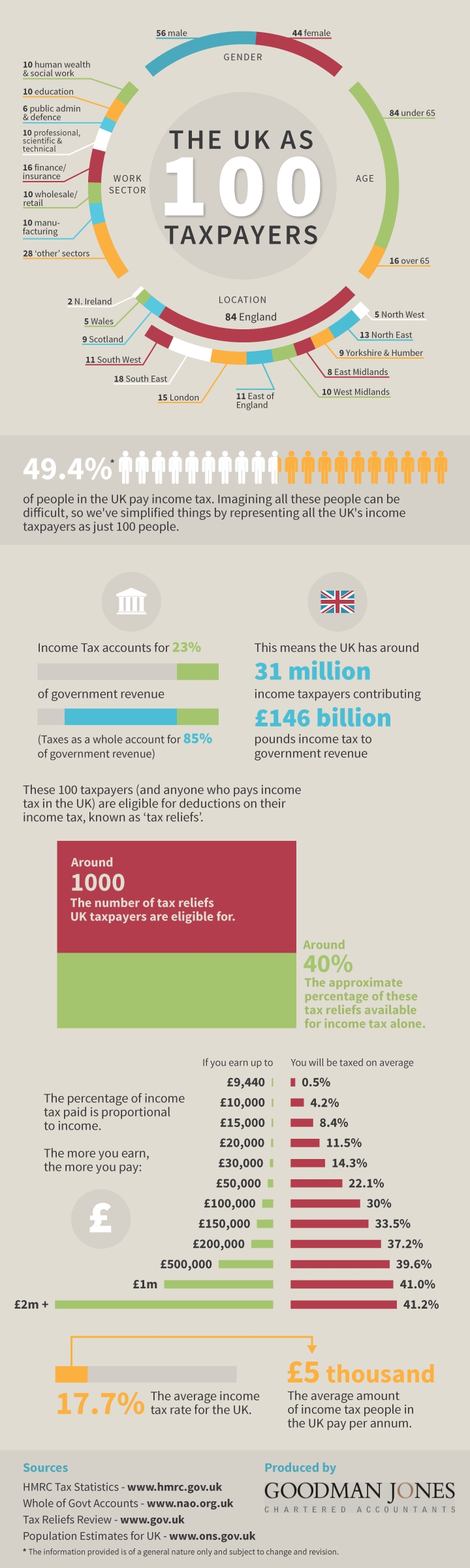
UK Income Tax – The UK as 100 taxpayers [infographic]

UK Income Tax – The UK as 100 taxpayers infographic
We have researched some data to create a visual graphic that easily shows the composition of income taxpayers in the UK. Visualising UK taxpayers as just 100 people makes it a little easier to comprehend.

Add this infographic to your website by copying and pasting the following embed code:


<img src="https://www.goodmanjones.com/blog/wp-content/uploads/2013/11/the-uk-as-a-100-taxpayers.jpg" width="540" alt="UK Income Tax – The UK as 100 taxpayers" id="the_img_link">
<a href="https://www.goodmanjones.com/blog/wp-content/uploads/2013/11/the-uk-as-a-100-taxpayers.jpg" id="the_img_link"></a>

Typical issues facing incoming business

Even in today’s interconnected world, businesses tend to start local and expand their geographic reach over time.  Initially regulations seem relatively straight forward – everyone in the US knows what’s meant by a 401K, just as everyone in the UK knows what a P45 is – because they’re the ones everyone grew up with.  Many of the rules affecting new businesses are ones its management is broadly familiar with.  Managers know what they know, the better ones have a good feel for what they don’t.

The problems start to pile up when that geographic reach extends beyond home territory.  Initially, there aren’t any – businesses find a third party agent with appropriate territorial expertise and stick to their home markets with little more than gentle forays into foreign lands.  But over time, and as those forays become more regular, reliance on third party agents becomes increasingly unsatisfactory.  They may not have done anything wrong, their service may be excellent, but they’re not you, their priorities aren’t yours, their flexibility doesn’t match your own, and if you’ve a growing presence in that territory, the day comes when you have to have your own facility. And that’s when the problems start.

A typical example is a US corporation that’s developed a significant and growing activity this side of the pond.  Up to now it’s used third party agents to distribute goods to retailers / third party installers to install product / third party maintenance technicians to maintain its equipment / third party sub-contract professionals to help fulfil contracts.  They might be in the UK, or Germany, or France – somewhere, anywhere, in Europe or the Middle East, or Asia or further afield.

The decision is taken – “we’ll set up our own support operation”.  Easily said – but then the problems start.  What form should that operation take?  Does every territory require its own operation? Who do we send to set it up, how do we pay them, will they be taxed locally, and on what?  Where will they live?  Will we be taxed locally?  If we are, how will profits be determined?

Over the years we’ve helped many such US businesses get their own European support operation off the ground. The answers to the questions are usually, but not always:  a UK limited company, not necessarily, someone you trust, pay locally, yes they will, on what you pay them, London or home counties’ rented accommodation, yes you will, and “cost plus”.   But there are variances – a US-owned UK registered branch rather than a UK limited company, everything overseas controlled through the UK establishment with no place of business elsewhere, wages paid in the US with a grossing-up process undertaken in the UK to ensure UK tax compliance, and business taxed on apportioned profits to reflect genuine revenue generation outside the US.

There are all the other issues as well – just how adequate are your US employment contracts when it comes to employing overseas (generally, not very!), are you obliged to register for VAT and how do you account for it (answer – not invariably, though it’s usually in your interest to do so), should your UK operation have authority to contract with third parties or should all third party contracts remain in your control (answer is, apart from contacts for overheads, best if authority vests in the US – the more arms-length activity initiated in the UK, the greater the “plus” in “cost plus” becomes).

Expanding your horizons to foreign climes? –  you need the support of those who’ve grown up in them.

Transparency & Trust – Company Ownership

On 15 July, Dr Vince Cable, Secretary of State for Business, Innovation and Skills, announced the launch of the Transparency & Trust discussion paper.

The full document is called “Transparency and Trust: enhancing the transparency of UK company ownership and increasing trust in UK business” and is available online.

This document, whilst being targeted at criminals and international money launderers and terrorists, will impact on every UK private company and particularly on overseas companies looking to set up trading subsidiaries in the UK.

The Executive Summary runs to over 10 pages but I can cover it in a few lines:


    1. Every Company & LLP will be required to maintain a Register of Beneficial Owners (those who control 25% or more of a company). The only debate is on who will be entitled to access this Register.


    1. Corporate directors are likely to be outlawed.


    1. Nominee directors will have to disclose publicly the full details of their Instructor or Principal.


  1. New Bearer Shares are to be banned and existing shares to be converted to Ordinary Shares.


Whilst this is a consultation document there should be no doubt legislation will follow.

Inward Investment – affected by a EU referendum?

David Cameron’s EU referendum proposal has put the cat amongst the pigeons, but what real impact is it likely to have on inward investment in the UK?

I’ve commented previously that the UK is the ideal gateway for business into the European Community.  I’ve enumerated the following advantages:

  1. It’s quick and cheap to set up here
  2. It’s not within the Eurozone
  3. Its internationalist outlook – a polyglot nation if ever there was one
  4. London’s status as the world’s most important financial centre
  5. The flexibility of its labour market
  6. Its business sophistication and innovation
  7. The dependability of its legal system

The UK’s pragmatist approach to the EU and its oft-expressed view that the EU’s greatest attribute is the Single Market attracts a substantial level of support from within the EU itself – one need only read Angela Merkel’s balanced comments to realise that even within the Eurozone, there is a recognition, perhaps grudging, that the UK frequently has a point.  Amongst non-Euro members of the EU, the UK’s stance that the Single Market is the EU’s primary purpose is well-regarded.

The EU currently comprises three distinct groupings – existing Eurozone countries, countries committed to joining the Eurozone, and those with no such commitment.  There are divergent positions within each of these groups.

Most obviously, within the Eurozone, there are industrialised successful economies such as Germany and Finland, there are the wannabe’s with varying degrees of problems led by France, and there are the strugglers – Greece, Spain etc.  Concerns about the future of the Eurozone may be making less headline news today than they were last month, but they haven’t gone away.   Solutions need to be found to tackle mass unemployment in the periphery and a hugely burdensome welfare structure that threatens all.  The problems are economic – the solutions are political.  That’s seventeen countries attempting to find compromises between each that their political leaders can sell to their own electorates.  No-one knows how long it might take, and no-one has a clear idea of what the outcome might look like.   So if you’re an inward investor, how certain can you be that the location you choose today will still prove to be the right one tomorrow?  You can’t.  You’ve no real idea what you’ll be getting into.

Whatever the compromises Eurozone members conclude between themselves, inevitably they will impact on the EU as a whole.  So non-Eurozone members need also to participate in the compromise process. And as the non-Eurozone members are an even more diverse group, what form might those compromises take?  What impact might they have on individual states?  Will they incline an inward investor toward Bulgaria, perhaps, as opposed to much more highly developed  – and relatively expensive – Poland?  Will either or both be within the Eurozone itself by the time the dust has settled?  There are no answers to these questions.  Uncertainty reigns.

Inward investment is by its very nature long-term.  The rationale for it must always be economic, and that requires there to be a degree of certainty about the longer term.  One could surmise that in the longer term the Eurozone will become the EU, but that’s simply not going to happen within any reasonable estimate of what might be a foreseeable timescale.  It is inconceivable that either Denmark or the UK – the two countries not committed to ever join the single currency – would choose to do so in the next 10 to 15 years just as it’s inconceivable the other EU members could eject them from the EU against their wishes.

So to come back to the original question, what real impact is the promise of a referendum on a renegotiated membership terms likely to have on inward investment in the UK?

It’s worth bearing in mind Stephanie Flanders’ recent post.  Currently Germany’s largest trading partner is the UK – not a relationship either Germany or the UK would want to lose.  Given Germany’s status within the EU and its role as paymaster for the ills of the Eurozone, it will ensure such steps are taken as are necessary to enable a future Conservative government to present a renegotiated treaty to a referendum.  A referendum to either continue with the known, but on better terms, or to step into the unknown.  It would be a seriously failed government, supported as it would be by all but the foaming at the mouth diehards, that couldn’t sell that to the UK population.

So – the conclusions I reached in my earlier posts remain the same – the UK is still the gateway to Europe.   The pigeons were there anyway, squabbling as per usual – all Cameron’s done is to place the cat needed to give them a fright.

International Secondments of Staff

As businesses grow and expand into the UK it is quite common to send employees into the UK to oversee the expansion. There are various strategies to ensure that employees coming to the UK can do so tax efficiently.

Detached duty relief

An assignment to the UK may be a short term secondment. The UK allows those on short term assignments to receive certain benefits free of tax. If correctly structured the assignment can permit the individual to receive accommodation without a tax charge and permit flights back to their home country, for them and their family, to be provided free of tax. These make the UK an attractive destination for internationally mobile workers. The social security consequences of the secondment should not be overlooked and will be subject to separate considerations.

Dual contracts

If the individual is to be in the UK for a longer period of time then a split contract arrangement may be appropriate. These are suitable if the duties performed by the individual can be clearly separated between those undertaken in the UK for the benefit of the UK business and those the individual may undertake in other countries for other parts of the international group. Due to certain legislation it is only the UK element of the employment which will be taxed in the UK. Split contracts are a well understood technique which need appropriate circumstances to implement. To be effective they need to be correctly documented and have on-going recording obligations. As with secondment planning we have a number of clients who use this opportunity.

Tax equalisation

Tax equalisation is becoming more popular in the international market. Equalisation seeks to promote mobility amongst the staff by ensuring that they are not disadvantaged by going to another country whose tax rate may be higher than that of the home state. At a basic level equalisation ensures that the post-tax salary of the employee remains unchanged irrespective of the country in which they operate. There are variations on this theme. For example, one way tax equalisation (sometime known as tax protection) is for the sole benefit of the employee. If the tax rate in the overseas country is less than that of the home state, the employee keeps the benefit of the differential whilst the employee is protected should the overseas tax rates be higher than that of the home state.

Cost of living equalisation

Tax is only one aspect of the costs incurred by internationally mobile workers. Different countries have different cost of living and different governments provide different services to their residents. This is leading to the developing concept of cost of living equalisation. This form of equalisation looks at the total cost of living in a country compared to that of the home state and seeks to equalise the two. For example, state sponsored health care is free in the UK whilst some countries require the individual to take out a mandatory insurance plan. Moving to the UK would negate the costs of the insurance plan and therefore the cost of living in the UK would be different from that of another country. Conversely property rental in the UK is higher than many other parts of the world. Cost of living equalisation attempts to take account of these variations.

Anyone for UK Limited?

Notwithstanding, the public euphoria gathering pace with the Diamond Jubilee celebrations and the 2012 Olympics around the corner, here are the five top reasons why the UK remains such an attractive location to do business;


1.       Reputation and economic stability

The UK has a long established trading history and worldwide reputation built on strong ethical business standards and commercial acumen.  Whilst the global downturn has stunted economic growth, compared to the rest of Europe
with economic unrest, bailouts, mass unemployment and threats of contagion, the UK appears positively bliss.

2.       Company formations

Incorporating a company in the UK could not be easier. For a nominal cost and with a minimum share capital of a humble £1, a company can be incorporated with UK Companies House following a few clicks on-line.  Contrast this with
Germany; minimum share capital EUR25,000, Italy ; EUR10,000 and Spain EUR3,000 for a private limited company, not to mention the extra regulatory and administrative burden.


3.       Corporation tax rates/tax incentives


Tax will always be one of the
deciding factors in establishing the attractiveness of the UK. With the main rate of corporation tax currently at 24%, falling to 23% from 1 April 2013, UK Ltd enjoys one of the lowest tax rates compared to its main European competitors; Germany, France and Italy all have corporation tax rates in excess of 30%.  The UK tax system also offers a wide range of tax/financial incentives including tax treaties with the sole purpose to attract foreign investment.


4.       Infrastructure and communications network


UK offers a world class transport network linking mainland Europe and the rest of the world and in Heathrow boasts one of the busiest airports in the World.  The UK also has an extensive broadband market and one of the strongest IT infrastructures in the world. 


5.       Low asset valuations/favourable exchange rates


Cash rich foreign investors continue
to benefit from depressed property valuations post the September 2008 crash.  Coupled with the fall in Sterling against other currencies, has there ever been a better time to invest in the UK London property market?


Inward investment in the UK – tax certainty and fairness

One of the difficulties that Government have is to strike the three way balance between tax certainty, tax simplicity and tax fairness. The recent headlines around Barclays Bank’s tax structuring brings this dilemma into focus.

The UK is seen as having a tax regime which is stable (i.e. certain) and businesses are treated fairly by the taxing authorities. Despite this we have one of the, if not the, longest tax codes in the world. This does not imply simplicity.

The UK is often held as an example of a fair tax system. Many non-British nationals find it hard to believe that we have a self-assessment regime for individuals and corporate which effectively require the taxpayer to self-determine their liabilities. The tax calculation is not necessarily subject to any form of review by HMRC. Compare that with for example the recent European convention on human rights case where a shopkeeper in the Ukraine claimed that their human rights had been violated by the actions of a tax police squad who, during a premises visit, allegedly, assaulted a business employee. Even the concept of a tax police is alien to a UK national.

The UK enhances its reputation for certainty by consulting with the taxpayers before implementing wide ranging legislation and by avoiding retrospective legislation.

Fairness and certainty are two of the many reasons that the UK is an attractive place for inward investment. Our tax code attracts investment with incentives such as tax free perks for immigrating staff, the non-domicile regime, a wide network of tax treaties, the lack of dividend withholding tax and the substantial shareholding exemption. Some of these incentives have been varied in a way which reduces their impact. An example being the introduction of the remittance base user charge. Even when they are varied the changes have been well trailed by HMRC which demonstrates that it is possible to change legislation whilst still retaining the certain nature of the UK’s tax code.

Recent actions to retrospectively close down Barclays tax structuring may be understandable in the context of the tax at stake and the perceived artificiality of the arrangements. My concern is that this retrospective legislation will have a long term disadvantage of reducing the UK’s standing in the area of certainty. Only time will tell.

The Bribery Act won’t affect me, will it?

Doubtless anyone reading this will have heard about this Act, some will have read commentaries on it, others may have gone on courses or spoken to their lawyers or accountants about it.

For those that haven’t gone beyond stage 1, perhaps these comments might whet your appetite.

I first saw real-life reference to the Act some weeks back when looking at a questionnaire issued to vendors of a small business by solicitors acting for potential purchasers (for whom we also act). The section devoted to The Bribery Act comprised 17 core questions, the second asking for details of compliance procedures the vendor had put in place. I admit I laughed – there was no way on earth the vendor business would have the faintest idea what the lawyers were on about.

I then attended an excellent course on the subject, by the end of which I had listed those of my clients who are highly likely to be exposed to it – not by anything they do or have done, but simply because of the business sectors they occupy and/or their geographical trade. The list was too long for comfort.

There’s a website that shows corruption risk by territory and by sector they’re worth a look. If you trade with nordic countries, in agriculture, IT or banking, your exposure’s likely to be low. But if you’re in mining, in Africa, well, it’s probably as bad as it gets. But Russia’s not much better, Italy’s not wonderful, and Greece is only marginally better than Albania.

So what’s the risk? In basic terms, whether directly or indirectly through agents acting on your behalf, someone, somewhere may get a back-hander to facilitate your business. It may be as simple as expediting speedy customs clearance in time-honoured fashion. Under this Act, that’s considered corrupt, and the guilty party is not just the donee, it’s the donor and the organisation for whom the donor was acting. Penalties are pretty draconian – fines or up to 10 years free board and lodging.

The rules are simple – if there’s been a bribe, there’s guilt. End of story.

There is just one mitigation – those businesses that have provable “adequate procedures” to prevent bribery will almost certainly be in the clear.

I won’t list what might qualify as “adequate procedures” – many will be case-specific. But one comment the speaker made is worth bearing in mind – “It’s not an offence to have no procedures in place. But if you haven’t got them, you won’t have a defence when you need one”.