Tag Archives: tax

The Finance Act 2015 – the impact on property developers

A round up of current tax issues for property developers.

london propertyThe Finance Act 2015 may hold the record for the shortest period taken to debate a Finance Bill.  Depending who you ask the general consensus is that the debate lasted somewhere between one and three days.  This was to ensure that Parliament could be dissolved in advance of the election.  Despite the brevity of the debate there were significant changes which have an impact on the property development sector.

New 20% flat rate

Although not strictly part of the Finance Bill the new flat rate of 20% for company’s profits took effect from 1 April 2015.  This may lead to property development within a corporate vehicle more often.  The thinking being that lower tax rates lead to greater sums to reinvest or to be subject to extraction techniques.

Late Interest Rules

Property development groups of companies which receive finance from shareholders often use the late interest rules to plan for the timing of tax deductions on interest payments. This is to match the tax deduction with a period of taxable profits. It also allows companies to manage their cashflow with withholding taxes being payable in a period in which sales income can finance the withholding tax. It had been announced that these rules were to change. Finance Bill 2015 confirmed this. The impact being that the tax deductions are now more aligned to accounting accruals. For pre-existing loans there is a grandfathering period allowing a limited scope for existing planning to continue. If it is appropriate it is possible to prevent the impact of the grandfathering rules and structure affairs so that the new regime is immediately relevant to existing loans.  Either way developers should revisit their connected party structuring arrangements.

Feeder Companies

Property development SPVs are almost invariably trading entities for direct tax purposes.  This means that shareholders who are individuals can extract development profits out of the SPV tax efficiently by liquidating the SPV and applying Entrepreneurs’ Relief to the liquidation proceeds.  The extraction costs could therefore be at a tax rate of 10%.  Entrepreneurs’ Relief only applies to individuals who own at least 5% of the share capital of the SPV.  In larger developments this may preclude certain individuals, often management, from benefitting from the opportunity.  In order to overcome this, the individual would typically incorporate a feeder company in which they owned 100% of the shares.  The feeder company could own less than 5% of the shares of the SPV.  Based on the joint venture rules, as applied to Entrepreneurs’ Relief, the feeder company was deemed to be a trading company in its own right and SPV development profits could be transferred to the feeder company (free of tax) with the feeder company then being liquidated.  Entrepreneurs’ Relief would be available to the individual.

The same basics applied if the development was within a partnership with a corporate partner as a feeder company.  Development partnerships were common due to SDLT advantages which were closed in past Finance Acts.

The Finance Act 2015 has made the use of a feeder company more difficult and has restricted the ability to extract profits out of development vehicles at a 10% rate of tax. Although the changes have not closed this opportunity in its entirety the instances where Entrepreneurs’ Relief will be available has been severely reduced.  Developers should therefore be revisiting the entities they use for their trades and the investor/shareholders should revisit the entities which hold their interests in the venture.

The Terrace Hill case

Matters such as Entrepreneurs’ Relief rely on the development SPV’s being trading companies.  Sometimes it is not clear if a transaction is property trading or sale of an investment.  The Terrace Hill (Berkeley) Ltd case demonstrates this.

Terrace Hill, the development group, bought a site in Mayfair and demolished it.  An office building was build and by May 2015 fully let.  Two months later the site was sold.  Was this an investment which was sold in a short timeframe or a property development typical of the general group strategy?

It mattered to Terrace Hill as they had capital losses and the risk of a considerably penalty if they had submitted a tax return on an incorrect basis.

The tax appeal process confirmed Terrace Hills’ understanding that it was the sale of an investment.  Contemporaneous notes demonstrated this and the persons put in the witness box were felt to be credible.  The sale was not foreseen, being an unsolicited approach, which was accepted as rental income was lower than originally forecast.

The above is relevant for developers as it demonstrates the importance of contemporaneous notes, profit and cashflow forecasts, and the availability of senior staff for Revenue enquiry and meetings.

Be Wary

Bear traps which developers face include:

bear trap istock

  • Ensuring that financing structures or unconnected shareholder groupings with different profit shares may represent a collective investment scheme for financial services purposes. Specialist advice should be taken.
  • The passport treaty scheme makes negotiating the terms of debt finance from overseas parties easier. Theoretically it should also reduce the need for debate about the appropriateness of gross-up clauses within a loan document. However developers should be aware that syndicated loans can cause difficulties in obtaining a passport treaty reference number.
  • Recent case law and The Pension Regulators response has led to uncertainty about the treatment of partners in partnerships for auto-enrolment purposes. This leads to the risk that partners may be subject to mandatory pension contributions on their profit share. Care should be taken when negotiating profit shares attributable to individuals.
  • The Annual Tax on Enveloped Dwellings (ATED) is the annual tax on holding residential property within structures. The value of properties subject to this tax has fallen to those whose value is at least £1m. It will fall further to those of £500k from April 2016. There is an election out of the regime for developers with the normal deadline for election being 30 April annually. However, HMRC have recently acknowledged that the form to elect out is not available and therefore there is an extension for developers. Although this may seem a trivial matter the issue for developers is the extent that missing a deadline and therefore being charged a penalty could affect their gross status (or the status of group companies) for Construction Industry Scheme purposes.

Property developers should review their set up against these new changes and the sometimes unseen impact they may have.

Theatre Tax Relief – A Guide

Creative industry reliefs are not new to the UK – the film, animation, video games, and high-end television industries are all potentially able to benefit from existing tax reliefs.

Now the live performing arts industry can also benefit following the introduction of Theatre Tax Relief (“TTR”) in the Finance Bill 2014. Claims can be made for qualifying expenditure incurred after 1 September 2014. So who can claim and how does the relief work?

Who can claim theatre tax relief?

TTR is available to production companies that are responsible for the production, running, and closing of a theatrical production. The production company can be a commercial company – be it can also be another organisation such as a charity or a charity’s trading subsidiary.

To qualify, the production company must:

• be actively engaged in the decision making at all stages of the production;
• make an “effective” creative, technical, and artistic contribution to the production; and
• directly negotiate for, contract for, and pay for rights/goods/services in relation to the production.

What is meant by ‘theatrical production’?

A theatrical production is defined as being as a dramatic production or a ballet where:

• the performers (including actors, singers, dancers etc) give their performances wholly or mainly through playing a role;
• each performance in the proposed run is live; and
• the presentation of live performances is the main object, or one of the main objects, of the company’s activities in relation to the production.

This means that the production of plays, operas, musicals, and potentially even circuses can all qualify for TTR.

There are also certain criteria that prevent a production from qualifying for TTR – productions that involve wild animals, include a contest or competition, are of a sexual nature, or where the main purpose is to advertise goods/services do not qualify.

Are there any other conditions for theatre tax relief?

Yes – there are two further main conditions that must be met in order to be eligible for the relief:

  1. Commercial purpose condition – only professional theatrical productions qualify, i.e. it is the intention that all or a high proportion of performances are to paying members of the public or provided for educational purposes
  2. EEA expenditure condition – at least 25% of the core expenditure on the production must incurred within the European Economic Area (EEA).

Interestingly, there is no cultural test to pass to qualify for and claim TTR.

What is the rate of theatre tax relief?

Relief is obtained on 80% of the lower of qualifying expenditure and overall available loss on the theatrical production trade, and there are two rates of relief:

• 20% – non-touring productions
• 25% – touring productions (subject to certain criteria to qualify as touring)

What expenditure qualifies for theatre tax relief?

Expenditure qualifies if it is incurred in relation to the producing and closing of the production. Expenditure incurred in the ordinary running of the production does not qualify – but a substantial recasting or set redesign mid-performance run may qualify.

Non-direct costs such as financing, marketing, legal services, or storage do not qualify.

Is there a separate tax return?

No there is no separate return. The relevant tax is corporation tax and the relief is claimed via the CT600 corporation tax return. This raises a couple of practical points.

An organisation can still claim the relief even if it has does not have a corporation tax liability against which to offset the relief (for example due to no taxable profits for the period) or if it does not pay corporation tax (for example if the organisation is a charity and it has been approved by HMRC as exempt from tax) – in such circumstances, the relief is obtained by means of a cash payment from HMRC.

There are also a couple of further practical considerations for charities. The first is that charities are unlikely to be preparing and submitting annual corporation tax returns. Therefore, these will now be required each year in order to claim the relief.

The second consideration is that charities may require a trading subsidiary in order to claim the relief, for example if the charity is unincorporated (which may give rise to further practical issues such as VAT impact and group reporting requirements).

An example

Let’s take a simplified example of a non-touring opera production. Total income on the production is £1.5million, and total expenditure is £2.5million. Let’s assume that qualifying expenditure is £2million.

In the above example, relief is obtained on 80% of qualifying expenditure – meaning relief at 20% of £320,000 (£2million x 80% x 20%). As noted above, this may be a cash payment from HMRC as it doesn’t have to offset a tax liability.

Conclusion

This is a new relief and, given the detailed guidance from HMRC is not expected until Spring 2015, there may be devil in the detail – conditions and criteria mentioned above are certainly not exhaustive. However, the relief is available now for qualifying organisation and well worth investigating. To find out if your organisation has a valid claim or for further information, please do get in touch.


Tax Planning: A Pre-April Tax Health Check

February and March can be busy and useful months in the world of a tax compliance worker as we look to tax planning opportunities that can be fulfilled before the start of the new tax year.

Pre April tax planning is a useful and potentially tax efficient way to review your financial situation. Due to the anomalies of the tax system if your income falls into one of the following bands below then you can be caught by unusually high rates of tax. Taking simple action to reduce the amount of income falling into those bands can therefore be particularly tax efficient:

  • Income just exceeding the Basic rate band (£41,865)
  • Income falling between £50,000 and £60,000 for the clawback of child benefit
  • Income over £100,000 – a reduction in personal allowances and potentially paying up to a 60% tax charge on income over this limit

Examples of the actions that can be taken are:

  • Making personal pension contributions
  • Gifting monies to charity under gift aid
  • Making tax efficient investments such as EIS (30% tax reducer) /SEIS (50% tax reducer)

If you are reviewing your finances at this time of year, other matters to consider as well could be:

  • Start saving money tax free in an ISA (currently up to £15,000 cash for 2014/15)
  • IHT gifts of up to £3,000 per annum
  • Using the capital gains tax annual exemption of £10,900 per annum

If you would like to discuss any of the points raised above, please do not hesitate to contact a member of our tax team.

A Possible HMRC Attack on Misstated Profits

The revelation that Tesco had overstated profits by £250m will, no doubt, have consequences for the group’s share price and for some of its senior staff.

The general consensus is that the issue was recognition and interpretation of accounting rules regarding discounts and incentives from suppliers. I can’t help but notice that quoted plc’s appear to have accounting issues which lead to overstated profits whilst private companies appear to be subject to HMRC enquiries into the extent that accounting interpretations could understate profits.  Usually this would be most relevant to aspects of judgement in accounts; for example provisions.

Let us say that a company acknowledges that an accounting interpretation has understated past profits. You would expect the next accounts to correct the matter, perhaps by prior year adjustment if the extent of the error is fundamental.  This would lead to the correct tax being paid.

UK corporation tax is paid on accounts which comply with UK GAAP or, if accounts don’t comply with UK GAAP, the numbers which should have been reported had they agreed with UK GAAP. I can’t help but feel that HMRC could run an argument that materially understated profits represent previously reported profits which don’t comply with UK GAAP.  The tax computation of the errant period (and not the correcting period) should therefore be revised.  This may lead to interest on late payment of tax, companies falling into quarterly instalments who would otherwise not do so and penalties.  It is not an argument that I have seen HMRC actively run.  With tax deficits to recover and government debt to repay it may be an agreement that HMRC may closely pursue more frequently.

Are You In The Clear? [Liechtenstein Disclosure Facility]

In 2011 the UK and Swiss governments signed an agreement to deal with Swiss bank accounts held by UK residents.

Under that Agreement account holders had a choice – opt for voluntary disclosure or retain anonymity. The deadline for making a decision was 31 May 2013.

Under the voluntary disclosure route Swiss banks provide the names of UK resident account holders to HMRC each year. The first disclosure was for the 2012/13 tax year and therefore it was essential to ensure that income and gains realised on the funds in the account for that year and earlier years had been disclosed to HMRC. Many people chose to regularise matters by using the Liechtenstein Disclosure Facility (LDF). The LDF had the unique advantage of limiting the disclosure period to income and gains earned since 6 April 1999 and a penalty of only 10% was levied on tax due up to 5 April 2009. (Penalties for deliberate omissions are usually much higher and in certain cases can be as high as 200% of the tax due). The LDF also offered a guarantee of immunity from criminal prosecution. A successful LDF disclosure has the advantage of giving clearance on all past tax liabilities on the Swiss account.

If the account holder opted to retain anonymity a one-off charge was levied on the capital in the account and this was paid over to HMRC. The one-off charge was calculated using a complex formula and the rate of the charge was between 21% and 41%. Income and gains are subject to withholding tax at rates varying between 27% and 48%. The one-off charge does not provide immunity from prosecution and also does not confer clearance for past tax liabilities. It only clears liabilities to income tax, capital gains tax, inheritance tax and VAT where these liabilities relate to the capital balance used to calculate the one-off charge.

As a result there could still be an exposure to tax in respect of monies previously withdrawn from the account where the withdrawals were not included in the capital balance used to calculate the one-off charge. There could also be a liability to corporation tax if the money deposited in the account had been diverted from a company.

Even if the one-off charge has been paid it is not too late to regularise matters. The LDF can still be used to put things right and the one-off charge can be used as a credit against tax liabilities. In some cases there may be no further tax to pay but a disclosure under the LDF will give clearance and peace of mind.

We have dealt with a considerable number of LDF disclosures. If you wish to discuss in confidence then please contact me.

Capital gains tax to apply to non-residents from April 2015

HM Revenue and Customs have issued a consultation document introducing the capital gains tax charge on non residents owning residential property in the UK which was proposed in the Autumn Statement.

Currently non-residents are not subject to capital gains tax. From April 2015 a new charge will apply to non-residents on gains arising on UK residential property after that date.

Tax will be charged at the same capital gains tax rates as for UK individuals of 18% or 28% depending on their level of income. Principal private residence relief will be available in limited circumstances, but as part of the proposals HMRC are considering removing the option to make a main residence election, not just for non-residents, but for all individuals.

The charge will apply to capital gains regardless of whether the property is rented out. This is different from the current Annual Tax on Enveloped Dwellings (ATED) charge which applies mainly to companies who own UK residential property, where relief from the charge is available for let properties.

The charge will not apply to UK residential properties held through a UK REIT or other collective investments scheme. This will be subject to a genuine diversity of ownership test to avoid small groups buying property jointly to avoid the charge.

To ensure compliance it is proposed that solicitors, accountants or other agents dealing with relevant sales will be required to withhold tax from the sales proceeds.

This is a major change for all non-residents owning UK residential property. Everyone falling into this category should be reviewing their tax position in advance of next April.

“Home is where the heart is” – but HM Revenue and Customs may not agree with you [Principle Private Residence Relief]

HMRC’s attitude to capital gains tax and residential property is changing and this change could potentially affect many home owners.

Currently an individual’s main residence is exempt from capital gains tax due to the generous main residence exemption commonly referred to as Principle Private Residence relief (PPR).

In most domestic property sales the relief will cover the entire capital gain on sale. If you own only one property which you have lived in throughout the period you have owned it then you will almost certainly qualify in full for PPR.

If you own more than one property or expect your period of ownership to be short or there have been periods of non-occupation then the situation is more complicated. PPR may only be partially available or in some cases not at all and you will need to plan carefully to maximise your chances of making a successful claim.

In the past HMRC has taken a light touch in deciding what constitutes a main residence for the purpose of PPR, often accepting that a property has been the main residence even when the actual periods of occupation or ownership have been short or where an intention to develop was apparent.

A number of recent tax cases have challenged the status quo with HMRC successfully seeking to deny PPR. The cases have generally focused on the intention to occupy as a main residence and the quality of occupation. Deciding factors have included property being actively marketed for sale throughout the period of occupation and living on site during development not being a sufficient quality of occupation.

I am often asked how long it is necessary to live in a property for it to qualify for main residence exemption, but it is clear from HMRC guidance and the case law that, as with many things in life, quality of occupation rather than quantity is the most important factor. Taking steps to ensure that post is directed to your property, that you appear on the electoral register, registering with a local doctor and actually moving your furniture in are more likely to lead to a successful claim than physically camping out at the property for any length of time.

Where PPR is due in full on a sale then it applies automatically and does not need to be claimed. This leads to most sales of domestic property not being declared at all on a self-assessment tax return. However, problems will arise for anyone failing to declare a sale in the mistaken belief that PPR will cover the whole of their gain when it is only partially due or not due at all.

HMRC can and do obtain details of all property sales in the UK from the Land Registry and are on the look out for undeclared gains. Should HMRC successfully challenge a claim to PPR then tax, interest and penalties will all become payable. It is therefore important that if you are in any doubt over the validity or quantum of your claim then full disclosure of the facts should be made.

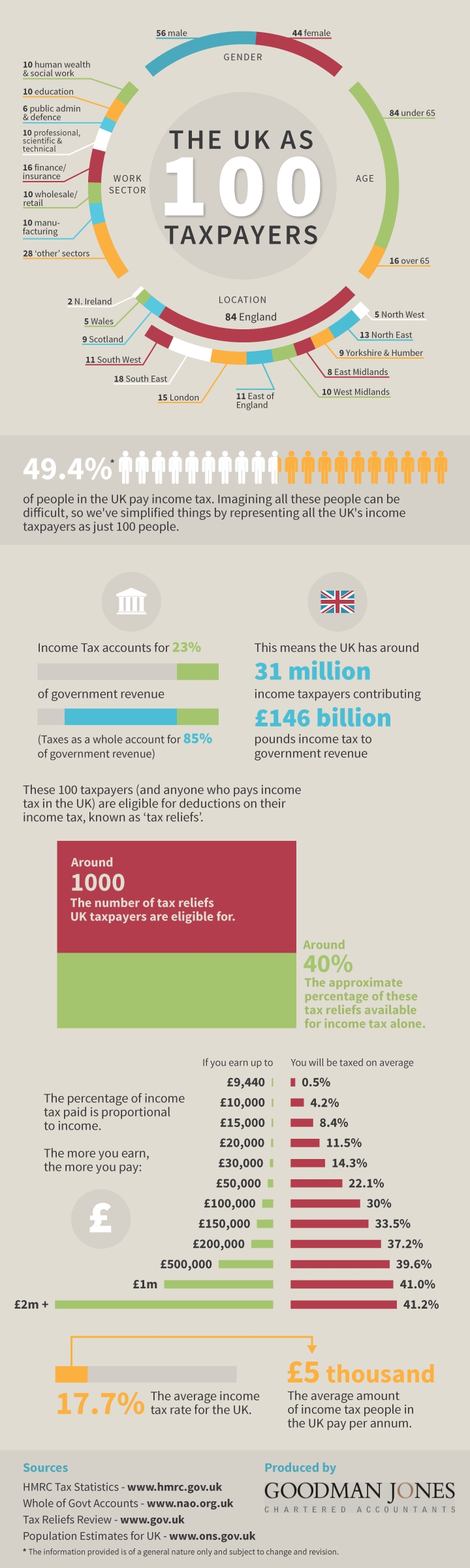
UK Income Tax – The UK as 100 taxpayers [infographic]

UK Income Tax – The UK as 100 taxpayers infographic
We have researched some data to create a visual graphic that easily shows the composition of income taxpayers in the UK. Visualising UK taxpayers as just 100 people makes it a little easier to comprehend.

Add this infographic to your website by copying and pasting the following embed code:


<img src="https://www.goodmanjones.com/blog/wp-content/uploads/2013/11/the-uk-as-a-100-taxpayers.jpg" width="540" alt="UK Income Tax – The UK as 100 taxpayers" id="the_img_link">
<a href="https://www.goodmanjones.com/blog/wp-content/uploads/2013/11/the-uk-as-a-100-taxpayers.jpg" id="the_img_link"></a>

Buy-to-let Landlords and Second Homeowners

HM Revenue and Customs are now entering stage two of their campaign to target second homeowners. True to their word, they are starting to chase landlords who have a second property and have failed to declare rental income and capital gains on sales.

The disclosure opportunity that I referred to in my April blog closed on 8 August and already we are seeing a marked increase in HMRC investigations targeting those who ignored this opportunity to bring their tax affairs up to date.

A question I often get asked as a tax practitioner is “How will the Tax Inspector find out about undeclared income?” The answer is that there are many different sources of information available to the Tax Inspector to help identify potentially undisclosed rental income. These include Land Registry records, information requests to letting agents and tenant deposit registers, to name but a few. Information sharing with overseas authorities is becoming increasingly common and we have also seen that HMRC Inspectors are increasingly making use of technology to help them, from the relatively low tech searching of the internet for property adverts to the higher tech use of demographic profiling to track likely areas and candidates for investigation.

My experience has been that a lot of individuals who are now finding themselves on the wrong end of an HMRC enquiry have got into trouble due to a head-in-the-sand approach to their tax obligations rather than a deliberate attempt to avoid paying their dues. However, HMRCs view is very much that, having given taxpayers an opportunity to disclose, they will now take a tough line with anyone who hasn’t come forward voluntarily.

If you find yourself receiving an enquiry letter from your local Tax Inspector or if you know you have income to declare, but don’t know what to do, then I encourage you to speak to your accountant as soon as possible. It is always better, as you will pay lower penalties, to disclose before HMRC comes calling. We have a great deal of experience in dealing with tax enquiries and investigations. If you need our help then please contact a member of our tax department.

The Demise of the LLP?

Over recent weeks I have heard increasing noises about the death of the Limited Liability Partnership (LLP). The commentators highlight factors such as the higher rates of income tax and the frequency by which partnerships have converted to companies. The legal profession is often cited as a further reason for the demise of LLPs. The alternative business structures (ABS) in which lawyers can now operate, permit legal firms to transact through the medium of a company. This has aided the expansion of quoted law firms and has facilitated incorporation of law firms which previously were partnerships.

Even as recently as 25 October 2013, HMRC issued tax legislation that detracts from professional practices operating as partnerships. Prior to that there has been discussion about HMRC taxing partners in partnerships as if they are employees. All of this suggests that the direction of travel is away from LLPs and into companies. Incorporation of partnerships can lead to tax planning where the partners extract value out of the partnership at a rate of 10%. There have been many tax-driven incorporations which use this technology.

Despite this I am not so pessimistic about the demise of LLPs. They are well understood and commonly used vehicles in areas other than professional practices. Even in professional practices they have one very substantial tax advantage over private companies. When it comes to succession, partners can be brought through the ranks without a tax cost. Bringing in the next generation of shareholder in a company can be very difficult to implement unless the individual included is willing to suffer a tax cost. Another benefit of partnerships is that Partnership Agreements can allocate partners rights to income and rights to asset ownership in different proportions. This flexibility is difficult to match in a company.

Finally, a non-tax reason which suggests the continued existence of an LLP is the partnership ethos. The thought that “we are all in it together” helps prevent dysfunctional behaviour that can be found in more structured, corporate, environments.

As a tax practitioner with a client base including many partnerships I do not see the demise of the LLP and am looking forward to a long and fruitful career advising them.