
Tag Archives: Making Tax Digital

Old HMRC portal for filing quarterly or monthly returns will close on 1 November

Making Tax Digital (MTD) for VAT is compulsory for all VAT registered businesses, for returns starting on or after 1 April 2022. This means returns must be filed using MTD software and digital VAT records must be kept.

From 1 November, the old HMRC portal for filing quarterly or monthly VAT returns will be

switched off. Businesses that file annual returns will still be able to use their VAT online account until 15 May 2023. HMRC will be writing to businesses that have not yet signed up to MTD for VAT.

Making Tax Digital: What’s changing?

Much has been said about Making Tax Digital and more will be said over the coming months, but the changes being introduced in the first phase from April 2019 are actually fairly straightforward and will only affect VAT registered businesses whose turnover exceeds the VAT registration threshold which is currently £85,000.

Making tax digital for VAT

What is Changing?

Currently VAT registered businesses are required to submit VAT Returns, usually on a quarterly basis, via the HMRC online portal. This requires the completion of the nine boxes of the VAT Return, which can be entered manually or electronically onto the portal and then submitted.

There are still some instances where businesses may submit VAT Returns in paper format, but these cases are relatively rare and if you currently fall into one of the categories that can file by paper then this is not expected to change after April 2019.

With effect from 1 April 2019, VAT registered business with turnover over £85,000 will be required maintain the business records in an electronic format and for the VAT return information to be electronically transmitted to HMRC. There will no longer be an option to manually complete the VAT boxes on the HMRC portal.

For most companies they should be able to process and submit their VAT return as HMRC require without the need for adjustment. It is expected that accounting software providers will  upgrade their systems to automatically incorporate the necessary changes for this to happen.

If you are preparing your accounts on an accounting system, then you should contact your software supplier to ensure that the system is being upgraded before April 2019.

Who needs to do something before April 2019?

If you do not currently use a commercial accounting package to produce your VAT records, for example you are using spreadsheets or keeping paper records, then you will need to change the way you prepare your records for the purpose of submitting VAT returns.

HMRC have confirmed that keeping records on spreadsheets will meet the requirement for electronic record keeping, but it will be necessary to acquire some bridging software to bridge the gap between your spreadsheets and HMRC’s portal which you currently do manually. HMRC have not yet provided any information on available bridging software but we will update this article to provide a link to further information when we become aware that it is available.

If you currently produce your VAT records manually on paper then you will need to change your processes so that you keep your accounting records in a digital format. This may include using spreadsheets or buying accounting software.

Useful links

HMRC list of software suppliers

HMRC VAT notice 700/22

Extending Making Tax Digital to Income Tax

HMRC are keen to point out the benefits of making tax digital to businesses and individuals and there will indeed be some benefits. However, it is also fair to say that one of the main motivations behind the introduction of quarterly digital reporting of business records and income details was to target what the Government perceived as a tax gap particularly in the small business space.

Due to resourcing, HMRC have focused on VAT registered businesses in the first instance, but still plan to roll out the next phase by April 2020 which will bringing small businesses and landlords’ income tax into the arrangements. Business may be required to submit their accounting records quarterly during the course of the year and then make an annual end of year submission to take into account any accounting and tax adjustments.

Whilst we don’t know for certain that this will be introduced as planned by April 2020, HMRC are currently running a voluntary pilot scheme.

Making Corporation Tax Digital

The original roadmap for making tax digital included corporation tax. As yet there have been no announcements on this but provided making tax digital for VAT and Income tax are successfully introduced then Corporation tax will surely follow.

Making Tax Digital

Making Tax Digital

HMRC have recently issued 6 consultation documents outlining their proposals for a fundamental change to way they want individuals and business to submit their tax return information. If implemented as planned this will be the biggest change to the tax system since the introduction of Self-Assessment 20 years ago.

Quarterly basis

The proposals are to move to a more electronic based system where as much information as possible is automatically gathered directly from third parties. The taxpayer will then only be required to update information which cannot be obtained automatically from elsewhere.   However, these updates will have to be made on a quarterly basis instead of the current system of providing information after the year end on the annual tax return.

By embracing the technology now available, HMRC hope to improve the tax system by:

  • reducing the costs of assessing and collecting tax
  • cutting out duplication of work for the taxpayer by avoiding the need to provide information already held by HMRC
  • reducing the time delay between the receipt of income and the payment of tax

HMRC are eager to point out the benefits of the new system to the taxpayer, but if the proposals are introduced as planned the reality will be that many people will pay tax much earlier than they do now and their compliance burden will increase.

What do you think?

We will be responding to HMRC’s consultation and making representations on our clients behalf and invite you to let us have your views.

See our summaries of each of the consultations:

Please email us on MTD@goodmanjones.com with your views.

Making Tax Digital: Simplified cash basis for unincorporated property businesses

MTD

The government is consulting on introducing the choice to use the simplified cash basis currently available to some unincorporated traders. As for traders, adoption of the cash basis would be optional. As the cash basis rules would be designed with the simplest businesses in mind, they may not be the right choice for all eligible unincorporated property businesses. Landlords will therefore be free to choose the basis which works best for their business.

The cash basis method of calculating tax works on a cash in, cash out basis. Income is only recognised when it is received and expenses when they are paid.
At present, property businesses must use the same accountancy rules as most other businesses, including trading businesses, when they work out their profits. Calculation of profits must be done in accordance with Generally Accepted Accounting Practice (GAAP). GAAP uses the accruals basis (sometimes referred to as the earnings basis) which recognises income earned and the expenses incurred in earning that income in a period (whether or not the amounts have actually been received or paid).

Who does this apply to?

The proposals are relevant to individuals and partnerships of individuals with unincorporated property businesses. It is proposed that the cash basis would also be available to eligible non-UK resident landlords.

Does not apply to

The proposals do not apply to company property businesses, trusts, holders of units in unit trusts, real estate investment, trusts, and partnerships with corporate members, limited liability partnerships and other similar, more complex entities would not be able to use the cash basis.

Types of businesses

Unincorporated property businesses can take several different forms; a UK property business or overseas property business could include residential or commercial properties, furnished holiday lettings or receipts to which the rent-a-room scheme applies.

General Principles of the proposal

  • The cash basis would not change the underlying principles of what expenditure is allowable in calculating the profits of a property business. As with the accruals accounting basis, expenditure must be incurred wholly and exclusively for the purpose of the property business to be tax deductible and withdrawal of cash from the business will not affect the calculation of profits. Adopting the cash basis would simply change the time when deductible expenditure is recognised.
  • As with the current rules, those amounts which would normally be chargeable under the Capital Gains regime would continue to fall within that regime and not be property income for income tax purposes, for example, premiums on long leases or the sale of the property.
  • Some receipts which are not treated as property income receipts under the accruals accounting basis would be income receipts under the cash basis, for example, the proceeds from the sale of a van used for the property business where the cost has been deducted when initially purchased. Also, some events, such as a change of use of such an asset from business to personal use, would require the current value of the asset to be treated as an income receipt.

The cash basis should also help property businesses to calculate their taxable property business profit for any given period therefore making the move to quarterly digital updates as smooth as possible.

No “relevant maximum” for eligible unincorporated property businesses

One of the eligibility criteria for the cash basis for trading income is that the total cash basis receipts for all trades carried on by a person in a tax year does not exceed the “relevant maximum”. The relevant maximum amount for a tax year is the VAT registration threshold at the end of that tax year (£83,000 for 2016/17) or twice the VAT registration threshold for Universal Credit claimants. The government is not intending to impose a relevant maximum limit on entry into the cash basis for eligible unincorporated property business. The eligibility criteria will instead only be based on whether the unincorporated property business is carried on by an individual or partnerships of individuals.

Restriction of finance costs

The cash basis for trading income has a restriction on interest expense, with a maximum of £500 allowable as an expense for interest and other costs paid on cash borrowings. Under the cash basis for unincorporated property businesses, there would also be a restriction on interest expenses and other costs paid on cash borrowings. For those with residential properties, relief for interest will continue to be restricted to the basic rate of income tax, in accordance with the restriction of finance cost relief for individual landlords introduced in the Summer Budget 2015.
Regardless of which method is used whether the accruals or cash basis, the same amount of relief for interest (and other borrowing costs) on mortgages should be available. Any difference would purely be the timing of the relief.

Summary of Consultation Questions

  • Question 1 Do you feel there should be a relevant maximum limit imposed for eligibility for the cash basis for unincorporated property businesses? If so, what should this limit be and why?
  • Question 2 Do you feel there is any reason why the cash basis should not be optional for all eligible unincorporated property businesses?
  • Question 3 Would you want to opt in for each of their property businesses separately (for example, UK property business and overseas property business) or would they prefer to choose whether to opt in for all their property business
    income or none of it?
  • Question 4 Does the above advice give you enough information to decide whether or not to use the cash basis with/without (please indicate) professional advice? If not, what else would you need to know about the new rules?
  • Question 5 Does a regime that allows for individuals letting jointly, not in partnership, to separately opt to report using the cash basis present particular difficulties or issues
  • Question 6 Should eligibility for the trading cash basis affect eligibility for the cash basis for unincorporated property businesses? If so, do you have any suggestions on what this interdependence should be?
  • Question 7 Would only recognising deposits that landlords are entitled to keep at the end of a tenancy create unnecessary complexity?
  • Question 8 Do you feel there is anything which has not been considered which could make the cash basis as simple as possible for landlords?
  • Question 9 Are you aware of any risks that the cash basis for
    unincorporated property business could present which could lead to the avoidance or reduction of liability to income tax? If so, please provide details.
  • Question 10 Do you have any comments, not already provided, on any aspect of the proposal?
  • Question 11 If the government introduces a simpler tax system for unincorporated property businesses, please provide details of how this will affect your business. This should include details of both the expected one-off and ongoing benefits and costs of:
    a) Familiarisation with the new basis and updating your software or systems.b) Not having to keep accruals accounts and prepare calculations in accordance with UK GAAP.
  • Question 12 Please tell us if you think there are any other benefits or costs not covered in the summary of impacts.

What do you think?

We will be responding to HMRC’s consultation and making representations on our clients behalf so please let us have your views by emailing MTD@goodmanjones.com.

Other areas covered by the consultation

This is only one part of the consultation.  See summaries of the other areas here.

Making Tax Digital: Voluntary Pay As You Go

MTD

Businesses, sole traders and landlords who keep digital records would be able to budget towards their tax bills by having the facility to make voluntary payments on a PAYG basis in respect of expected IT, NIC and CGT liabilities from 1 April 2018. The method will also apply to VAT from April 2019 and CT for unincorporated businesses from 2020.

The facility to pay these taxes voluntarily as you go will not change the normal due dates for each tax liability, so the usual non-voluntary tax payments will still be due on their respective deadlines if the amounts are not already covered by voluntary payments.

HMRC will allocate each voluntary payment against any tax liabilities as they become due. The method of allocation will be clearly set out on the digital account to give an integrated picture across all of a customer’s taxes. This will prevent non-payment of a specific tax.

Smoothing out cash flow

It is hoped that PAYG will ensure there are no shocks or problems down the line, and could thereby improve cash flow and reduce exposure to late payment penalties and interest charges, particularly if repayments are able to be made earlier.

HMRC want to increase flexibility for its customers by allowing them to decide how often and what amount they want to pay at any time: choices which can be amended if needed.

Digital Account

They may also pay at the same time as they submit an update on their digital account, or more regularly by direct debit. HMRC wish to make sure that these regular sums will be clearly visible on a customer’s account and making any changes will be a simple process.

They aim to protect contributions towards benefit entitlements, ring fence sums for onward transmission (i.e. in relation to VAT) and review the appropriation order where more than one tax is due and payments made are insufficient to cover them all.
HMRC anticipates that there will be a digital facility to request a repayment of an unallocated voluntary payment if a customer’s circumstances change. However, a repayment may be restricted where a tax liability will shortly become due for payment. Comments are invited on whether this is a reasonable approach.

Security

Minimum/maximum payment limits may be needed for security, as well as anti-fraud and money laundering provisions, especially if a bank account is linked up to the digital account.

With regard to payments on account, HMRC envisage that the digital account would compare the estimated tax liability shown by the updates with the actual payments due, and recommend either making further payments or the option to reduce POAs.

They also wish for customers to be able to elect for overpaid credits to be held on their digital account as a voluntary tax payment rather than being repaid to the customer.

In this case, no overpayment interest would then be payable, but otherwise, current interest rules on under/overpayments will continue to apply, subject to the consultation responses.

Partners could see their estimated liabilities flow through from a partnership’s own account.

Third parties may make a payment on behalf of a customer using the correct reference, but repayment to a third party may be an issue.

Summary of Consultation Questions

  • Question 1: Do you see any challenges with the voluntary payments process described? Do you think there are alternative options that should be considered, and if so, what are these?
  • Question 2: Do you have any views or suggestions on the display of voluntary payments in the digital tax account?
  • Question 3: Should there be a ‘period of grace’, and if so, what period would be appropriate to allow for separate payment of an amount becoming due?
  • Question 4: Do you have any general comments to make on the allocation of voluntary payments?
  • Question 5: Do you foresee any problems with HMRC’s intended approach to the allocation of voluntary payments?
  • Question 6: What improper or inappropriate use of the repayment facility do you think there may be, and what rules do you think should be applied by HMRC to stop that happening?
  • Question 7: Do you agree with a restriction on repayment shortly before a liability becomes due, and if so, what period or terms of restriction do you think should be put in place?
  • Question 8: Do you have any views or evidence on whether, and how, HMRC should revisit the sums paid as payments on account to match more closely to the sums being reported under MTD?
  • Question 9: Do you have any views or suggestions on customers’ ability to elect for overpayments to be held as voluntary credits?
  • Question 10: What are your views on how voluntary payments might work for partnerships? Do you think partners will see the convenience of direct payment towards their total liabilities as outweighing a loss of a limited amount of confidentiality?
  • Question 11: Do you think there are any special considerations that should apply to third party voluntary payments?
  • Question 12: What additional processes or measures would make customers feel more confident about making voluntary payments?
  • Question 13: Do you have any suggestions for the basis on which earlier repayments could be reasonably claimed?
  • Question 14: Please tell us if you think there are any other costs or benefits not covered in the summary of impacts, including any detail you may have.

What do you think?

We will be responding to HMRC’s consultation and making representations on our clients behalf so please let us have your views by emailing MTD@goodmanjones.com.

Other areas covered by the consultation

This is only one part of the consultation. See summaries of the other areas here.

Making Tax Digital: Tax Administration

MTD

The HMRC Tax Administration consultation document is consulting on four areas:

  1. Compliance
  2. Late submission penalties
  3. Late payment sanctions
  4. Interest

This consultation does not include other aspects of tax administration. Changes to inaccuracy penalties will be covered in subsequent consultations. There is no proposal to introduce a power to enable HMRC to enquire in-year into regular updates, nor increase the overall number of compliance interventions as a result of these updates.

Compliance

There will be a new obligation for certain customers to keep records digitally on software that links to and updates HMRC. Existing record keeping legislation will need to be modified to reflect those proposals.

HMRC want a new power to enquire into the regular updates and check any of the information that is included in a customer’s End of Year declaration and is used to calculate their tax. The customer’s digital records may form part of any enquiry.

HMRC propose a power to make determinations of End of Year declaration as with Tax Returns.

They propose to replicate the power for HMRC to correct obvious errors made in the End of Year declaration.

In MTD business customers will need to provide regular updates. This consultation proposes a new way of addressing failures to provide regular updates and carry out the End of Year declaration.

Penalties

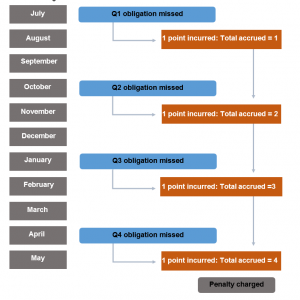
“Instead of applying penalties to each failure, we propose a much more gradual model whereby each failure would attract penalty points. Only once the points reach a set level would a penalty be charged.”

Once a penalty has been incurred, the customer would incur further penalties if they failed to meet their subsequent submission obligations. The points total would remain unchanged until such time as a sustained period of compliance caused it to be re-set to zero.

The points total would be re-set to zero after the customer has achieved 24 months of compliance with their submission obligations.

See Diagram 1 for an example of how points based penalty regime would work.

Diagram 1
Appendix 1

HMRC propose 12 months as an appropriate length of time to allow customers to become familiar with the new obligations before the new penalty regime comes into effect.

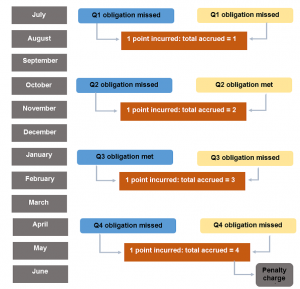
Many customers are subject to a number of separate obligations. For example, an individual in business and having employees would have to provide quarterly updates and finalise those updates after the end of the tax year for their own Income Tax purposes and regularly submit PAYE information about their employees via Real Time Information (RTI). In practical terms, all submissions due in the same calendar month would have to be treated as being due “at the same time”.

The government would explore options for taking account of the customer’s compliance history across all of the taxes they are involved with in developing a new late submission penalty.

See Diagram 2 for an example of how this would work.

Diagram 2
appendix 2

The basic points-based penalty would be unsuitable for occasional obligations (such as the filing of Inheritance Tax returns). In these cases it is unlikely that points incurred could act as a warning system to encourage a return to compliance.

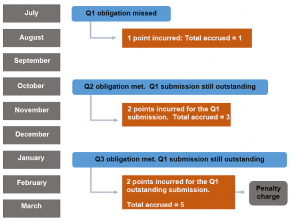
An alternative to points based system is the Escalator Model – see Diagram 3

Diagram 3
Appendix 3

The basic model is designed to be simple but it lacks an incentive for those who have missed making a particular submission to remedy that failure. One way to address this would be for customers to incur further points to reflect the fact that a submission was still outstanding. This would focus the customer’s attention on remedying what has already gone wrong as well as encouraging good compliance in the future.

The escalator model might be unsuitable for monthly obligations because points could accumulate very quickly and the customer might have insufficient time to heed and act upon the warning.

Late payment sanctions

There are two proposals which are:

A. The use of penalty interest to be charged on customers who fail to pay in full
within fourteen days of the due date, or who before that date have failed to enter into arrangements to pay over an agreed period to which they then adhere.

B. A revision of existing legislation to deliver an aligned penalty regime for income tax, VAT and corporation tax per Models 1 & 2

Model 1 – Introduce a model based on the Income Tax late payment penalty regime for each of the three taxes coming into scope of MTD.

Model 2 – Introduce a tapered system where the late penalty percentage rate increases the longer the debt remains outstanding. This would encourage customers to fulfil their payment obligations sooner, before a higher penalty rate is reached.

Late payment interest

HMRC propose to continue with the current rules for Income Tax and Class 4 NICs when MTD starts in April 2018.

Summary of consultation questions from HMRC

  1. Do you agree that compliance legislation should be amended to replicate current enquiry powers into the Self Assessment return to the End of Year declaration?
  2. Do you agree that current HMRC and customer safeguards should also be maintained?
  3. Are there any other options for preserving HMRC’s current enquiry powers in MTD?
  4. Do you agree with the proposed approach to replicate HMRC’s compliance powers for determinations, corrections, information powers and discovery assessments?
  5. Do you have any other comments on how compliance powers need to change to transition to MTD?
  6. Do you agree that 12 months is an appropriate length of time to allow customers to become familiar with the new obligations before the new penalty regime comes into effect?
  7. Do you agree that the period to wipe the slate clean should be 24 months? If not, what other period would be appropriate?
  8. We invite views on the design principles outlined for the points-based penalty. For example, do you consider there are any further elements to build in to this basic model?
  9. At what stage for each of these different submission frequencies should points generate a penalty?
  10.  We would welcome comments on whether existing penalties are sufficient to support compliance with occasional filing obligations. If not, what more is needed?
  11. Do you agree that, in principle, a single points total that covers all of the customer’s submission obligations is the right approach?
  12. Do you agree that the points based proposal outlined in is the right way to operate a single points total? If not, what alternative would you suggest that ensures the design of the penalty is kept simple?
  13. We welcome views on whether the escalator model would be a more effective way of aligning with HMRC’s customer focused fairness based principles?
  14. Do you agree that a fixed amount penalty is appropriate?
  15. Should the amount of fixed penalty reflect the size of a business?
  16. Do you agree that points should only become appealable when they have caused a penalty to be charged?
  17. Do you agree that 14 days is an appropriate length of time to allow customers to either pay in full, or make arrangements to do so before penalty interest is charged?
  18. Do you think that charging penalty interest is the right sanction for noncompliance with payment obligations?
  19. Are there other commercial models that might be appropriate for us to consider?
  20. We invite views on the design principles outlined for penalty interest. For example, do you consider there are any further elements to build into this proposal?
  21. Does model 1 or model 2 best meet the government’s objective of providing a fair and proportionate response to late payment of tax?
  22. Do you agree that the timing of late payment penalties should change to reflect the frequency of payment due dates?
  23. We invite views on the design principles outlined for late payment sanctions. For example, do you consider there are any further elements to build into these proposals?
  24. Which proposal best meets the design principles?
  25. Should the current interest rules for Income Tax and Class 4 National Insurance contributions continue to apply in MTD?
  26. Do you have any initial comments about aligning interest rules across taxes?
  27. Please provide details of how the proposed administrative changes will affect you, including details of any one-off and ongoing costs or savings.
  28. Do these administration proposals have a significant or disproportionate impact on groups with legally protected characteristics, as recognised in the Equalities Act 2010?

What do you think?

We will be responding to HMRC’s consultation and making representations on our clients behalf so please let us have your views by emailing MTD@goodmanjones.com.

Other areas covered by the consultation

This is only one part of the consultation.  See summaries of the other areas here.

Making Tax Digital: Transforming the tax system through better use of information

MTD

Digital Tax Accounts

HMRC want to make better use of Digital Tax Accounts to include information from third parties. This will result in outstanding tax being collected ‘in-year’.

The current position

HMRC currently obtains third party information from banks, employers and government departments. However HMRC still ask customers to collate this information and report it on a Tax Return. This means that the customer will only find out about under/over payments after the end of the tax year.

HMRC believes that PAYE does not accurately reflect the current job market & lifestyle of customers. Often there are second jobs, casual work and fluctuating incomes. The aim therefore is to identify and collect more tax throughout the tax year.

Changes in the next 2 years

Oct 16 – Starting with customers whose interest is above the Personal Savings Allowance, this will be included in PAYE codes based on an estimate from previous years (already used for higher/additional rate).

Apr 17 – PAYE information will be used during the tax year to calculate whether the tax is correct and notify customers through their Digital Tax Account if not. Under/over payments will then be collected throughout the year by HMRC automatically instructing employers’ payrolls, in order to prevent these accruing at the year end. More admin burden will fall on employers’ with the increase in P6 notices but HMRC hope that these will be automatically updated on payroll software. However employers’ will also have to deal with more queries arising from employees about their tax calculations.

Apr 18 – Include common income types in the in-year calculation – starting with bank interest so that only a small number of customers will be affected first. The default position will be to collect any tax owed via PAYE – but customers can opt out and pay in one lump sum. State pensions could be next on the list to include in the in-year calculations.

If it is not possible to collect the tax owed via PAYE, customers will be advised of the projection of tax due for the year end through their account. In theory, this tax amount will be updated throughout the year based on real time updates of bank interest etc.. They can make payments through ‘Pay As You Go’ rather than one lump sum.

Concerns – quality of information

HMRC advise that they will only use information to calculate tax that they are confident is correct. Customers cannot change information such as the amount of bank interest on their digital tax account. They will need to contact the bank and get it resolved. This places the burden on the taxpayer. Whilst a query arises, they can tell HMRC this is happening and HMRC will not use this information to calculate any tax. If the query is not resolved at the year end, HMRC will use estimates to produce the tax assessment for what they believe is correct.

Jointly held assets will be assumed to be split equally unless HMRC are told otherwise. There is the scope to look at whether third parties should be telling HMRC in what proportions assets are held.

Future ambitions

HMRC wants to reduce to a minimum the amount of information customers provide to them. The next steps could be dividends/ share information and property information obtained directly from third parties.

Conclusion

HMRC want to increase the collection of third party information in order to reduce the admin burden for taxpayers. They believe that an up to date projection of tax to pay at the year end will help budgeting.

The consequences however will be:

  • those less able to ‘get online’ will be left at a disadvantage by having to wait longer to know their tax bill
  • if third party information is incorrect, the burden will be on the taxpayer to sort it out
  • any incorrect third party information could be included in the year end ‘estimate’ and paid by the client under ‘Pay As You Go’ – potentially by direct debit
  • if third parties tell HMRC how jointly held assets are owned, does this raise questions of privacy/security
  • the admin burden will fall on employers to keep up with employee queries on tax calculations
  • as HMRC expands their idea of what can be collected via third parties: pensions, rental income, dividends there is more scope for errors and the burden is on taxpayers to find the time to sort it out. Otherwise they will be paying ‘estimated tax calculations’ automatically from their bank account (via direct debit).

Summary of Consultation Questions

  • Question 1: Where events during the year result in a change to a customer’s tax projection, what is the appropriate format and regularity of notification that HMRC should send to employers and customers?
  • Question 2: Have you any suggestions for how we present third party information in your digital tax account in a way that will make it easier for you to understand your tax?
  • Question 3: If you are concerned over privacy impacts of HMRC’s plans for improving how we use third party information we already receive, do you have any suggestions for how these concerns could be resolved?
  • Question 4: If a third party information provider is aware of how the ownership of a joint asset is split, do you think the third party provider should inform HMRC?
  • Question 5: Information providers will want to keep their customers fully informed about the information they provide to HMRC (and have a responsibility to do so under the Data Protection Act 1998). Do you think there should be a standard approach, or should information providers design the best approach to meet the needs of their particular business and customers?
  • Question 6: Do you have any preferences for how you would like to be kept informed by third party information providers?
  • Question 7: Do you think there are any additional safeguards we should consider in relation to the protection and use of third party information by HMRC?
  • Question 8: Do you agree with the principles we have set out for how information queries should be resolved? What are your expectations for how this would work in practice?
  • Question 9: How can we best align HMRC’s third party information requirements with information provider’s circumstances? For example, with other standards information providers need to meet; other regulatory change; internal business processes and requirements.
  • Question 10: If you currently provide information to HMRC at year-end what would be the impact of moving to a more frequent in-year process, assuming that HMRC is able to align to your circumstances as described above?
  • Question 11: We have given you a high level introduction to the standards necessary to make the exchange of data efficient and dependable. Do third party providers foresee any specific challenges in adopting standards along these lines?
  • Question 12: What opportunities do current and potential information providers and software providers see for a stronger partnership with HMRC to enhance our customer experience?
  • Question 13: What new sources of third party information would most enhance the customer experience and best contribute to the aim of ending the tax return for all?
  • Question 14: How can we best open up discussions and begin to work with new potential information providers who are not currently providing information to HMRC on a regular basis?

What do you think?

We will be responding to HMRC’s consultation and making representations on our clients behalf so please let us have your views by emailing MTD@goodmanjones.com.

Other areas covered by the consultation

This is only one part of the consultation.

Making Tax Digital: Bringing business tax into the digital age

MTD

HMRC want businesses (including property rental businesses) to submit accounting records quarterly with a post year-end submission which reconciles to the annual accounts.

The Current Position

At present HMRC receive accounting information annually through the tax compliance process. This is either through the partnership tax return, an individual’s tax return or attached to a corporation tax return. HMRC do not have a feel for levels of income and expenses, and therefore tax receipts until these are submitted.

The tax return filing window for the unincorporated business opens on 6 April and closes on 31 January. A considerable percentage of filings are made in the last two months of the window and therefore it is not until nine or ten months after the end of the tax year do HMRC gain a reasonable view on profitability and therefore the quantum of income tax receipts that they can expect.

Although the largest corporate taxpayer pays tax on account during their year, the vast majority of companies pay tax nine months after the end of their accounting period. The tax return filing deadline for all companies is 12 months after the end of their year ends. As with income tax this makes it difficult for HMRC to project tax receipts.

Proposals

HMRC believe that the vast majority of taxpayers already have digital interactions with HMRC. All companies are required to interact digitally and the consultation document estimates that 92% of unincorporated businesses use the internet and digital tools. HMRC therefore believe that all sole traders, partners in partnership, landlords whose annual income is in excess of £10,000 and companies should therefore be subject to the requirement for digital interactions.

Quarterly reporting

The proposal is that these parties produce quarterly reports which provide accounting information to HMRC. Within nine months of the end of the accounting period a final report is submitted which adjusts the previous reports to reflect year end matters, such as accruals. From HMRC’s perspective this allows for a better understanding of UK profit flows and therefore a better understanding of tax receipts.

The consultation is at pains to highlight that quarterly reporting will be for the benefit of taxpayers. It states that the taxpayer will “be able to view an up to date picture of their tax affairs, providing greater certainty about tax due and entitlements …. and this will …. help businesses manage their affairs effectively and to understand their tax position more easily.

Many businesses have told us they want more certainty over their tax bill and don’t want to wait until the end of the tax year, or often longer, to find out how much they have to pay”.

The proposals are that the reporting will commence from 2018 for unincorporated businesses and companies will be required to report quarterly from 2019.

Concerns

The concerns already identified are:

  • Businesses already employ advisers to identify potential liabilities in advance of payment dates. HMRC’s perceived benefit to taxpayers is therefore illusionary.
  • Unincorporated businesses do not necessarily have an obligation to interact with HMRC electronically as they can file income tax returns in paper form. Why should those businesses be forced to convert to electronic submissions?
  • Some taxpayers do not need advance forecasting of liabilities. If the primary benefit of quarterly reporting is for the taxpayer then those taxpayers who do not want this benefit should be able to elect out of quarterly reporting.
  • It is unusual for business profits to accrue even over the four quarters and therefore the belief that tax liabilities can be identified throughout the year is not correct.
  • There is no legal requirement for quarterly accounts to be prepared and therefore why should a business incur costs for HMRC filings?
  • HMRC have already confirmed that they will not be providing the necessary software for interactions. If this remains the case then how can HMRC guarantee that developers will issue free software? Who will pay for the costs of developing and maintaining software required to produce quarterly accounts or the software to make submissions?
  • The quarterly filing dates may not be co-terminous with the VAT filing dates. Should they be aligned?
  • The consultation assumes that discretionary (often year-end) matters such as bonus posts are already known in advance. This is simply not the case.
  • The proposals are a “big-bang” change in process. Why will HMRC not have a period of piloting the proposals with a sample group of taxpayers?
  • Incorporated businesses have a greater degree of interaction with HMRC than unincorporated businesses. Why are the proposals suggesting that the order of implementation is the other way round?
  • The consultation document suggests that the changes will reduce the tax gap and contribute £945m to the Exchequer by 2020/2021. Many believe that this is the real reason that HMRC are pressing ahead with these proposals. If this is the case then it is inaccurate for HMRC to sell this process as being for the benefit of the taxpayer. Again those taxpayers who do not wish to reap this benefit should be able to elect out of it.

Summary of Consultation Questions

Acquiring Digital Tools

  • Question 1: What are the challenges for businesses that currently keep their records on paper or simple spreadsheets in moving to an integrated software package for record keeping, and what further measures or support would help businesses to meet these challenges?
  • Question 2: What information and guidance would you find helpful in choosing the appropriate software for your business?
  • Question 3: What types of business should a free software product cater for? What functionality would be necessary in a free software product?
  • Question 4: What level of financial support might it be reasonable for the government to provide towards investing in new IT, software or training, to whom should such support be aimed, and what is the most appropriate form for delivering such support?
  • Question 5: What other forms of support would help to make the transition to Making Tax Digital easier?
  • Question 6: What facilities would make it easier and more secure for businesses to enrol for Making Tax Digital and use software regularly?

Digital record keeping

  • Question 7: Do you have any comments about the practicalities of keeping evidence of transactions and trading when using digital tools?
  • Question 8: Do you agree with the minimum transaction data fields proposed for trading businesses, including retailers? What other data fields might the record keeping software usefully include as a minimum?
  • Question 9: Do you have any comments about reflecting the current VAT requirements in MTD-compatible software?
  • Question 10: Do you have any comments on the additional data capture requirements for property income and capital gains?
  • Question 11: What should the minimum categorisation in the software be? Would additional sub-categories be useful?
  • Question 12: Do you have any comments on how businesses should reflect transactions and expenditure with non-deductible elements in the software?
  • Question 13: What prompts and nudges would be most useful to businesses?

Establishing taxable profit

  • Question 14: Do you agree that businesses should have the choice as to when to record accounting adjustments?
  • Question 15: Do you agree that business should have the flexibility to reflect reliefs and allowances when they choose?
  • Question 16: What do you consider is the most appropriate approach to reflecting the effect of the personal allowance on an individual’s taxable business profit?
  • Question 17: Is this the right treatment of partnerships? Are there any additional partnership issues that need to be considered?
  • Question 18: Is this the right treatment of individuals who receive income from property, let jointly?
  • Question 19: Is this the right treatment of subcontractors within the Construction Industry Scheme? Are there any other CIS issues that need to be considered?

Providing HMRC with updates

  • Question 20: Do you have views on how detailed the summary data in the updates should be, and whether the level of summary data should be different depending on the size of the business?
  • Question 21: Do you have any comments on the categorisation of summary data in the updates?
  • Question 22: Do you have any views on what VAT data the updates should contain? Do you have any views on the advantages or disadvantages of including VAT scheme data in the updates? If so, which schemes and which data should be included in the updates?
  • Question 23: What flexibility around update cycles would be useful?
  • Question 24: Do you agree businesses should be allowed one month to submit their update? Would any problems be caused for VAT registered businesses by standardising the time limit for updates for all taxes?
  • Question 25: What method of deriving a business’s start date for providing updates under Making Tax Digital would be most straightforward for businesses?
  • Question 26: Do you wish to make any comments about the operation of ‘in-year’ amendments to updates for the purposes of profits taxes or VAT?

‘End of Year’ Activity

  • Question 27: Do you agree that the process of finalising the regular updates should be separate to the regular updates?
  • Question 28: Do you agree that businesses should have nine months to complete any End of Year activity?

Exemptions

  • Question 29: What criteria should be applied in determining whether to exempt a particular business or business type from the requirements of MTD?
  • Question 30: Should charities be exempt from the requirements to maintain digital records and to update HMRC at least quarterly?
  • Question 31: Should trading subsidiaries of charities be exempt from the requirement to maintain digital records and to update HMRC at least quarterly?
  • Question 32: Should CASCs be exempt from the requirement to maintain digital records and to update HMRC at least quarterly?
  • Question 33: Should businesses within the insolvency process be included within the scope of the requirement to maintain digital records and to update HMRC at least quarterly; and are any special arrangements required for this group?
  • Question 34: Which businesses should be included within a consistent definition of persons ‘unable to engage digitally’?
  • Question 35: Do you agree that £10,000 annual income is an appropriate threshold for exempting businesses from Making Tax Digital? Do you have any other comments on how the exemption should operate?
  • Question 36: Should the smallest unincorporated businesses that are not exempt have an extra year to prepare for Making Tax Digital? How should eligibility for this group be defined?
  • Question 37: Do you agree that the principles set out in Fig. 7.3 are the right ones to use in determining eligibility for an exemption? Are there any additional principles which should apply?
  • Question 38: Which additional groups (if any) should be exempt from the requirements to maintain digital records and to update HMRC at least quarterly?

Initial Assessment of Impacts

  • Question 39: Do you believe that there is the opportunity for MTD to create savings for your business? What percentage time reductions would you see from the following?
    a) Targeted software tax guidance (prompts and nudges to get information right first time).
    b) Gathering, collating and inputting data.
    c) Reporting obligations through providing regular updates.
    d) Any other potential savings not covered above.
  • Question 40: Do you think there are different business sectors or sizes likely to benefit more from MTD? If so, what would these be?
  • Question 41: What costs might you expect your business to incur in moving to the new regime? Please provide details of the costs for:
    a) Time spent in your business familiarising with the new processes and conversion to these new processes.
    b) Software expenditure costs (new or upgrading software).
    c) Hardware expenditure costs (purchase of a computer, tablet device, etc).
    d) Any other costs which are not covered above.
  • Question 42: Do you expect that your business will incur additional on-going costs as a result of these changes? Please provide the details of the additional costs or time for:
    a) Additional support from your accountant or tax agent.
    b) Additional time spent gathering, collating and inputting data.
    c) Additional time reporting obligations through providing regular updates and any end of year activity.
    d) Any other costs or time spent not covered above.
  • Question 43: Will particular businesses (e.g. partnerships) experience more difficulty in adapting to the changes? If so, please provide details, including any additional one off costs or ongoing costs.
  • Question 44: If you are an agent, please provide details of how these changes will impact on your own business, including details of any one-off and ongoing costs or savings. How do you perceive that these changes might affect your clients?

What do you think?

We will be responding to HMRC’s consultation and making representations on our clients behalf so please let us have your views by emailing MTD@goodmanjones.com.

Other areas covered by the consultation

This is only one part of the consultation.  See summaries of the other areas here.

 

Why the HMRC’s digital transformation will make the UK even more open for business

The roll-out of digital tax accounts will help companies to manage their taxes, access information and resolve queries more quickly.

Overseas companies seeking to open and operate subsidiaries in the UK will find this easier to do than ever before.

It can be difficult to start a new business in many countries – even in Europe. Personal visits to government offices may be required, wasting hours to submit or obtain company papers. Original hard-copy documents require certification and apostille – an often-nonsensical process as the information required is freely available to download from government websites. I’ve lost count of the times an exasperated client has shared with me their aggravations of dealing with overseas business affairs.

Open for business

Yet the UK government is keen to increase foreign investment and it is easier to do business here than any other major European economy.

The UK welcomes investors with its skilled labour market, a lower level of bureaucracy and a language that has become the world’s standard for commerce.

Tax policy provides a big competitive advantage for Britain. Corporation tax in the UK is charged at just 20%, which is one of the lowest rates in Europe.

Digital transformation

The UK’s tax authority, HMRC, is becoming a digital organisation. Tax returns are already made online and all taxpayers – personal and corporate – are being given their own digital tax accounts.

The rolling-out of digital tax accounts is being done in phases for completion by 2020. By then the tax authority will have moved to a fully digital tax system.

Using these digital accounts, all payments and correspondence with the tax authority will be conducted online. This will make it easier to deal with the tax system and taxpayers will get more up-to-date and reliable information from the tax authority, along with faster responses to queries.

Digital tax accounts will bring together into simple statements all the various taxes due – which for a company include corporation tax, national insurance and VAT, as well as income tax collected from employees.

Much of the tax system is already online: almost all corporation tax and VAT returns are submitted online. And more than two million small businesses use digital tax accounts.

Financial management

Not only do digital tax accounts improve relationships between a company and the tax authority, they can also be the basis for companies to improve their internal financial management.

HMRC takes the view that businesses should have a computerised accounting system. For our clients this is not an issue. We have cloud-based systems that can connect us with your company, to increase the flow of fully up-to-date financial information. These systems can also be integrated with those of the tax authority, reducing the cost and time it takes to make a tax return.

The UK’s tax system is going digital. The UK is a world centre for technology innovation and the UK government recognises the need to keep pace. It promises the digital transformation of tax administration, leaving more time to plan and utilise the abundance of tax reliefs available in the UK.

To read in more detail the transformation plans of the tax authority, HMRC, click on this link.