Author Archives: Amit Sharma - Partner

About Amit Sharma - Partner

T +44 (0)20 7874 8831

Expanding your business overseas is an exciting venture, but it comes with a set of administrative and legal responsibilities. If your company is considering entering the United Kingdom market, one critical aspect you need to understand is National Insurance (NI). National Insurance is a social security system in the UK that provides various benefits to residents. This article will guide overseas companies on what they need to know about National Insurance in the UK.

What is National Insurance?

National Insurance is a mandatory financial contribution scheme in the United Kingdom that funds various social benefits, including the National Health Service (NHS), state pensions, unemployment benefits, and more. It is different from income tax and is payable by both employees and employers. National Insurance contributions (NICs) are collected by HM Revenue and Customs (HMRC), the UK’s tax authority.

Understanding the Types of National Insurance Contributions

Class 1 NICs: These contributions are typically paid by employees and employers and are based on an individual’s earnings above certain thresholds. Employees pay a percentage of their earnings (12% for most employees), while employers also make contributions based on their employees’ earnings, at a rate of 13.8%. The contributions start at age 16 and stop once the individual reaches state pension age. Note that the Chancellor is now aiming to cut the 10% rate to 8% from 6 April 2024 following the Spring Budget.

Classes 1A and 1B NICs: These are charged on the cash equivalent of certain taxable employment benefits at a rate of 13.8%, and are paid by the employer. They are payable after the end of the tax year to which they relate.

Class 2 NICs: These are paid by self-employed individuals at a flat rate of £3.45 per week for the 2023/24 tax year, but following the Autumn Statement, Class 2 contributions will not be required from 6 April 2024. However, workers will still receive access to contributory state benefits. There are certain thresholds and exemptions that self-employed individuals should be aware of. These can also be paid on a voluntary basis for those with lower profits, or in certain industries, to prevent gaps in their NI records, and these voluntary contributions can continue in 2024/25 at the same rate as in 2023/24.

Class 3 NICs: Voluntary contributions that other individuals can pay to fill gaps in their National Insurance record, usually to qualify for certain state benefits, if they do not qualify for voluntary Class 2 contributions. The current flat rate is £17.45 per week, which will continue for 2024/25.

Class 4 NICs: These are paid by self-employed individuals on their annual profits above a certain threshold. For 2023/24, they pay 9% on profits between £12,750 and £50,270, and 2% thereafter. From April 2024, the main 9% rate is being cut to 6%. The 2% rate will remain.

What Overseas Companies Need to Know

Employer Responsibilities: If you hire employees in the UK, you are responsible for deducting Class 1 NICs from their salaries and making your own employer contributions. Ensure that you are registered with HMRC as an employer.

Employee Responsibilities: Inform your employees about their National Insurance obligations, including the need to provide a National Insurance number (NINO) and update their status if they are moving to the UK. Employees coming from overseas may need to apply for a NINO.

Tax Year and Reporting: NICs are deducted and paid over to HMRC in each pay period. Directors’ NICs are also paid in each period, but are assessed on their annual earnings. Note that the UK tax year runs from April 6th to April 5th of the following year. Ensure that you report and pay contributions accurately and on time.

Expatriate Employees: If your overseas employees are temporarily working in the UK, they may need to continue paying National Insurance contributions in their home country or through a reciprocal agreement.

Double Taxation Agreements: Understand any double taxation agreements that might exist between the UK and your home country to avoid paying Social Security contributions in both jurisdictions on the same pay.

Exemptions and Allowances: Be aware of any exemptions, allowances, and reliefs that may apply to your business. Some industries or regions may have specific National Insurance rules.

Record Keeping: Maintain accurate records of all National Insurance contributions made by your employees and your company. These records are essential for compliance and audits.

In summary

Navigating the complexities of National Insurance in the UK can be challenging for overseas companies, but it’s a crucial aspect of doing business in the country. Compliance with National Insurance regulations is essential to avoid legal issues and provide your employees with the benefits they are entitled to. Seek professional advice from tax experts or legal advisers with knowledge of UK tax laws to ensure that your overseas business is fully compliant with National Insurance requirements. By doing so, you’ll be on the right track to a successful expansion in the UK market while fulfilling your social responsibility to your employees.

How we’ve helped

A common scenario we encounter is that of overseas employees temporarily working in the UK. Without applying for the appropriate National Insurance exemption certificate, the default for the UK employer will be that any UK salary earned will be subject to both Income Tax and National Insurance. Hence, it is important the correct forms are in place before the employee commences work.

Similarly, UK employees working temporarily overseas will also need to apply for a certificate of continuing liability for UK National Insurance with HMRC.

In both scenarios we have assisted clients who were simply unaware of the legislation and assisted with completing the necessary forms.


0

The information in this article was correct at the date it was first published.

However it is of a generic nature and cannot constitute advice. Specific advice should be sought before any action taken.

If you would like to discuss how this applies to you, we would be delighted to talk to you. Please make contact with the author on the details shown below.

Comment on this...

If you’re a leader, how do you find focus at a time like this? It’s unlikely you’ve ever faced such a significant challenge. You may be in a front line organisation with staff in personal danger; you may be worried for the very survival of your business, wondering how to change direction or you may be struggling to cope with unprecedented demand for your services. Whatever the situation, this is not business as usual and it will be a test of your leadership.

Not least because the whole organisation will be looking to you for guidance. But who looks after the leaders?

Rising to the Leadership Challenge

In our webinar, Caroline Gourlay, business psychologist and leadership expert took us through a leadership model that looked at the 8 tasks of leadership and how the pandemic has challenged previous leadership priorities.  The key lesson is that, whilst no leader is good at every part of the model, it is important to ensure that energy isn’t devoted exclusively to only one area which would result in lop-sided leadership.

Coping with pressure

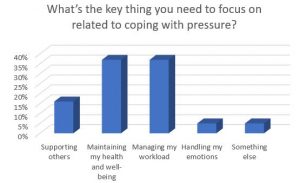
The pandemic has disrupted plans and certainties and coping with pressure has never been more pertinent for leaders, especially with the additional challenge of working remotely from the business and team.  Caroline said that it was important that leaders accept that this is difficult and have self-compassion but to set time aside to look after their own health and well-being.  In Carolines words, “You’re no use to your business if you keel over.”
Priorities for the leaders

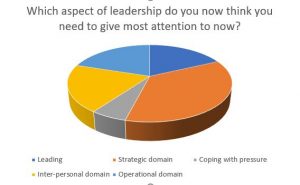
Throughout the webinar Caroline posed questions to the audience which was made up of leaders of businesses based in the UK and internationally.  The session examined how the pandemic had affected the aspects of leadership.

There was overwhelming agreement from the attendees that the biggest question for leaders now was ‘Where do we go next?’.  The number of leaders now prioritising that has doubled.


Strategic issues

Whilst it was good to see that there was a healthy number of businesses focusing on capitalising on new opportunities, that was equally balanced with the need to get everyone aligned, how to navigate uncertainty, and simply, how to survive.

Operationally

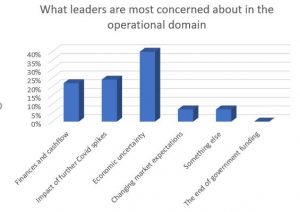
Unsurprisingly, leaders are most concerned about  the economic uncertainty we are facing followed by the impact of further Covid spikes.  Financing and cashflow remains key.

The pandemic has propelled the discussion about shifting working patterns and the need for leadership styles to shift accordingly. Its more about giving people the flexibility to work how they want (and in many cases, need eg those also juggling new childcare challenges).  Productivity vs presenteeism.

Leaders need to consider what good performance looks like now and how to measure that.

Inter-personal

The impact of new working arrangements is being felt by leaders who said that maintaining team cohesion was a significant challenge as was maintaining external relationships. This article on anxiety at work may be helpful for those leaders who are also trying to look after people who are struggling.

Please enjoy Carolines Covid-19 Leadership guide and it you would like to receive Caroline’s blogs please sign up here.

0

The information in this article was correct at the date it was first published.

However it is of a generic nature and cannot constitute advice. Specific advice should be sought before any action taken.

If you would like to discuss how this applies to you, we would be delighted to talk to you. Please make contact with the author on the details shown below.

Comment on this...

According to recent reports, UK’s withdrawal deal from Europe is already 90% agreed with some even suggesting that an agreement may be in place by as early as November. If true, this is indeed welcome news. However, given all the posturing, indecision and uncertainty to date, can we really be so sure?

Assess the risks of Brexit

According to a survey undertaken by the British Chamber of Commerce, one in five British companies will relocate part of their operations to the EU in the event of a no deal Brexit and 18% would cut recruitment. Worryingly, the survey also highlighted that many businesses remain unprepared for Brexit with nearly two thirds yet to undertake any form of risk assessment.

Unsurprisingly, larger companies are more likely to have assessed the implications Brexit will have on their business. However, a staggering 69% of businesses with fewer than nine workers have not undertaken any form of assessment. Simply putting your head in the sand is not really an option but given the degree of uncertainty, one can understand the reluctance.

Brexit-proof with a European subsidiary

Many of our SME clients have expressed concern if they are unable to continue to trade freely with their European counterparties. Coupled with the potential VAT issues that may follow, having a viable plan B in the event of a disruptive Brexit sounds sensible. One such strategy, could be setting up a European subsidiary, the geographical location of which will depend on a number of factors.

Over the course of the last five years, one of my clients, has successfully secured a number of consultancy contracts with various European airline carriers. There was considerable concern that these contracts would be at risk following a no deal Brexit. Having decided that setting up a European subsidiary would be a safe option to protect the business, the next issue was selecting a suitable location. Could it be Paris, Frankfurt or Amsterdam? What about Brussels or Luxembourg? How easy it is to set up subsidiaries in these locations? What about cost? Once he realised that learning a new language was not really an option and more importantly, it was not critical for his customers the actual location of the European subsidiary, then there was only one option- Dublin.

Given Dublin’s proximity to the UK, common language, similar laws and regulations and general ease of doing business, it has an obvious appeal. Through our International network, we introduced the client to our Dublin affiliate firm. Following the completion of some fairly standard registration forms, the Irish subsidiary was successfully incorporated within one week – not quite as speedy as the UK but impressive nevertheless, especially compared to mainland Europe.

The intention is to keep the newly formed subsidiary dormant for the time being, with the option of making it active in the event of a hard Brexit. The costs involved are minimal at this stage.

Whatever your business, the likelihood is that Brexit will have some degree of consequence. Being proactive by reviewing your supply chain and workforce are some of areas that should be assessed as a bare minimum. Controlling costs and creating reserves to safeguard against the unexpected are some of the more simple strategies one can adopt.

0

The information in this article was correct at the date it was first published.

However it is of a generic nature and cannot constitute advice. Specific advice should be sought before any action taken.

If you would like to discuss how this applies to you, we would be delighted to talk to you. Please make contact with the author on the details shown below.

Comment on this...

With effect from 6 April 2017, the way that the Government funds apprenticeships is changing. Any UK Employer with a “pay bill” of more than £3m in a tax year will pay the new Apprenticeship Levy to assist in funding apprenticeships across the UK. Once Employers have registered and paid the levy, they will then be able to access funding of new apprentices through a digital apprenticeship service account. The Apprenticeship Levy applies to all employers operating in the UK and not just employers already employing apprentices or those who will be in the future.

There is no opt-out. UK Employers who meet the more than £3m annual “pay bill” must pay the levy regardless of number of employees, size of turnover or industry sector.
If you are connected to other companies or charities (see below), which in total have a “pay bill” of more than £3m then you are also liable.

What is the “pay bill”?

The pay bill is based on the total amount of earnings on which an employer is liable to pay Class 1 employer NIC and includes the following;
• Any remuneration including wages, bonuses and commissions
• Earnings of employees below the lower earnings threshold
• Earnings of employees under the age of 21 and apprentices under the age of 25.

How to calculate the “pay bill” amount?

At the start of each tax year, the Employer must determine its annual pay bill in the previous tax year (2016-17). If it was more than £3m then the Apprenticeship Levy is payable. If not, then the Employer must assess whether its pay bill for the current tax year is expected to exceed the limit. If the expectancy is that it will, then the levy is calculated each month from April 2017 in the same way that PAYE liabilities are reported and settled.

How much is the Apprenticeship Levy and is there an allowance?

The levy amounts to 0.5% of the Employer’s annual pay bill offset by a Levy Allowance. Employers not connected to another company or charity will have an annual levy allowance of £15,000. Hence, Employers with a pay bill of exactly £3m will have no liability as any charge will be wholly offset by the allowance.
Any payments made in respect of the Apprenticeship levy are deductible for the purposes of calculating the Employers tax liability.

Are there any restrictions?

If the Employer has more than one PAYE scheme, or where companies are connected, only a single £15,000 Levy Allowance will be available. The allowance can be shared across the schemes or companies in any manner, by notifying HMRC through the monthly payroll reporting procedure. However, you cannot change the allocation of the allowance during the tax year.
The connected company rules are the same as those used for the Employment Allowance.

How do I determine if my company is connected or not?

Basically two companies are deemed connected if;
• One company controls the other
• Both companies are controlled by the same person or persons.
The term “control” is described as where an individual has or is entitled to acquire the greater part of the share capital or voting rights in a company or the greater part of the income or assets in the event of a winding up.

If you have any questions regarding the Employment Allowance or your own payroll situation, please e-mail paye@goodmanjones.com

0

The information in this article was correct at the date it was first published.

However it is of a generic nature and cannot constitute advice. Specific advice should be sought before any action taken.

If you would like to discuss how this applies to you, we would be delighted to talk to you. Please make contact with the author on the details shown below.

Comment on this...

Overseas Groups

Overseas groups can be frustrated when UK subsidiaries are holding large sums in cash but do not hold sufficient distributable reserves to declare a dividend back to the parent company. Take this example; a company has cash reserves of £100K but a negative retained profit. They have a loss reserve of £50K and a share premium reserve of £150K.  As the share premium reserve does not form part of distributable reverses, Company Law states that the company cannot declare a dividend despite having a positive cash balance. – This is known as the dividend block.

But there is a way, and it is easy.

Unlocking Share Premium Reserves

Can privately owned companies convert large share premium reserves into distributable reserves?

Company rules in the UK can be really quite business-friendly – much more so than in many other countries. One example is the ability for privately owned companies to convert large share premium reserves into distributable reserves. This allows dividends to be paid which would otherwise be impossible. A welcome discovery for many of our international clients.

For International Groups, it may take UK subsidiaries several years  to actually generate profits as they adapt to a new market and establish themselves in the UK.  They share issue new shares to the parent company at a substantial premium, leading to a share premium reserve. The share premium reserve is normally treated as a non-distributable reserve. It can be used to cover expenses related to the issuing of shares, or to issue bonus shares.  When the subsidiary eventually starts generating profits, chances are that their retained  profit and loss reserves are still negative and hence despite a positive cash balance, there is an inability to declare dividends.

In the UK, the 2006 Companies Act provides a straightforward solution to this problem for privately owned companies.  The rules allow you to effectively convert  the share premium reserve into the profit and loss reserve by way of a capital reduction, creating distributable reserves  that can then  be used to distribute dividends. Before the change in law, shareholders would have had to apply to court and  obtain clearance in order to undertake this process – a complex and, more often that not, a lengthy affair.

These days, the solution is thankfully much easier

If you are looking to undertake this capital reduction, all directors of the UK subsidiary must sign a solvency statement, making it clear that the UK company is solvent. Consider your solvency position very carefully, including the company’s prospective and contingent liabilities.

Shareholders must then agree to the capital reduction by signing a special resolution within 15 days of the solvency statement. Providing you complete and file the paperwork correctly with Companies House, the process is complete.

A common frustration

A number of our private international clients – including Italian, Spanish and US companies – have seen real benefit from this change in Company Law.

We recently worked with an international group that owns a UK company with valuable intellectual property rights. The UK subsidiary did not have reserves large enough to pay dividends, but it held a fair amount of cash that it wished to distribute back to the parent.  It also had a large share premium reserve. The group assumed it would be difficult to declare a dividend. Specifically, they expected to be involved in a difficult and lengthy process involving large legal fees. Yet the directors were surprised by how easy and quick it was to create distributable reserves from their current structure and declare a dividend back to the parent company.

Another of our clients, an Italian fashion chain with a UK subsidiary, was historically loss-making because of its expensive location. The subsidiary had then started making profits, but again had insufficient reserves to declare a dividend.  We advised the group undertake a capital reduction in order to convert the share premium reserve into a distributable reserves. Although, they were aware that this could be done, they were concerned about the cost and the time commitment. They were staggered by the ease with which the process was completed.

UK companies

While these examples are of overseas headquartered groups, the procedure – and the benefit – is the same for UK companies whose UK subsidiaries have been loss-making, yet have a a substantial share premium account and a desire to declare a dividend.

Although the process is easy, it has to be done correctly. Signing a solvency statement is crucial. If you don’t do this then the process will not work. Getting the right documents and completing them correctly will be key to removing the dividend block.

For advice on capital reduction contact Amit Sharma, asharma@goodmanjones.com.

0

The information in this article was correct at the date it was first published.

However it is of a generic nature and cannot constitute advice. Specific advice should be sought before any action taken.

If you would like to discuss how this applies to you, we would be delighted to talk to you. Please make contact with the author on the details shown below.

Comment on this...

From 6 March 2015, HMRC’s late filing penalty regime extends to employers with fewer than 50 employees.  The penalty regime for large employers- those with more than 50 employees, was introduced back in October 2014.

Under Real Time Information (RTI) a Full Payment Submission (FPS) must be submitted to HMRC on or before an employee is paid.  An Employer Payment Summary) (EPS) is made each month to disclose any adjustments to amounts being paid to HMRC including statutory sick pay and statutory maternity pay.

Under the penalty regime, any second late filing of the FPS or EPS (one default is permitted in any tax year) will result in an automatic late filing penalty dependant on the number of employees as illustrated in the table below;


Number of Employees Amount of monthly filing penalty
1 to 9 £100
10 to 49 £200
50 to 249 £300
250 to more £400


If a filing is more than three months late HMRC may charge an additional penalty of 5% of the tax and national insurance that should have been reported.

Confusingly, HMRC have announced that all returns may be late by up to three days without incurring a penalty.  This consideration is not expected to be withdrawn any time soon.

HMRC have recognised that micro-employers – those with up to nine employees, require more assistance in dealing with the adaption to RTI and hence, they can continue to file their FPS on or before the last payday in the month until April 2016. After this date, they expected to comply fully with the RTI legislation.

Employers can appeal against RTI penalties subject to a 30 day time limit. HMRC have issued guidelines as to what constitutes a “reasonable excuse” and these include death/bereavement, ill health, IT difficulty and theft/crime.

If you need any assistance with RTI or are interested in Goodman Jones becoming your payroll provider, please contact our payroll team at paye@goodmanjones.com

0

The information in this article was correct at the date it was first published.

However it is of a generic nature and cannot constitute advice. Specific advice should be sought before any action taken.

If you would like to discuss how this applies to you, we would be delighted to talk to you. Please make contact with the author on the details shown below.

Comment on this...

Earlier this week, the Employment Appeal Tribunal (EAT) held that the UK incorrectly interpreted European employment law by only taking into account basic salary in calculating an individual’s statutory holiday entitlement. Under the ruling, the individual’s “normal” remuneration should have been used as the basis for the calculation.

What constitutes “normal” remuneration? – Well basic pay plus any variable pay including “non-guaranteed” overtime – overtime that the employee is required to work but which the employer is not obliged to provide.  Providing this “non- guaranteed” overtime is normally worked, then it should form part of the holiday pay calculation.  Similarly, commissions and travel allowances (taxable payments for time spent travelling to work) if provided, should also be included.  The premise is to ensure that the worker is not financially worse off in terms of remuneration as a consequence of being on leave.

According to statistics around 5 million UK workers will be affected by the ruling, giving a major headache to a number of employers who were only just benefitting from the slight UK economic revival. The sectors considered high risk include retail, manufacturing and construction.

Office workers who regularly work beyond their contracted hours but do not get paid overtime are not affected.

The ruling only extends to the treatment of holiday pay payable under the Working Time Directive which equates to four weeks. The additional 1.6 weeks holiday, which workers are entitled to under the Working Time Regulations, is not included nor are contractual holidays in excess of the UK minimum. This offers a degree of relief to the employer, although, the administrative burden of monitoring this may prove to be challenging.

The only advantage for employers is that the ruling also clarified the position in relation to back dated claims. Initial fears of claims going back to as far as 1998 were dispelled when the EAT ruled that backdated claims cannot be made if more than three months has elapsed from the date the leave was taken.

Although, the above is good news to the workers who were disadvantaged in the past, the overall cost to employers cannot be underestimated. Some may reduce salaries, take on less staff,  – all negative actions that will potentially stifle growth in an economic climate that was showing signs of recovery.

There is still a high degree of uncertainty and it is no surprise that the ruling is being appealed to the Court of Appeal, although any decision is not expected until Spring 2015! The advice to employers is simple – keep monitoring the situation and watch this space!

0

The information in this article was correct at the date it was first published.

However it is of a generic nature and cannot constitute advice. Specific advice should be sought before any action taken.

If you would like to discuss how this applies to you, we would be delighted to talk to you. Please make contact with the author on the details shown below.

Comment on this...

For UK employers, Real Time Information (RTI) represents a significant change to the way payroll deductions, including PAYE and national insurance (NI), are being reported to HM Revenue & Customs (HMRC).

The current system has not changed since the 1940s when employees rarely moved jobs and only had one main source of employment.  Fast forward to the present day, the work place is very different with increasing job mobility and a greater casual labour work-force.

HMRC argue that the current system of reporting payroll deductions six weeks after the end of the tax year, through the submission of end of year P35 and P14 forms, is no longer fit for purpose and they’re probably right.

Under RTI, employers will be informing HMRC of tax, national insurance, pension and other deductions on or before an employee is actually paid.

HMRC claim that over time the benefit of receiving this information sooner will enable the right amount of tax and NI to be collected from individuals and will remove the need for time consuming end of year reconciliations. In addition, the administrative burden of preparing and submitting the end of year forms P35 and P14 will no longer be required.

Furthermore, RTI’s introduction also supports the “universal credit” benefits initiated by the Department of Work and Pensions, which is due to commence in October 2013.  This will ensure that claimants receive the correct amounts and on a timely basis.

Although HMRC state that RTI will mean cost savings to employers, the cynics will point out that RTI’s main objective is to improve HMRC’s own cash flow and by knowing exactly how much tax and NI is due to them each time a payroll report is run, HMRC can immediately start issuing demands following non-payment.

For all employers, RTI will mean an upgrade to their present payroll software and a “data cleansing exercise” to ensure that employee information, including full names, dates of birth and national insurance numbers, are accurate and match the records held by HMRC -HMRC have commented on the large number of inaccurate employee details held by employers who joined their RTI pilot. This will represent yet another cost and administrative burden on the poor employer.

There are also some significant difficulties in operating RTI under the current guidelines.  For example, are payroll staff expected to work weekends to ensure an RTI submission can be made before casual bar staff working on a Saturday night can be paid?  We wait with bated breath for some practical guidance to be issued over the coming months.

Interesting, the UK is one of the first of the OECD countries to implement a Real Time reporting process with the other members looking on with intrigue to see how it all unfolds.

One thing that is certain, is that employers should start the process of planning now.

HMRC are intending that most employers will join RTI by April 2013 and by October 2013 all employers will be operating their PAYE system under RTI.

If you have any further questions regarding RTI or need further clarification as to what is required please contact a member of the Goodman Jones  payroll department or e-mail paye@goodmanjones.com.

0

The information in this article was correct at the date it was first published.

However it is of a generic nature and cannot constitute advice. Specific advice should be sought before any action taken.

If you would like to discuss how this applies to you, we would be delighted to talk to you. Please make contact with the author on the details shown below.

Comment on this...

Notwithstanding, the public euphoria gathering pace with the Diamond Jubilee celebrations and the 2012 Olympics around the corner, here are the five top reasons why the UK remains such an attractive location to do business;


1.       Reputation and economic stability

The UK has a long established trading history and worldwide reputation built on strong ethical business standards and commercial acumen.  Whilst the global downturn has stunted economic growth, compared to the rest of Europe
with economic unrest, bailouts, mass unemployment and threats of contagion, the UK appears positively bliss.

2.       Company formations

Incorporating a company in the UK could not be easier. For a nominal cost and with a minimum share capital of a humble £1, a company can be incorporated with UK Companies House following a few clicks on-line.  Contrast this with
Germany; minimum share capital EUR25,000, Italy ; EUR10,000 and Spain EUR3,000 for a private limited company, not to mention the extra regulatory and administrative burden.


3.       Corporation tax rates/tax incentives


Tax will always be one of the
deciding factors in establishing the attractiveness of the UK. With the main rate of corporation tax currently at 24%, falling to 23% from 1 April 2013, UK Ltd enjoys one of the lowest tax rates compared to its main European competitors; Germany, France and Italy all have corporation tax rates in excess of 30%.  The UK tax system also offers a wide range of tax/financial incentives including tax treaties with the sole purpose to attract foreign investment.


4.       Infrastructure and communications network


UK offers a world class transport network linking mainland Europe and the rest of the world and in Heathrow boasts one of the busiest airports in the World.  The UK also has an extensive broadband market and one of the strongest IT infrastructures in the world. 


5.       Low asset valuations/favourable exchange rates


Cash rich foreign investors continue
to benefit from depressed property valuations post the September 2008 crash.  Coupled with the fall in Sterling against other currencies, has there ever been a better time to invest in the UK London property market?


0

The information in this article was correct at the date it was first published.

However it is of a generic nature and cannot constitute advice. Specific advice should be sought before any action taken.

If you would like to discuss how this applies to you, we would be delighted to talk to you. Please make contact with the author on the details shown below.

Comment on this...